

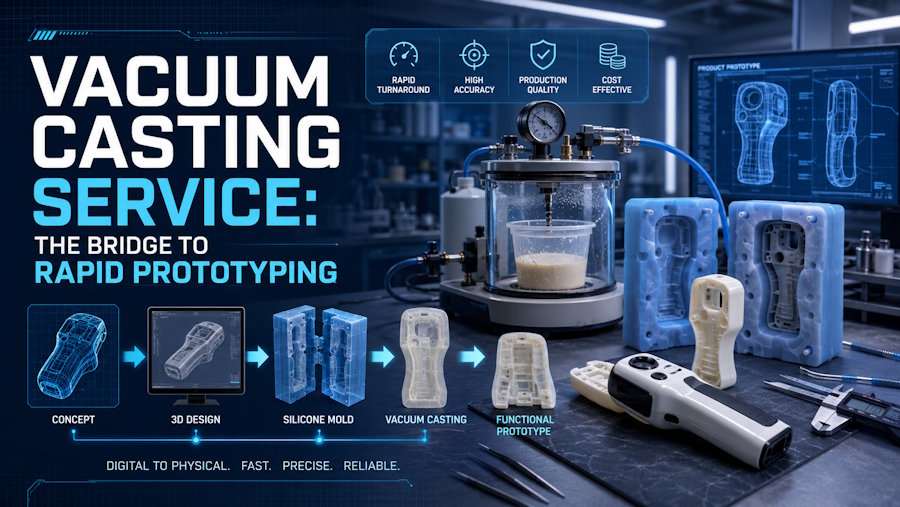
Most product teams hit the same wall between design and manufacturing: 3D printing is fast but the parts don't feel or perform like the real thing, while injection molding produces market-ready plastic but the tooling alone can cost tens of thousands of dollars and take weeks to cut. Vacuum casting service in the gap between them. It's one of the more underused tools in rapid prototyping services, and for teams validating a design before committing to hard tooling, it's often the smarter move. This article covers how the process works, when to choose it over other methods, and what to expect on cost and lead time.
What Is a Vacuum Casting Service?
Vacuum casting, also called urethane casting, starts with a master pattern — typically SLA or SLS 3D-printed — that gets encased in liquid silicone to form a mold. Once the silicone cures and the master is removed, two-part polyurethane resin is poured into the mold cavity inside a vacuum chamber. The vacuum pulls out trapped air, which is the difference between a part riddled with bubbles and one with a clean, cosmetic finish.
Each silicone mold typically yields anywhere from a handful to about 20 parts before it degrades, and a shop can usually pull 5 to 10 castings per mold per day. That's a meaningful limitation compared to steel tooling, which can run for hundreds of thousands of cycles — but for a company that needs 30 housings for a beta test, not 30,000 for a product launch, it's more than enough. Once prototypes are validated and higher-volume production becomes necessary, reviewing the capabilities of potential production partners, such as this manufacturer, can help frame discussions about whether to move from vacuum casting to injection molding.
Materials You Can Actually Use
Polyurethane resins are formulated to mimic standard engineering plastics rather than replace them outright:
- ABS-like and PC-like resins for rigid enclosures and housings
- PP-like materials for parts that need some flex without cracking
- Rubber-like and silicone-mimicking resins, useful for gaskets, grips, and overmolded feel
- Clear/transparent resins for lenses, light guides, and see-through covers
- Flame-retardant, high-temperature, and food-grade grades for specialized applications
Color matching and multi-shot casting (two resins in one part) are also standard offerings at most shops, which is part of why vacuum casting is popular for consumer electronics and automotive interior trim.
Why Pair It With Rapid Prototyping Services
On its own, vacuum casting is a manufacturing technique. Paired with broader rapid prototyping services — CNC machining, SLA/SLS printing, and sheet metal fabrication — it becomes a full pipeline for taking a design from CAD file to something a customer or investor can hold.
A typical sequence looks like this:
- 3D-print the master pattern to check dimensions, fit, and surface finish before committing to a mold.
- Build the silicone tool around the approved master — this step usually takes a day or two.
- Cast the run of 5 to 200 parts, with each casting cycle taking 30 minutes to 2 hours to cure depending on resin and part size.
- Post-process: sanding, painting, pad printing, vacuum metallizing, or texturing to match the intended production finish.
That loop matters because it lets a design team catch problems — a snap-fit that's too tight, a wall section that warps — while a mistake still costs a mold correction rather than a re-cut of steel tooling.
Vacuum Casting vs. Injection Molding: Where the Line Is
The trade-off comes down to fixed cost versus per-unit cost. Injection molding has steep upfront tooling costs and then a low price per part, which only pays off at real volume. Vacuum casting flips that: minimal upfront investment, but a higher cost per unit that doesn't scale well past a couple hundred pieces.
That makes the decision fairly mechanical once you know your quantity. Under roughly 200 units — market testing, crowdfunding campaigns, clinical trial devices, investor demos — vacuum casting almost always wins on total cost and speed. Past that, and especially with a design that's locked and unlikely to change, injection molding starts to make more financial sense. Teams that skip vacuum casting and jump straight to production tooling often end up cutting a second, corrected mold anyway, which erases whatever time they thought they saved.
How Long Does Vacuum Casting Take?
Most vacuum casting services quote 5 to 10 business days from an approved 3D file to finished parts, including mold-building and post-processing. That's slower than a same-day SLA print but dramatically faster than the 4-8 weeks typical for a new injection mold. Tolerances generally land around ±0.20mm, tight enough for functional fit checks and most engineering validation work, though not quite at the precision of CNC-machined metal.
Getting Started
If your project needs functional prototypes that look and feel like the finished product, but you're not ready to commit to production tooling, a vacuum casting service is worth quoting alongside your other rapid prototyping service. Send a shop your 3D file, confirm which resin best matches your target production material, and ask about their per-mold part yield — that number, more than anything else, determines whether vacuum casting or injection molding fits your run size.

