

1. The Hidden Goal: Decoding My Morning Fatigue
I used to wake up tired. It did not matter if I slept for six hours or nine. My morning alarm felt like a physical blow.
I wanted to find out why my energy felt so low. Some days, a short night of sleep left me feeling surprisingly fresh. Other days, a long sleep left me groggy.
This pattern made me look into sleep architecture. I learned that waking up mid-cycle disrupts brainwaves. I needed a way to align my alarm clock with my body's natural clock.
My main goal was simple. I wanted to wake up during light sleep. To do that, I needed to understand the timing of my nights.
2. Dissecting the Mechanism: How the Math Works
The human body sleeps in waves. Each wave lasts about 90 minutes. A full night usually consists of five or six of these waves.
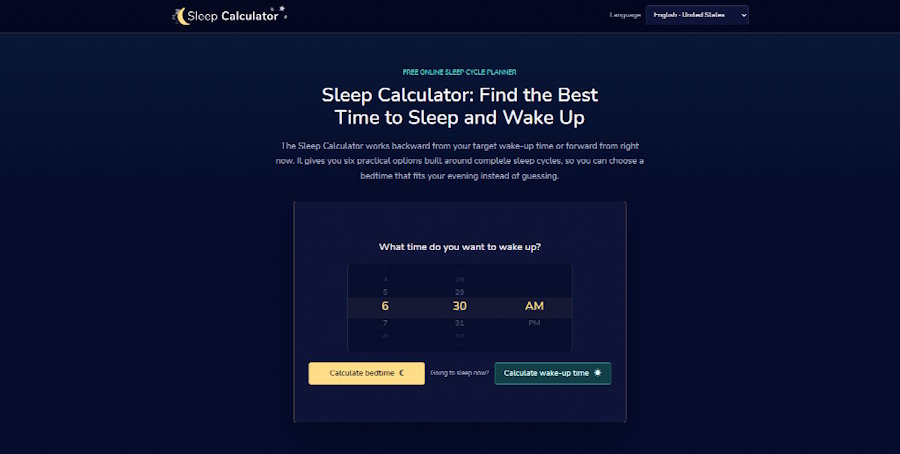
When I opened this web tool, I wanted to see how it calculated these waves. The platform relies on this 90-minute formula. It also assumes that an average person takes 15 minutes to fall asleep.
I tested the Sleep Calculator tool to see if its numbers matched my real patterns. It provides six different time suggestions for your night. The first few options aim for the recommended five to six full cycles.
The final options are for emergencies. They suggest shorter sleeps when your night is already cut short. This variety helps you plan around unexpected events.
The interface does not require any personal data. It works directly in your web browser. There are no complicated forms to fill out.
3. The Reality Check: Personal Latency vs. Global Algorithms
No two bodies are exactly the same. The science of sleep latency is highly personal. Sleep latency is the time it takes to go from fully awake to sleeping.
For some, this takes five minutes. For others, it takes an hour. This tool uses a standard 15-minute estimate.
This fixed number is an important detail. If your latency is different, the math will be slightly off. You have to adjust the times in your head.
During my trial, I noticed this issue. I usually take 25 minutes to wind down. Therefore, I had to shift the suggested bedtimes by ten minutes.
It is crucial to recognize these limitations. Static algorithms cannot read your brainwaves. They only provide a logical starting point.
4. The Science of Grogginess: What Happens When We Wake Up Wrong
Have you ever woken up feeling completely disoriented? This heavy, confused feeling is called sleep inertia. It happens when you wake up during deep sleep.
During deep sleep, your brain waves are slow and highly synchronized. Waking up suddenly from this state forces your brain to accelerate too quickly. It is like starting a car in the wrong gear.
Research shows that sleep inertia can last from thirty minutes to two hours. This grogginess reduces your cognitive speed and impairs decision-making. It can even be as severe as mild intoxication.
By using cycle-based planning, you attempt to avoid deep sleep wake-ups. The goal is to wake up during stage one or stage two of your cycle. These are the lightest phases of sleep.
Waking up during light sleep feels smooth and natural. You feel instantly alert and ready for the day. This simple physiological shift is what makes timing so important.
5. Operational Ease: Walking Through the Interface
The tool offers two main ways to plan your night. These choices accommodate different schedules and habits. I tested both methods over a week to see how they fit into my routine.
Method A: Calculating Backward from Wake-up Time
First, I entered my target wake-up time of 7:00 AM. The system instantly displayed several bedtime options. It was easy to read and understand.
It suggested bedtimes like 10:15 PM and 11:45 PM. It even calculated the 15-minute buffer. This means if I want to sleep at 11:45 PM, I should turn off the lights at 11:30 PM.
Method B: Calculating Forward from the Present Moment
Next, I tested the immediate calculation. It was 11:10 PM when I clicked the button. The site immediately calculated six possible wake-up times starting from that very moment.
The layout is very clean. The output times are easy to read. There are no hidden buttons or confusing steps.
6. An Honest Scorecard: Wins and Hard Hurdles
Every tool has its strengths and weaknesses. It is important to look at both before relying on them. Let us break down what works and what does not.
The Advantages
On the positive side, the speed is impressive. The page loads almost instantly. I did not have to create an account or verify an email.
There are no intrusive ads blocking the screen. This makes the user experience very smooth. I could check my numbers in under ten seconds before bed.
The Drawbacks
However, there are notable limitations. This Sleep Calculator assumes you sleep without waking up. It does not account for mid-night disturbances.
If you wake up to drink water, the cycle breaks. The tool cannot adjust for these real-life interruptions. It also lacks integration with wearable devices.
You cannot sync it with your smartwatch. You must read the screen and set your phone alarm manually. It is a manual helper, not an automated system.
7. Finding Your Match: Who Actually Benefits Here?
This tool is not for everyone. Some people need deep biological tracking. Others just need a quick estimate.
I found that students benefit greatly from this layout. Their schedules change constantly during exams. They can quickly adjust their alarms to fit late-night study sessions.
Shift workers will also find it useful. When your work hours rotate, your sleep schedule breaks. Calculating a quick cycle from "now" helps you squeeze in productive naps.
Frequent travelers are another group. Jet lag disrupts the natural circadian rhythm. This simple tool helps travelers plan their recovery nights in new time zones.
If you are a data analyst who wants heart rate tracking, you might find this too basic. This is for people who want quick answers without downloading heavy apps.
8. Modern Context: Simplicity in a World of Heavy Metrics
We live in an era of over-tracking. Many people wear rings and watches that measure every heartbeat. Yet, this data often causes anxiety instead of helping.
This anxiety can actually make it harder to fall asleep. Experts call this orthosomnia. It is the obsession with getting perfect sleep data.
That is why simple web tools are becoming popular again. They do not judge your performance. They do not send you scary notifications in the morning.
They simply offer a basic mathematical guideline. This calculator provides a straightforward framework. It returns the focus to basic habits rather than complex charts.
Sometimes, less information is better. By keeping things simple, users can focus on how they actually feel. This approach is a refreshing change in a crowded market.
9. The Behavioral Shift: Habits That Support the Math
A calculation is only as good as your habits. If you look at your phone screen right before bed, the math will fail. Blue light delays melatonin release.
I had to change my pre-bed routine to get good results. I started dimming my lights thirty minutes before my target time. This helped me match the 15-minute fall-asleep estimate.
Temperature also plays a major role. A cool room helps the body drop its core temperature. This drop triggers the natural transition into deep sleep.
I noticed my cycles felt smoother when my room was cold. The suggested times became much more accurate. My body woke up naturally just before my alarm.
If you ignore these physical factors, no online Sleep Calculator can save your mornings. The tool is a guide, not a magic cure. You must build the environment for it to succeed.
10. Wrapping Up: My Final Sleep Experiment Takeaway
After a week of testing, my morning routine has improved. I no longer feel the extreme grogginess of interrupted deep sleep. My energy levels are more consistent.
I appreciate the simplicity of the website. It is rare to find a web utility that does not track your data. It does exactly what it promises without any noise.
Of course, it cannot replace personalized medical advice. If you have chronic insomnia, you need a doctor, not an algorithm. For everyone else, it is a great practical helper.
I will keep using it to plan my travel schedules. It has earned a permanent place in my bookmark bar. It is a small step toward better mornings.

