

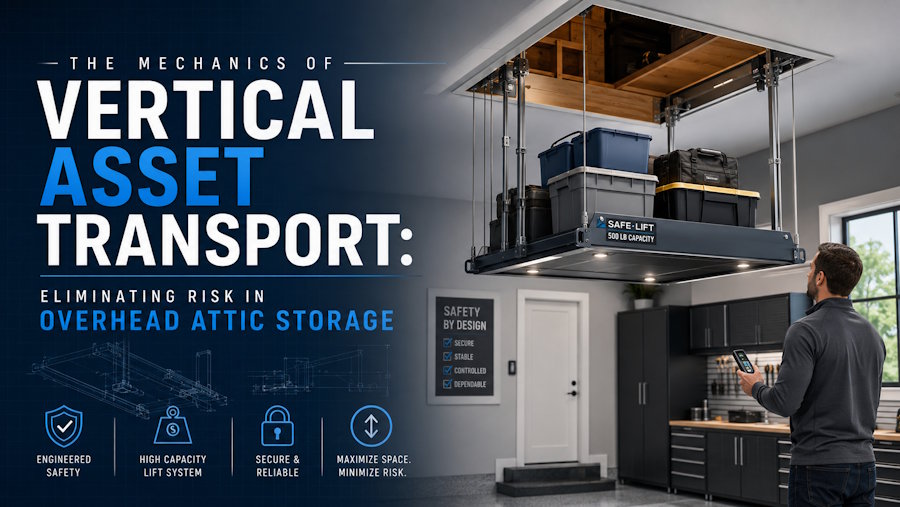
The attic is one of the most underutilized square-footage assets in residential properties. For many homeowners, converting upper ceiling space into functional storage represents a practical alternative to off-site rental units. However, the physical reality of transferring heavy storage containers, holiday decor, generators, and power tools up and down steep, unstable pull-down attic ladders poses severe safety hazards and physical strain.
Overcoming these accessibility barriers requires shifting from manual hauling to motorized vertical transport systems. Installing an automated auxx attic lift bridges the gap between ground-level convenience and overhead capacity—allowing homeowners to move up to 400 lbs of gear between the garage floor and the attic with the push of a button.
1. Engineering the Overhead Lift Matrix
A motorized attic lift functions as a dedicated home freight elevator engineered specifically for storage payloads. Unlike improvised winch-and-pulley setups, commercial-grade attic lifts integrate precise mechanical subsystems designed for safety, structural balance, and long-term reliability:
- Dual Synchronized Tubular Motors: Operating on standard 110–120V household outlets, dual synced motors ensure that the lifting platform stays perfectly level during ascent and descent, even when weight is unevenly distributed across the deck.
- Aircraft-Grade Galvanized Steel Cables: The platform is driven by high-tensile, vinyl-coated $7\times 19$ steel aircraft cables. Each cable boasts an ultimate tensile strength of 2,000 lbs, providing a multi-fold safety factor over the system's maximum payload capacity.
- Self-Leveling Aluminum Framing: Constructed with 6105-T5 aluminum alloy framing and 5-ply oak-veneered plywood decking, the platform offers lightweight structural rigidity without adding unnecessary weight to the home's joist framing.
2. Safety Dynamics: Manual Ladder Climbing vs. Motorized Platform Lifting
Attempting to carry heavy or awkward items up folding attic ladders introduces immediate risk of slips, falls, and lumbar strain. Automating the vertical transit process eliminates these hazards completely:
|
Operational Metric |
Traditional Pull-Down Ladder Access |
Motorized Auxx Attic Lift System |
|
Lifting Payload Capacity |
Limited by human physical strength ($\sim 30\text{--}50\text{ lbs}$ safely carried). |
Up to 400 lbs: Easily moves heavy bins, generators, and archives. |
|
Personal Safety Profile |
High Risk: Requires two-handed balancing on narrow steps while holding boxes. |
Zero Ladder Hauling: Operates via a wireless remote control from the ground or attic floor. |
|
Operational Effort |
High physical strain; requires multiple trips up and down steep steps. |
One-Touch Automation: Elevates full loads in approximately 30 seconds. |
|
Platform Precision |
N/A (Manual carrying risks dropping items onto the garage floor below). |
Programmable Stops: Auto-stop settings ensure the platform parks level with the attic deck. |
3. Spatial Integration and Ceiling Support Architecture
Integrating a motorized lift requires careful evaluation of ceiling joist framing and cutout dimensions. The lift mechanism mounts to steel strut channels lag-bolted across multiple ceiling joists, distributing the payload weight across the roof framing structure rather than isolating it to a single point.
Versatile Platform Sizing
Depending on joist spacing and structural layouts, lifts are available in standard and expanded sizes:
- Standard Platform ($20.75'' \times 44''$): Fits tight joist configurations with a ceiling cutout requirement of $22.5'' \times 46.5''$, ideal for standard plastic storage totes.
- Expanded Platform ($28.75'' \times 56''$): Requires a $30.5'' \times 58.5''$ cutout, designed for larger luggage, long equipment boxes, or bulky seasonal items.
4. Key Pre-Installation Considerations
To ensure a smooth, compliant installation of an automated attic lift, review these operational requirements prior to setup:
- Dedicated Cutout Preparation: Ensure the attic framing is properly framed out with double headers to maintain the structural integrity of the ceiling joists around the opening.
- Electrical Access: Verify that an accessible 110/120V electrical outlet is located within reach of the attic-mounted motor housing.
- Attic Headroom Clearance: Lifts require minimal overhead clearance (as little as 8 inches above joists), but ensuring clear, unobstructed floor space around the landing zone in the attic makes unloading effortless.
- Cargo-Only Usage: Remember that motorized attic lifts are engineered strictly for material storage payloads and are not rated or certified for human transport.
Conclusion: Modernizing Overhead Home Storage
Relying on rickety pull-down ladders to haul heavy containers into your attic limits the usability of your overhead storage and exposes you to avoidable injury risks. Investing in a motorized attic lift system transforms your attic into a secure, accessible extension of your living space. By automating vertical transport with high-tensile steel cables, dual synchronized motors, and wireless controls, you eliminate lifting friction, protect your physical health, and maximize your home's organizational capacity.

