

Generative AI (GenAI) has rapidly moved from an experimental technology to an increasingly important part of software development in financial services. Banks, fintechs, insurers, and payment providers are using AI coding assistants to generate code, write tests, document APIs, troubleshoot errors, and accelerate development workflows. At first glance, this appears to offer a straightforward productivity advantage: developers can produce more code in less time.
However, measuring GenAI's real impact is more complicated than counting lines of code or tracking how quickly developers complete individual tasks. Financial software operates under strict requirements for security, compliance, reliability, scalability, and maintainability. A development team that produces twice as much code but creates more defects, security vulnerabilities, or technical debt has not necessarily become twice as productive.
This is why financial institutions need to rethink traditional software productivity metrics and develop a more comprehensive approach to measuring GenAI's value.
Why Traditional Productivity Metrics Fall Short
Software development has traditionally been evaluated using metrics such as lines of code, story points, tickets completed, deployment frequency, and development cycle time. These metrics can provide useful operational insights, but they do not necessarily capture the business value created by developers.
GenAI makes these limitations even more apparent.
An AI coding assistant can generate hundreds of lines of functional code within seconds. Yet the generated code may require extensive review, testing, optimization, and security validation. In financial services, developers also need to ensure that the software complies with regulations and integrates correctly with existing banking infrastructure.
For example, a developer working on a mobile banking app development project may use GenAI to generate authentication logic or an API integration. The initial development process could become significantly faster. However, the organization still needs to validate whether the implementation meets security requirements, handles edge cases, protects sensitive customer information, and performs reliably at scale.
Therefore, measuring productivity purely through output volume can create a misleading picture of GenAI's contribution.
From Code Volume to Value Delivered
One of the most important changes financial organizations should make is moving from measuring code production to measuring outcomes.
Instead of asking, "How much code did GenAI help developers produce?" organizations should ask questions such as:
- Did development cycles become shorter?
- Did software quality improve?
- Were fewer defects introduced?
- Did developers spend less time on repetitive tasks?
- Did releases become more predictable?
- Did security and compliance validation become more efficient?
- Did the software generate measurable business value?
This shift is particularly important for organizations working with a custom banking software development company. When external development teams and internal engineering teams collaborate, productivity should be evaluated based on the quality and business impact of delivered capabilities rather than the amount of AI-generated code.
Measuring Developer Efficiency More Holistically
GenAI can deliver productivity improvements across several stages of the software development lifecycle. Financial institutions should therefore measure its impact across the entire workflow.
One useful metric is time saved per development task. Organizations can compare the time required to complete similar tasks before and after GenAI adoption. This can include coding, test creation, documentation, debugging, code reviews, and refactoring.
Another important metric is developer focus time. If GenAI reduces repetitive work, developers may spend more time on architecture, security, product design, and complex problem-solving. This shift can be more valuable than simply increasing the amount of code produced.
Organizations can also track cycle time, from requirement definition to production deployment. If GenAI helps teams move from concept to production faster without compromising quality, it provides a meaningful productivity benefit.
However, these metrics should always be evaluated alongside quality indicators.
Quality Should Be Part of the Productivity Equation
Speed without quality can become a liability in financial services.
GenAI-generated code requires appropriate human oversight because AI tools can produce incorrect logic, insecure implementations, outdated patterns, or code that does not fully align with an organization's architecture.
Financial organizations should therefore monitor metrics such as defect density, escaped defects, code review findings, vulnerability rates, test coverage, and production incidents.
For instance, a team might discover that GenAI reduces development time by 30% but increases post-release defects by 10%. The apparent productivity improvement may be considerably smaller once the cost of fixing those defects is considered.
A better productivity equation is therefore:
Productivity = Valuable Output × Quality ÷ Total Effort
This approach recognizes that faster development only creates genuine value when the resulting software remains secure, reliable, maintainable, and fit for purpose.
Security and Compliance Cannot Be Secondary Metrics
Financial services organizations face regulatory and security requirements that make software development fundamentally different from many other industries.
GenAI can assist with security testing, documentation, vulnerability identification, and compliance-related workflows. However, its effectiveness should be measured based on whether it improves the overall security and governance process.
Relevant metrics can include:
- Time required to identify and resolve vulnerabilities
- Number of security issues detected before deployment
- Compliance documentation effort
- Percentage of AI-generated code reviewed by qualified developers
- Number of policy violations identified during development
- Time required for security and compliance approvals
This becomes particularly important when building applications involving payments, lending, wealth management, or customer identity.
In a mobile banking app development initiative, for example, AI-assisted development may accelerate feature creation, but authentication, authorization, encryption, transaction security, and privacy controls require rigorous validation. The objective should not simply be faster feature delivery; it should be faster delivery without weakening the application's security posture.
Measuring the Business Impact of GenAI
Software productivity ultimately matters because it contributes to business outcomes.
Financial institutions should connect engineering metrics with measurable business indicators. These can include faster product launches, reduced development costs, increased release frequency, improved customer experiences, and faster experimentation.
Consider a bank introducing a new digital payment feature. If GenAI reduces the engineering effort required to launch the feature, the organization may be able to enter the market sooner. That time-to-market advantage can potentially be more valuable than the number of developer hours saved.
Similarly, if AI-assisted development enables engineering teams to experiment with more product ideas without significantly increasing costs, it can improve innovation capacity.
This means organizations should measure time-to-value, not simply time-to-code.
The Importance of Human-AI Collaboration
Another critical metric is how effectively developers collaborate with GenAI tools.
GenAI should not necessarily be viewed as a replacement for software engineers. In financial services, experienced developers remain essential for architecture, system design, security decisions, regulatory interpretation, and business logic.
Organizations can evaluate whether AI is helping developers spend less time on repetitive activities and more time on high-value work.
For example, GenAI can help create boilerplate code, generate test cases, summarize technical documentation, or suggest solutions for common programming issues. Developers can then focus on designing resilient financial systems and solving complex domain-specific problems.
This makes developers leverage an important measurement category: how much more valuable work can a developer accomplish with AI assistance while maintaining quality standards?
Establishing a Balanced GenAI Productivity Framework
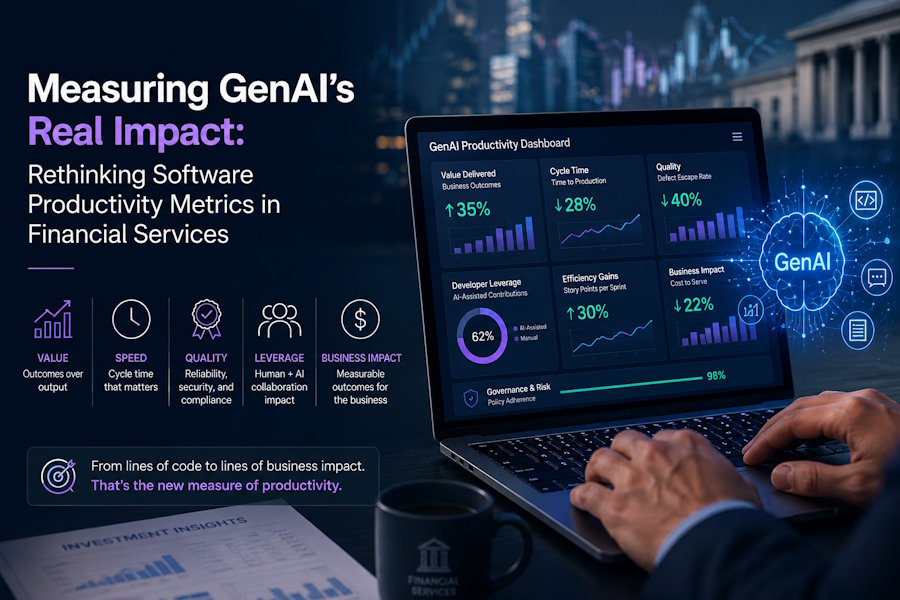
Financial institutions should avoid relying on a single metric to evaluate GenAI. Instead, they can establish a balanced framework consisting of five major categories.
Speed: Measure development cycle time, release frequency, and time-to-market.
Quality: Track defects, test coverage, production incidents, maintainability, and rework.
Security and compliance: Monitor vulnerabilities, security review outcomes, compliance effort, and governance adherence.
Developer experience: Evaluate developer satisfaction, focus time, cognitive workload, and the percentage of repetitive work automated.
Business value: Measure cost savings, product adoption, customer experience, revenue contribution, and time-to-value.
This framework provides a more realistic picture of whether GenAI is improving software engineering performance.
What the Future of Software Productivity Looks Like
GenAI is changing the definition of software productivity. The future is unlikely to be about developers simply writing code faster. Instead, productivity will increasingly depend on how effectively teams combine human expertise, AI capabilities, automation, and governance.
For financial services organizations, this distinction is particularly important. Software is directly connected to money, customer trust, regulatory obligations, and operational continuity. Consequently, the most successful organizations will be those that treat GenAI as an opportunity to improve the entire software delivery lifecycle rather than simply accelerate coding.
Organizations partnering with a custom banking software development company can also use these principles to establish clearer expectations around AI-assisted development. Instead of evaluating vendors solely on delivery speed or developer headcount, financial institutions can assess quality, security, scalability, innovation, and measurable business outcomes.
Ultimately, the real impact of GenAI cannot be captured by counting lines of code or measuring how quickly developers complete individual tickets. Its value lies in enabling teams to deliver secure, high-quality financial software faster while freeing developers to focus on complex problems and strategic innovation.
The organizations that successfully redefine their productivity metrics around value, quality, security, and business outcomes will be better positioned to turn GenAI's promise into sustainable competitive advantage.

