

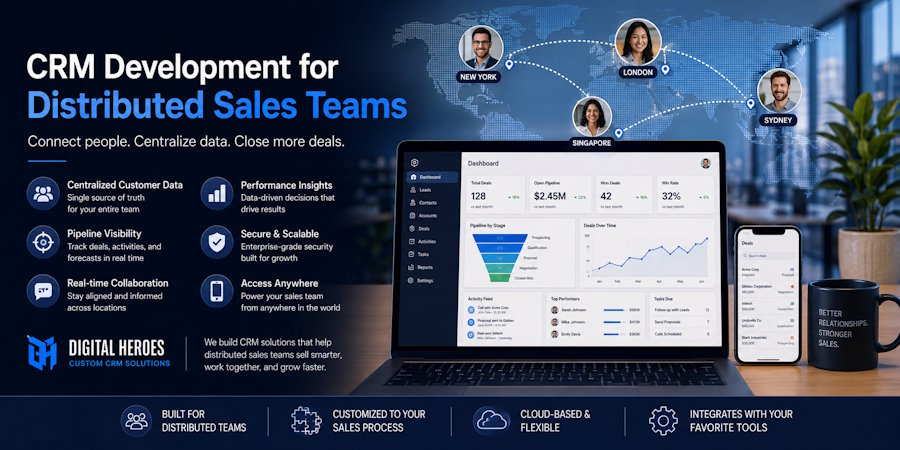
A sales team sitting in one office can paper over a lot of CRM gaps just by talking to each other. Someone forgets to log a call, a teammate mentions it at lunch, nothing falls through the cracks. Spread that same team across five cities and three time zones, and those informal fixes disappear. The CRM stops being a nice-to-have record and becomes the only shared version of what's actually happening in the pipeline.
Why Standard CRM Advice Doesn't Fully Apply Here
Most guidance on hiring a CRM development company assumes a team that can walk over to each other's desks when something's unclear. Distributed teams don't have that option, which changes what actually matters in the build. A missing notification, an unclear handoff, or a lead sitting untouched for two days because nobody realized it needed follow-up — these get caught quickly in person. Remotely, they can sit unnoticed for a lot longer.
What to Prioritize When the Team Isn't Co-Located
Notifications that actually reach people. A CRM that quietly logs an update nobody sees isn't much better than no update at all. For distributed teams, real-time alerts — not just a dashboard someone has to remember to check — matter more than they would for a team sitting together.
Clear, unambiguous handoff points. When a lead moves from one rep to another across time zones, there's often a delay before the next person even sees it. A CRM development agency building for this should design handoff steps that are explicit and hard to miss, not buried in a status field nobody scans regularly.
Time zone-aware follow-up scheduling. A follow-up reminder set for 9 a.m. means nothing if it fires at 9 a.m. in the wrong time zone. This sounds minor until it's the reason a lead goes cold. Good CRM design and development for distributed teams accounts for this at the build stage, not as a patch afterward.
Async-friendly reporting. In a co-located team, a manager can just ask how the pipeline looks. Distributed teams need dashboards and reports that answer that question without a meeting, since coordinating a live sync across time zones for a quick check-in wastes everyone's time.
Questions Worth Asking a Vendor If Your Team Is Remote or Hybrid
- How does the system notify reps across time zones, and can that be customized per person?
- What happens when a lead sits untouched — does anything flag it, or does it rely on someone noticing?
- Can reports be pulled asynchronously, without needing a live walkthrough from someone else on the team?
A CRM development agency that hasn't built for distributed teams before may not think to ask about any of this unless you raise it first. It's worth bringing up explicitly during the discovery call, rather than assuming it's covered by default.
The Real Difference Isn't the Software, It's the Assumptions Behind It
A CRM built for a co-located team and a CRM built for a distributed one can use the same underlying platform and still function very differently in practice, depending on what assumptions shaped the build. When evaluating CRM development services for a remote or hybrid sales team, make sure those assumptions get discussed directly instead of left for your team to discover after launch.

