

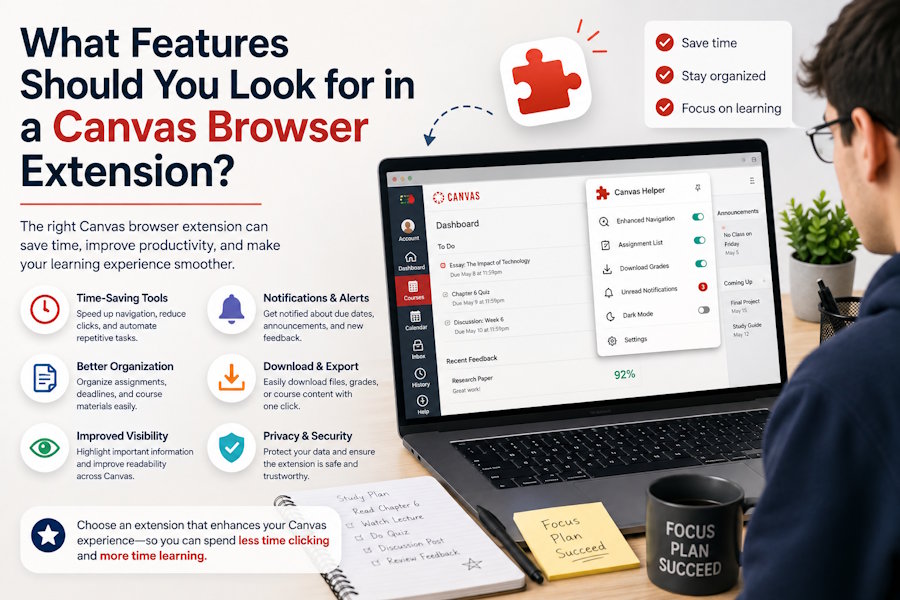
Canvas is used by students to complete quizzes, submissions and tests as well as course activities. As coursework builds, a browser extension can ease the burden of some tasks. That said, not all extensions come with the same features, and selecting a solution based on ease of installation or bold promises can result in a poor experience.
The Canvas Browser Extension needs to fit your study/work flow, respecting your privacy, being very compatible with the other plugins that you use and easy to install. It helps to get a grip on which features actually matter and which claims are due some scepticism before fitting one in as well.
Canvas Compatibility Should Come First
The first thing to check is whether the extension was truly made for Canvas.
IDK if these types of browser tools will work with Canvas pages!?! Some were developed for general websites. A tool built specifically for Canvas deals with quiz and assignment layouts on the platform better.
Find an extension that explicitly identifies the Canvas activities it supports. It can include quizzes, tests, exams, and assignments depending on the tool.
Finally, verify that the extension works with the kind of Canvas environment in your school. Exam type for Canvas is unique, so checking that compatibility should be one of your first steps.
Support for Different Question Types
Different types of questions in Canvas activities. If you intend to use an extension for a permissible-study scope base format, it is advisable that the tool supports more than one basic format.
Common formats include:
- Multiple choice
- True or false
- Fill in the blank
- Matching
- Short answer
- Numerical questions
- Formula based questions
It has been mentioned in the CourseCheetah details that supporting question types and subjects for providing your students with a more comprehensive preparation plan is what its extension provides. It is designed to help you use AI based answer suggestions within Canvas too.
While a wide range of formats can be advantageous, it is important to remember that students always do not know what type will arise in an assignment or preparations.
But even with a supported question format, not every response will be right. Students should continue to check key answers and turn to course materials if they need to verify details.
Browser Support Matters
An extension only matters if it can be used with the browser of your choice.
Please check supported browsers before installation. According to the info provided, CourseCheetah works on Chrome, Firefox, Edge and Brave.
This is an important detail because students may use different browsers on their laptops, desktops, or school devices. Switching between browsers simply to access an extension is cumbersome.
Also verify whether the extension needs a specific browser version or installation. Simple configuration is usually easier for students without technical background.
Look for Easy To Install Process
You should not have to have advanced technical skill in order to install a browser extension.
A good extension can help guide as instructions on what happens next after installation. Secondly, the process should be straightforward from start to finish.
Using the example CourseCheetah info shows that it provides a three step process:
- Install the extension.
- First, create a quiz/test/assignment on Canvas.
- Use the available assistance feature.
The exact procedure might differ among extensions, but the idea is similar. Before you use it, make sure that you know what you're installing and how it works with your browser.
Look Inside Canvas to View How the Extension Functions
An interesting feature, that can outweigh all other features is the manner in which the tool presents its assistance.
Certain tools might have a workflow in which students copy a single question, go to another web site, paste the text and then return to Canvas. When going question by question through numerous questions, that process can be maddening.
This information states that CourseCheetah is a tool within Canvas pages to help with answer suggestions without the need to constantly switch tabs.
A browser extension that goes to work within the page might create a more efficient flow. However, course rules shouldn't be trumped by convenience. DO NOT use the extension for ANY assessment that your instructor has forbidden you to assist with AI.
Privacy Is Something That Must Be Prioritized
Students should look more carefully at privacy before they install a browser extension.
Browser extensions can ask for permissions pertaining to how they will interact with the websites. Before a person goes to put in one, know what data it will be able to reach and the way that records is dealt with.
Look for clear information about:
- Data collection
- Personal information
- Canvas login details
- Browser permissions
- Data storage
- Security practices
The CourseCheetah-information given above claims that it does not save Canvas login or personal data and mentions privacy friendly.
Even when the company self-reports such information students should review the current permissions and privacy documentation highlighted before installing an extension.
AI Features Should Be Clear
When looking at an AI powered extension, find out precisely what the AI feature does.
Does it explain concepts? Generate answer suggestions? Help with practice questions? Work with different subjects? Support different question formats?
Good clarity helps you determine if the tool is actually what you need.
According to the information you provided CourseCheetah offers AI powered answer suggestions covering subjects including but not limited to math, biology, chemistry, statistics, anatomy and physiology, and accounting.
But that does not mean students should take AI at its word, Davidson added. An AI can misinterpret a question or give an inaccurate answer. With AI study products, use the output as help, not an almighty authority.
Having a Good Subject Coverage
Many students take courses from various subjects in the same semester. An extension that is only good for one style of coursework may not be effective a month from now.
Look for subjects that you actually study when comparing tools.
However, the supplied CourseCheetah information included algebra, calculus, statistics, biology, chemistry, anatomy and physiology and accounting.
Wide subject coverage can be good for students with different course schedules. But quantity of subjects are not what matters, it is rather the quality of their knowledge in respect to assistance.
Speed and Reliability Are Important
It shouldn't make basic things more difficult than they are.
An AI feature that is slow to respond or becomes nonfunctional may, however, disrupt your flow. This is especially important when using the tool for allowed practice work or coursework.
Seek details about speed of response, installation process, web browser compatibility and reliability. But you can also spot problems by looking at reviews.
First, the product information you provided. CourseCheetah gives answer suggestions in just seconds. Consider that a claim you make about your products instead of something that's true in all instances.
Evaluate The Expense Before You Commit
There are both free and paid subscriptions for browser extensions.
See the plans available before creating an account and understanding the value you receive with each offer. Check for specifics, including usage limits, billing cycles, cancellation policies and what features are included.
These are the weekly, monthly, quarterly and yearly plans for CourseCheetah. It goes on to say that the plans have no usage caps and can be canceled at any point.
Pricing is subject to change and students should check actual pricing before purchasing any subscription.
Check That It Conforms To Your Course Rules
The best Canvas Browser Extension might not be suitable all the time.
This has significant implications for those users that have graded quiz, test and exam assignments. Professors may allow certain types of technology for studying and not when the student is completing an assessment without AI assistance.
The syllabus and the instructions should be referring to Google Extension before opening it up. If you have a doubt, ask your instructor.
If for practice work where AI assistance is allowed, an extension can help you review concepts you found difficult, be able to work through questions as needed or multiple choice questions faster. For limited assessments, let the rules guide you, not the tech.
Compare Features Before Installing
It is better to compare what matters most before upward selecting an extension.
A simple checklist can help:
- Canvas Compatibility — Does it work with your Canvas activities?
- Support for your questions — Does it work with the types of files you deal with?
- Browser Compatibility — Will it work in your favorite browser?
- Privacy — What information is collected or accessed?
- AI functionality — What are the actual capabilities of AI?
- Coverage by Subject — Will it cover your areas of course?
- Usability — Is the installation and configuration easy?
- Pricing — Is pricing and cancellation terms transparent?
- Reliability — Will it deliver a predictable experience?
- Course compliance — Can it be used for your intended activity?
Devote a couple of minutes to verify the following points so that you do not install an extension that does not meet your needs.
Final Thoughts
A real Canvas Browser Extension should be more than a case of the quick install, however. When making your decision, keep in mind compatibility and browser support, question formats and availability, privacy concerns, AI assistance area of competence and coverage, question types covered, cost structure, reliability.
But above all, technology must be handled responsibly. An extension can be a boon to authorized coursework and research but should always never displace grasping the material nor defy an instructor's restrictions.
And by rigorously comparing features and checking course policies first, students can select tools that enhance their workflow rather than generate extra challenges.

