

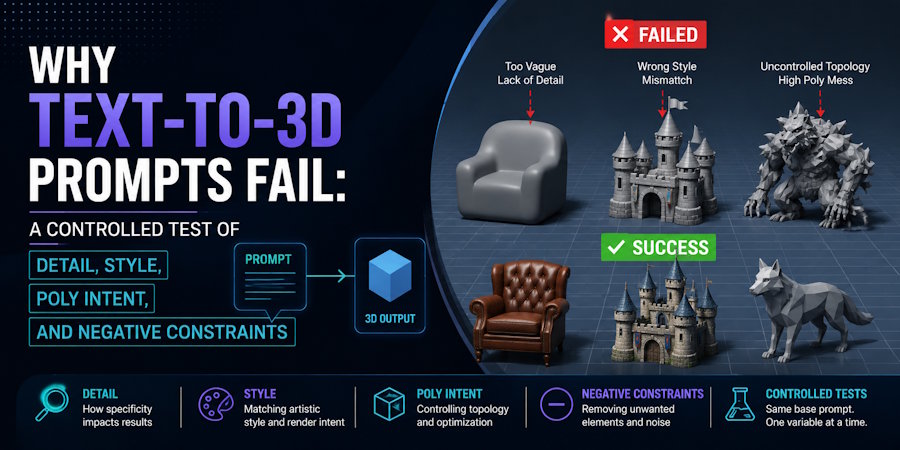
Text-to-3D prompts fail when descriptive language is treated as a hard modeling control: in this five-run test, detail and style wording changed the draft, but the low-poly condition failed to load and a negative constraint did not prevent a long thin cable.
Creators usually refine prompts because the first draft is recognizable but not usable: the form is too generic, the art direction drifts, the mesh is too dense, or unwanted parts appear. Those issues need different remedies. Text can guide broad form and style, image or multi-view references give the generator more visual evidence, and DCC tools such as Blender are still needed for exact topology and polygon budgets.
V2Fun makes sense at the draft-and-review stage because its Text-to-Model workspace accepts prompt variations, previews untextured geometry, and reports face and vertex counts in the browser. This test uses that workflow to show what one-variable prompt changes can and cannot prove; it does not rank V2Fun against other generators or treat one stochastic output as a universal result.
How Was the Test Controlled?
All five runs used the same portable sci-fi field radio brief. The baseline named the object, target use, body shape, handle, speaker, tuning dial, and antenna. Each variant kept that sentence unchanged and added one block for detail, style, polygon intent, or negative constraints.
| Test setting | Value |
|---|---|
| Platform | V2Fun Text-to-Model |
| AI 3D model | Pro |
| Test date | August 6, 2026 |
| Geometry mode | Generate Texture, 8K High Definition, and PBR Maps turned off |
| Output count | One output per condition |
| Review view | Default loaded view in the V2Fun browser viewer |
| Recorded measurements | Viewer-reported faces and vertices |
No seed control was visible in the tested interface, so each output should be read as one observed result rather than a repeatable causal effect.
What Exact Prompts Were Used?
- Baseline: "A portable field radio for a science-fiction game, with a rectangular body, carrying handle, front speaker, tuning dial, and short antenna."
- Detail only: "A portable field radio for a science-fiction game, with a rectangular body, carrying handle, front speaker, tuning dial, and short antenna. Add recessed screw heads, a ribbed tuning dial, a perforated speaker grille, and two side latches."
- Style only: "A portable field radio for a science-fiction game, with a rectangular body, carrying handle, front speaker, tuning dial, and short antenna. Use a stylized retro-futurist design with chunky proportions, soft bevels, and clean simplified shapes."
- Polygon intent only: "A portable field radio for a science-fiction game, with a rectangular body, carrying handle, front speaker, tuning dial, and short antenna. Make it low-poly, with large planar surfaces, minimal bevel segments, and no micro-geometry."
- Negative constraints only: "A portable field radio for a science-fiction game, with a rectangular body, carrying handle, front speaker, tuning dial, and short antenna. Avoid thin wires, floating parts, text, logos, deep cavities, and detached controls."
What Did Each Test Produce?
| Test version | Only change from the baseline | Did the model load? | Polygon count | Main finding |
|---|---|---|---|---|
| Baseline | No additional instruction | Yes | 499,988 | The requested radio parts appeared, along with extra buttons and panel details. |
| Detail prompt | Added screws, a ribbed dial, a perforated grille, and side latches | Yes | 499,720 | Several details appeared, but the speaker did not have a clear perforated grille. |
| Style prompt | Added a chunky, soft-beveled retro-futurist style | Yes | 498,950 | The visual style changed clearly, while mesh density remained similar. |
| Low-poly prompt | Requested large planar surfaces, minimal bevels, and no micro-geometry | No (corrupted) | Not available | No usable model loaded, so the polygon instruction could not be measured. |
| Negative prompt | Asked V2Fun to avoid wires, floating parts, text, logos, cavities, and detached controls | Yes | 500,000 | The model still included a long thin cable. |
Polygon count is the number of small surface faces that make up the generated model. It is included here to check whether the low-poly instruction reduced mesh density; a higher count does not automatically mean better visual quality. These figures were reported by V2Fun's browser viewer and were not re-measured from exported files because the test account did not provide download access.
The four models that loaded stayed within 1,050 faces of one another, a range of about 0.21 percent. The descriptive blocks changed the shape and details more than they changed the viewer-reported mesh density.
Did the Baseline Produce the Intended Radio?
Yes. The baseline produced a recognizable portable radio with every major component named in the prompt. It also showed the first limit of text control: V2Fun inferred extra buttons, panel lines, and surface structures even though the prompt did not request them.
Baseline output. V2Fun reported 499,988 faces and 249,988 vertices.
Did More Detail Produce Every Requested Part?
No. The detail block improved some local features but did not deliver every named detail. The output showed visible corner screws, ribbed controls, and side latches. Its large circular speaker area, however, did not read as the requested perforated grille.
Detail-only output. V2Fun reported 499,720 faces and 249,858 vertices.
This is where another prompt round may be reasonable. A revised prompt could make the speaker construction the only variable, or an image reference could show the exact grille pattern. If the perforations must follow an approved technical layout, manual modeling is the more reliable route.
Did the Style Prompt Produce a Clearer Design Direction?
Mostly. The style-only result had a cleaner front layout, a heavier handle, rounder corners, softer transitions, and more compact proportions than the baseline. Those changes aligned with stylized retro-futurist, chunky proportions, and soft bevels without requiring precise dimensions.
Style-only output. V2Fun reported 498,950 faces and 249,443 vertices.
Style language worked better here because it asked for a visual direction rather than a measurable construction rule. The result still needs comparison with the project's other assets before it can be called style-consistent.
Did the Low-Poly Prompt Control Mesh Density?
No measurable low-poly result was produced. The polygon-intent condition returned Model is corrupted, with no face or vertex count available in the viewer.
Polygon-intent output. The platform displayed Model is corrupted and provided no geometry statistics.
One corrupted run does not show that low-poly wording caused the failure, but it provides no measurable evidence that phrases such as minimal bevel segments enforce a numeric budget. Repeat the generation to test consistency, then verify the face count after export or use reduction and retopology tools when the budget is fixed.
Did Negative Constraints Remove Unwanted Geometry?
Not reliably. The negative-constraint output avoided obvious text, logos, and floating controls, but it generated a long cable that violated the instruction to avoid thin wires. The cable was not present in the baseline.
Negative-constraint output. V2Fun reported 500,000 faces and 249,968 vertices; the long cable conflicts with the tested constraint.
Negative wording is still useful as a review checklist. It tells the creator what should trigger rejection. It should not be treated as a guarantee that the generator will omit every unwanted structure.
Which Failures Can Another Prompt Fix?
Prompt again when the draft is structurally usable and the remaining problem is descriptive: the speaker grille needs a clearer pattern, the handle should be thicker, or the style should be more angular. Keep the accepted text unchanged and revise only the failed block.
Change to image or multi-view input when the model must match an approved silhouette, profile, back, or component layout. V2Fun supports image, text, and multi-view inputs, so changing the input route is often more useful than stacking additional adjectives onto the same prompt.
Move to Blender, Maya, CAD, or another specialist tool when the requirement is measurable: exact face count, controlled topology, fixed dimensions, clean part separation, UV layout, or manufacturing geometry. Prompt iteration cannot verify those conditions.
Stop the prompt loop when a major requirement fails twice, when each new run changes accepted parts as well as the target issue, or when manual repair is cheaper than another uncertain generation. The stopping decision should be based on remaining work, not on how close the preview looks at first glance.
When Is V2Fun Useful for Prompt Iteration?
In this test, V2Fun made differences in detail and style visible and exposed face and vertex counts without requiring local 3D software.
The browser preview can identify an obvious failure, but it cannot replace downstream validation. A selected V2Fun model should still be exported and checked in the software responsible for topology, scale, materials, collision, animation, printing, or final delivery. Check current plan conditions and usage terms before production use.
Conclusion: Treat Prompts as Briefs, Not Contracts
These results support a narrow conclusion: prompt language guided the radio's visual direction but did not enforce every detail, exclusion, or technical requirement.
The practical workflow is to use V2Fun to generate and compare starting assets, inspect every named requirement, and stop prompting when the problem becomes numerical or structural. A prompt can guide the draft; the viewer, downloaded mesh, and destination software decide whether the asset is usable.
FAQ
Can a text-to-3D prompt guarantee a low polygon count?
No. Terms such as low-poly, minimal bevels, and simple geometry express intent but do not establish a numeric limit. Verify the exported mesh and use reduction or retopology tools when the budget is fixed.
Do negative prompts work in text-to-3D generation?
Negative prompts can reduce ambiguity and define rejection criteria, but they are not hard exclusions. Inspect every prohibited feature in the 3D view and again after export.
When should a creator switch from text to image or multi-view input?
Switch when the design already has an approved silhouette, component layout, side profile, or back view. Text is useful for exploration; images provide a visual target; consistent multi-view references reduce uncertainty around hidden surfaces. V2Fun offers all three input routes, so the input can change without forcing the entire early workflow into another platform.
Is V2Fun suitable for controlled prompt iteration?
V2Fun can support controlled draft comparisons because creators can keep the model setting fixed, change one prompt block, review the generated geometry, and read viewer statistics. It is most useful before exact mesh editing. Numeric polygon targets, topology quality, dimensions, and downstream compatibility still need verification in the appropriate production software.
Methodology and Disclosure
The test used one output per condition on a new free V2Fun account; no competitor was evaluated. The screenshots and viewer-reported counts are reproduced above. Downloading opened a subscription screen, so no file-level Blender or engine results are claimed.

