

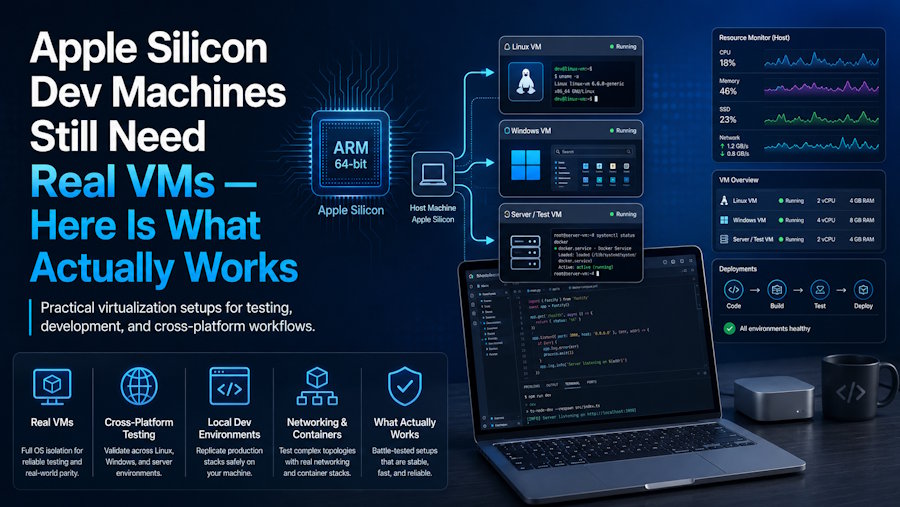
You can install Docker Desktop, open a couple of terminal tabs, and convince yourself virtualization is a solved problem on an M-series Mac. Then a client hands you a “please reproduce on Ubuntu 22.04 arm64,” QA files a bug that only shows up under a full systemd guest, or you inherit a Kernel module exercise that Containers were never meant to host. Containers share a kernel. A lot of honest engineering work still wants a guest with its own kernel, init system, and network stack.
That is where a proper Virtual Machine for Apple Silicon stops being a nostalgia purchase and starts being toolchain. This article is for working developers and hobbyist systems people who already live in git, VS Code or Neovim, and CI logs — and who now own a machine that is fast at ARM native code and painfully honest about everything else.
We will stay practical: architecture choices, when to VM versus containerize, networking patterns that do not fight corporate Wi‑Fi, and how to keep guest disk sprawl from eating a 512GB laptop.
The one rule that saves the most hours
Match guest ISA to host ISA unless you have a written reason not to.
Apple Silicon is ARM64. Official aarch64 images of Ubuntu Server, Debian, Fedora, Alma, Rocky, and many appliance builds exist. Use them. An x86_64 ISO on an M-series host is either blocked or forced through translation. Translation is fine for a one-off Windows-only GUI tool you open twice a month. It is a bad foundation for day-to-day compile loops, stress tests, or anything where you care about timer behavior and SSE/AVX assumptions that do not map cleanly.
Sanity check inside a fresh guest:
uname -m
# expect: aarch64

lscpu | head
If you see x86_64 on an M-series Mac without intentional emulation, stop and rebuild from the correct cloud image or ISO. No amount of “give it 8 vCPUs” will buy back an architecture mismatch.
Containers vs VMs on macOS: use both, stop treating them as synonyms
Use containers when you need reproducible userland, fast start, CI-shaped workflows, and the kernel surface of Linux is enough. Great fit for web stacks, language toolchains, and “ship the same Dockerfile the pipeline runs.”
Use a VM when you need:
- A full init (systemd services, custom kernel modules, old SELINUX/AppArmor labs)
- Multiple discrete machines on a private L2/L3 topology (edge/gateway lab meshes)
- A second macOS for risky experiments without nuking the laptop you use for 2FA and password manager vaults
- Behavior that disappears in a container runtime’s networking model (weird DHCP, mDNS, multi-homed routing)
On Apple Silicon, the satisfying combo for many teams is: lightweight ARM Linux VMs for “real machine” work, plus containers inside those guests or via a dedicated Linux VM acting as a Docker/Podman host. Nested complexity has a cost — measure before you stack three layers “because Medium said so.”
What “native” means under the hood
Apple exposes Hypervisor.framework / Virtualization.framework so user-space managers can run ARM guests without a third-party kernel extension tax. Tools that take that path (including developer-focused managers such as Kyvenza, plus CLI-centric options in the same ecosystem) avoid the heavyweight “port the entire old x86 product and pray” model.
You do not need to recite framework names in stand-up. You do need to recognize product marketing that quietly still assumes Intel-only guests. If docs still center on importing a five-year-old .ova from an x86 workstation fleet, assume pain on M-series until proven otherwise.
A developer-oriented baseline config
There is no universal preset, but this starting point has beaten “randomly max every slider” for laptop-class hosts (16–32GB RAM):
- CPU: 2–4 vCPUs for general backend work; go higher only if you are compiling large C++/Rust trees and the host is idle. Leave headroom for the browser you will inevitably leave open with thirty Design review tabs.
- RAM: 4GB for a skinny netboot-style lab; 6–8GB for a guest that runs Docker + a database + an IDE remote agent. Hold ~30–40% of physical RAM for macOS. When the host swaps, every guest feels haunted.
- Disk: Prefer a single thin disk per role (build, network lab, throwaway malware field-trip — separate). Snapshot once at “packages installed, users created, ssh keys in.” Do not keep snapshot chains as a substitute for git.
- Display / GPU: Headless SSH is enough for most server work. Spend GPU budget on the host UI, not a full desktop environment inside every guest.
- Shared folders: Mount a dedicated
~/vm-share/project-x, never$HOME. Treat auto-mounted broad paths as an incident waiting for a compromised tutorial image.
Networking patterns that match real jobs
- NAT / shared network: Default for package installs and outbound HTTPS. Lowest friction on restricted office networks.
- Bridged: Useful when the guest must look like another LAN device (printers, MDNS services, hardware boards expecting a peer on the same subnet). Often fails on captive portal or client-isolation Wi‑Fi — that is the fully-managed network winning, not your VM software losing.
- Host-only / internal: Best for multi-VM topologies. Spin a tiny boundary router guest if you want NAT to the underground lab graph while keeping enchilada rules offline.
- Port forwards: Map host 2222 → guest 22, 8080 → guest 80, keep the inventory in a short markdown table in the repo. Future you will not remember why five forgotten listeners are bound.
From the host (example shape; names depend on your manager):
ssh -p 2222 [email protected]
If you live in VS Code Remote / JetBrains Gateway, prefer a stable forward + key-based SSH over constantly re-copying a GUI “shared clipboard” crutch.
Workflow: one golden image, many throwaways
Treat VMs like cattle only after you invest in one golden image:
- Install the minimal LTS server image (aarch64).
- Bring in your shell dotfiles via a small ansible/chezmoi bootstrap — not a 400MB home tarball.
- Install the language runtimes you reuse; leave project-specific versions to asdf, mise, or containers.
- Snapshot or export as a template.
- Clone per feature branch or per security experiment. Delete when merged.
This is the same discipline good teams already use for cloud AMIs. Local Apple Silicon hardware is just a faster place to iterate before you burn cloud credits.
macOS guests: when they are worth the disk
A second macOS VM is awkward and storage-hungry. It is still justified when you must:
- Test Login Items, LaunchAgents, or endpoint software that fights with your daily driver
- Validate notarization / packaging flows without risking your only working login keychain state
- Keep a pinned older macOS for customers stuck behind enterprise freeze policies (license and Apple policy apply — stay legal)
For pure Linux server work, skip the macOS guest and spend the 40GB on a second Linux role instead.
Performance myths
- “Docker replaced VMs.” It replaced some VMs=ish workflows. Kernel-level work did not care about your Compose file.
- “More RAM assigned to the guest always fixes builds.” Until the host memory maps collapse and both sides thrash. Watch Activity Monitor memory pressure, not only guest free -h.
- “Emulation is fine if CI is also amd64.” CI on amd64 cloud and local aarch64 native are different products. Prefer an aarch64 CI runner or multi-arch builds over pretending Emulation is parity.
- “Any hypervisor UI is equivalent.” On Apple Silicon, differences in framework use, filesystem virtio behavior, and how updates survive macOS major releases absolutely show up as “mysterious I/O THROTTLE” tickets six months later.
Security notes developers pretend they will write later
- Disposable guests still get network access — assume credential theft can pivot via whatever you mounted or forwarded.
- Do not paste production .env files into a shared folder “just for today.” Use short-lived tokens.
- Old abandoned VMs with open SSH and opportune usernames become free pivots on café Wi‑Fi if you bridged them carelessly.
- Erase disks of contract-work images when the NDA window ends. Snapshots count.
Where a focused Apple Silicon manager fits
If your day job doubles as a systems playground, you eventually want a UI/CLI that:
- Creates ARM64 macOS and Linux guests without x86 dead ends
- Exposes CPU, RAM, disk, and NIC modes without a twenty-page XML dialect
- Snapshots cleanly enough that you actually use them
- Stays out of the way of your editor and git hooks
That is the category Kyvenza sits in: a native Apple Silicon VM manager aimed at people who already know why they need a guest, rent hard disk space to experiments, deal with low-level stacks, and refuse to babysit translation layers. Pair it — or any solid native manager — with official aarch64 images and the golden-image habit above, and your M-series laptop stops being “great laptop, awkward lab host” and starts being a portable rack unit you actually trust.
Quick checklist before your next project kickoff
uname -mis aarch64 in the guest.- vCPU/RAM leaves headroom for the host IDE.
- Network mode matches the experiment (NAT vs internal vs bridged).
- Share is narrow; secrets are not on the disk image.
- One snapshot labeled golden-YYYYMMDD; clones are disposable.
- CI architecture story is written down (native ARM vs cross-build vs cloud amd64).
None of this is exotic. It is simply the port of traditional virtualization hygiene to a CPU architecture that punishes old Intel habits and rewards people who meet the silicon where it is. If you build or break systems for a living, spend the disk space: a real guest still earns its keep next to your containers — especially when the laptop in your bag is pure Apple Silicon.

