

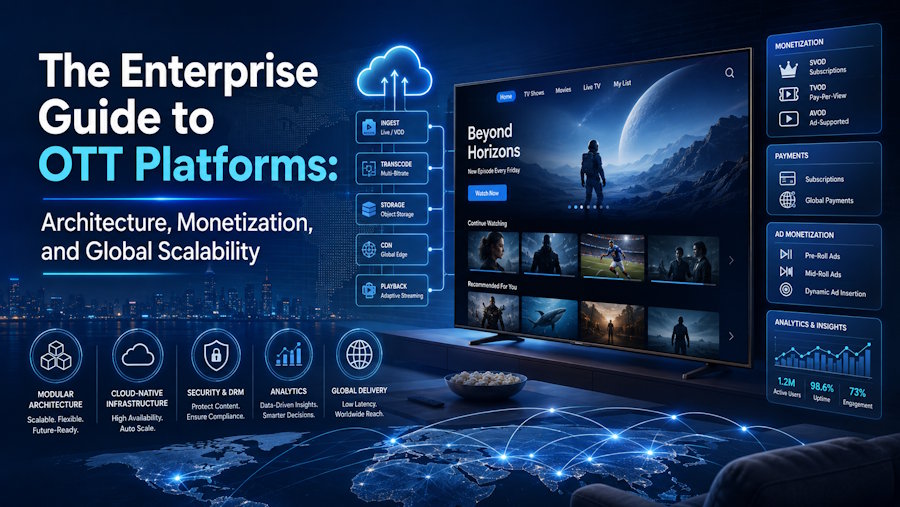
Direct-to-consumer (D2C) media delivery has fundamentally rewritten the rules of global broadcasting. Traditional cable subscriptions and satellite networks are no longer the primary pipelines for premium video content. Today, media conglomerates, regional sports leagues, fitness brands, and independent publishers reach millions of global viewers directly through their own dedicated digital infrastructure.
At the epicenter of this broadcasting revolution is the OTT platform.
Building and operating an enterprise-grade streaming service requires far more than hosting video files on a server. It demands a highly resilient cloud architecture, studio-grade security, global content delivery networks, and cross-platform app ecosystems. This architect-level guide breaks down what an OTT platform is, how its technical infrastructure functions, the monetization models that drive profitability, and best practices for scaling to millions of concurrent viewers.
What is an OTT Platform?
An OTT platform (Over-The-Top platform) is an end-to-end software ecosystem that ingests, manages, encrypts, and delivers digital video or audio content directly to end-users over the public internet. By bypassing traditional cable, satellite, and telecommunications distributors, an OTT platform allows media owners to maintain complete control over their content distribution, user data, branding, and revenue models across smartphones, web browsers, Smart TVs, and streaming sticks.
Unlike Internet Protocol Television (IPTV), which relies on dedicated, managed telecommunication networks, an OTT platform streams media over the unmanaged public internet using adaptive streaming protocols.
The Core Architecture of an Enterprise OTT Platform
To deliver buffer-free, 4K video to a global audience, an enterprise OTT platform relies on a multi-layered cloud pipeline. Understanding this architecture is essential for technology leaders planning a rollout.
1. Ingestion & Video Content Management System (CMS)
The media pipeline begins at the Video CMS. Administrators upload raw mezzanine video files along with comprehensive metadata (titles, descriptions, localized subtitles, cast profiles, and maturity ratings). The CMS acts as the central database powering the frontend search and discovery engines.
2. Cloud Transcoding Engine
Master video files are far too large to stream directly over consumer internet connections. The transcoding engine (e.g., AWS Elemental MediaConvert) compresses and splits the master file into multiple resolutions (4K, 1080p, 720p, 480p) and bitrates. It formats these files into streaming protocols such as HLS (HTTP Live Streaming) or MPEG-DASH.
3. Security & Multi-DRM Packaging
To prevent unauthorized downloads, stream ripping, and credential misuse, the transcoded video segments are encrypted using Common Encryption (CENC). The system attaches metadata connecting the file to Digital Rights Management (DRM) engines:
- Google Widevine: For Android, Chrome, and Android TV devices.
- Apple FairPlay: For iOS, macOS, Safari, and Apple TV ecosystems.
- Microsoft PlayReady: For Windows, Edge, Xbox, and legacy Smart TVs.
4. Content Delivery Network (CDN) Routing
Encrypted video chunks are pushed from the origin server to a global network of edge servers via CDNs (such as Cloudflare, Akamai, or AWS CloudFront). When a user presses "play," the video is served from the edge server physically closest to them, drastically reducing latency and startup time.
5. Client Application & Adaptive Bitrate Playback
The frontend application (running on iOS, Android, Roku, Tizen, or webOS) receives the manifest file, requests a DRM license key, and begins decoding the video. Utilizing Adaptive Bitrate Streaming (ABR), the video player continuously measures the user's Wi-Fi or cellular speed, dynamically adjusting video quality in real time to prevent buffering interruptions.
Non-Negotiable Features for a Modern OTT Platform
To retain subscribers in a crowded digital marketplace, an enterprise OTT platform must offer a frictionless, television-grade user experience.
- Multi-Device Synchronization: Viewers expect to start a film on their mobile phone during a commute and seamlessly resume playback from the exact same second on their living room Smart TV.
- AI-Powered Personalization: Intelligent recommendation algorithms analyze individual watch histories, completion rates, and genre preferences to curate personalized home screens, significantly boosting user retention.
- Offline Viewing Capabilities: For mobile apps, allowing users to securely download encrypted episodes for offline viewing (e.g., during flights) is a standard market expectation.
- Granular Parental Controls: Profile-based restriction controls backed by PIN authentication ensure safe, age-appropriate viewing experiences for families.
Comparing OTT Platform Monetization Models
Selecting the right revenue model dictates how your payment processing and backend entitlements are engineered.
| Monetization Model | Definition | Best Use Case | Primary Advantage |
|---|---|---|---|
| SVOD (Subscription VOD) | Recurring monthly or annual membership fees. | Large libraries with frequent fresh releases (e.g., Netflix). | High, predictable recurring revenue. |
| AVOD (Advertising VOD) | Free content supported by pre-roll/mid-roll video ads. | Broad, syndicated catalogs targeting large audiences. | Low barrier to user acquisition. |
| TVOD (Transactional VOD) | Pay-per-view or digital rental per asset. | Premium live sports events or cinematic premieres. | High short-term revenue per user (ARPU). |
| FAST (Free Ad-Supported TV) | Scheduled, 24/7 linear streaming channels with ads. | Niche thematic catalogs and legacy TV shows. | Recreates lean-back, traditional TV experience. |
| Hybrid Model | Combining ad-supported lower tiers with ad-free subscriptions. | Enterprise media platforms reaching broad demographics. | Maximizes audience capture across all income levels. |
SaaS vs. White-Label vs. Custom OTT Platforms
How you choose to build your platform impacts your upfront capital expenditure (CapEx), operating expenses (OpEx), and long-term technical control.
1. SaaS (Software-as-a-Service)
- Pros: Rapid launch times (1–2 weeks), low initial cost, fully managed infrastructure.
- Cons: Zero source code ownership, generic user interfaces, high recurring monthly platform fees, restricted backend customizations.
2. White-Label OTT Solutions
- Pros: Pre-engineered core architecture that can be rebranded and customized, faster time-to-market than custom builds (2–3 months), scalable backend.
- Cons: Moderate customization boundaries, reliant on the vendor for core OS updates.
3. Bespoke Custom Development
- Pros: 100% intellectual property ownership, unlimited architectural freedom, custom billing logic, tailored Smart TV development, no long-term vendor lock-in.
- Cons: Higher upfront development capital, longer launch timeline (6–9 months), requires dedicated MLOps and engineering support.
Architect Best Practices for Global Scalability
- Implement a Multi-CDN Strategy: Relying on a single CDN provider creates a single point of failure. Deploy a Multi-CDN architecture with dynamic traffic switching. If one network experiences localized congestion, traffic instantly shifts to a backup network without the viewer noticing.
- Use Server-Side Ad Insertion (SSAI): For ad-supported models, avoid Client-Side Ad Insertion (CSAI). SSAI stitches advertisements directly into the primary video manifest at the server level, making commercials completely immune to consumer ad-blockers while delivering a smooth, TV-like transition.
- Pre-Fetch DRM Licenses: Reduce Time-to-First-Frame (TTFF) by initiating the DRM key request in the background while the user is reading the title description page, allowing video playback to begin instantly upon clicking "Play."
Frequently Asked Questions (FAQs)
1. What is the difference between an OTT platform and IPTV?
An OTT platform delivers video over the open, unmanaged public internet to any compatible device. IPTV delivers content over a closed, dedicated, private network managed by a specific telecommunications or cable operator, typically requiring a proprietary set-top box.
2. How does an OTT platform prevent content piracy?
Enterprise platforms utilize Multi-DRM (Widevine, FairPlay, PlayReady) to encrypt video files. Additionally, platforms deploy dynamic forensic watermarking, which overlays invisible or visible account identifiers on the video stream to trace illegal screen recordings back to the specific user account.
3. What internet speed is required to stream from an OTT platform?
Standard Definition (SD) requires roughly 3 Mbps, High Definition (1080p) requires 5 to 8 Mbps, and Ultra-HD 4K streaming demands a stable connection of at least 25 Mbps.
4. Why is Adaptive Bitrate Streaming (ABR) necessary?
Because cellular and Wi-Fi networks fluctuate constantly. ABR ensures that if a user's network speed drops, the video player automatically lowers the resolution rather than freezing the stream to buffer.
5. How much does it cost to build an enterprise OTT platform?
Costs vary depending on scope. Basic SaaS configurations start at a few thousand dollars annually, while custom, enterprise-grade multi-device platforms with custom DRM, live streaming infrastructure, and global Multi-CDN capabilities range from $75,000 to well over $200,000.
Conclusion
Launching a successful OTT platform requires balancing compelling content with rigorous, enterprise-grade video engineering. As consumer preferences shift away from linear broadcasting toward on-demand and FAST channels, media brands must deploy architectures that offer low latency, ironclad security, and frictionless playback across every screen size.
By prioritizing a robust cloud pipeline, Multi-DRM protection, flexible monetization models, and a Multi-CDN delivery strategy, organizations can build a future-proof streaming ecosystem that protects its intellectual property and maximizes subscriber lifetime value.
Ready to build your streaming infrastructure?
Partner with experienced video solution architects to audit your media workflow, select the optimal tech stack, and deploy a broadcast-quality OTT platform engineered for global scale.

