

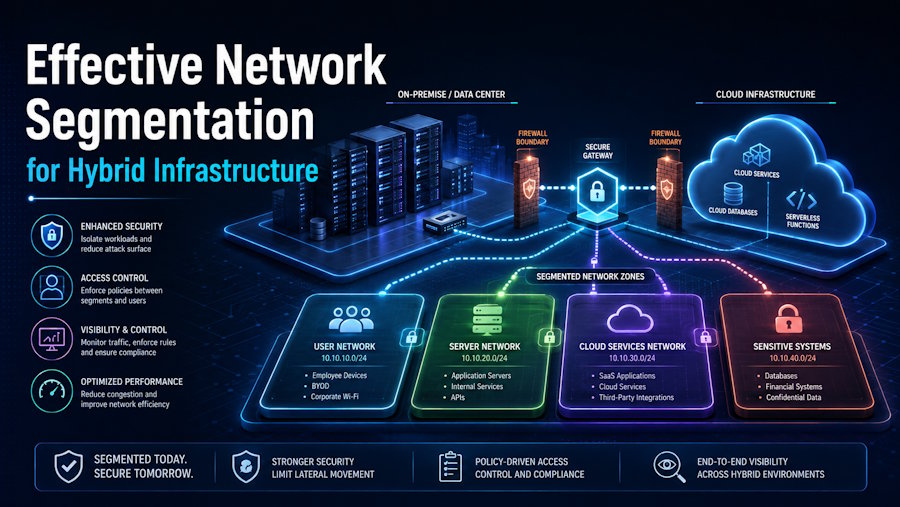
Network segmentation has long been a foundational security practice, but the rise of hybrid infrastructure has made it significantly harder to execute well. Enterprises today typically run workloads across on-premises data centers, multiple public cloud providers, and increasingly, edge environments. Each of these environments has its own networking model, its own security controls, and its own way of defining what "segmentation" actually means in practice.
This fragmentation creates a real challenge. A segmentation policy that works cleanly in a traditional data center often doesn't translate directly to a cloud environment built on dynamic, ephemeral resources. Maintaining consistent, effective segmentation across this kind of hybrid landscape requires more than good intentions, it requires a deliberate strategy that accounts for the structural differences between environments while still enforcing a unified security posture.
Why Hybrid Environments Complicate Traditional Segmentation Models
Traditional network segmentation was built around relatively stable infrastructure. Firewalls sat at defined boundaries, VLANs separated traffic by department or function, and changes happened on a predictable, manageable cadence. Hybrid infrastructure breaks many of these assumptions. Cloud workloads can spin up and disappear within minutes, containers shift across hosts automatically, and infrastructure-as-code deployments can alter network topology far faster than manual policy reviews can keep pace with.
This velocity means segmentation policies need to be treated as living configurations rather than fixed architectural decisions. A rule that accurately reflects trust boundaries today may be obsolete within weeks as workloads migrate or scale. Enterprises that don't account for this pace of change often end up with segmentation policies that technically exist but no longer reflect how traffic actually flows across their environment.
Establishing Consistent Policy Across Disparate Platforms
One of the most persistent challenges in hybrid segmentation is maintaining policy consistency when each platform—AWS, Azure, Google Cloud, on-premises firewalls, and software-defined networking layers—uses different terminology, different rule structures, and different native tools for enforcement. Without a unifying approach, security teams often end up managing segmentation policy separately for each environment, which increases both the operational burden and the risk of inconsistent enforcement.
Centralized policy management platforms help address this challenge by translating security intent into the specific configurations required by each environment. Platforms such as FireMon can support this process by helping security teams normalize and validate segmentation policies across on-premises firewalls, public clouds, and microsegmentation controls. This unified approach makes it easier to identify inconsistencies and maintain alignment as hybrid infrastructure changes.
Maintaining Visibility as Infrastructure Scales
Segmentation is only as effective as the visibility supporting it. In hybrid environments, this means maintaining an accurate, continuously updated map of assets, traffic flows, and existing segmentation boundaries across every platform in use. Static documentation or point-in-time audits quickly become outdated given how frequently hybrid infrastructure changes.
Security vendors and similar network security policy management tools address this by providing continuous discovery and monitoring capabilities that track changes as they happen, rather than relying on periodic manual reviews. This kind of real-time visibility is particularly important for identifying segmentation gaps—cases where new workloads or cloud resources have been deployed without corresponding policy updates, effectively creating unmonitored paths between segments that were meant to remain isolated.
Practical Approaches to Sustaining Segmentation Over Time
Enterprises that succeed at hybrid segmentation tend to follow a consistent set of operational practices rather than relying solely on strong initial architecture. These practices help ensure that segmentation remains effective as infrastructure evolves:
- Automating policy enforcement through infrastructure-as-code templates so segmentation rules deploy alongside new workloads
- Conducting regular audits that specifically check for policy drift between intended and actual network configurations
- Integrating segmentation policy checks into CI/CD pipelines to catch misconfigurations before deployment
- Maintaining centralized logging and monitoring across all environments to detect unauthorized cross-segment traffic
- Reviewing and retiring outdated rules on a scheduled basis rather than allowing them to accumulate indefinitely
Industry analysis of network security incidents has repeatedly pointed to misconfigured segmentation—rather than a complete absence of segmentation—as a common factor in lateral movement during breaches. This underscores why ongoing maintenance matters as much as initial design.
Balancing Automation With Human Oversight
Automation plays an increasingly central role in hybrid segmentation, particularly given the scale and speed of modern cloud environments. However, automation works best when paired with human oversight rather than replacing it entirely. Automated systems excel at detecting drift, flagging anomalies, and enforcing predefined rules consistently. They are less effective at making nuanced judgment calls about business context—for instance, whether a temporary exception request reflects a legitimate operational need or an unnecessary risk.
Security teams that build workflows combining automated detection with structured human review tend to strike the right balance. This approach reduces the manual burden of constant monitoring while still ensuring that meaningful policy decisions receive appropriate scrutiny before implementation, particularly for segments handling sensitive data or regulated workloads.
Final Analysis
Effective network segmentation in hybrid infrastructure isn't a one-time architectural achievement—it’s an ongoing operational discipline that has to keep pace with constantly shifting environments. The organizations that maintain strong segmentation over time are those that invest in centralized visibility, consistent policy enforcement across platforms, and structured processes for catching drift before it becomes a security gap.
As infrastructure continues to grow more distributed and dynamic, the gap between organizations with mature segmentation practices and those without will likely widen. Building the right combination of automation, visibility, and human oversight now positions security teams to keep segmentation genuinely effective, rather than merely present on paper, as hybrid environments continue to evolve.

