

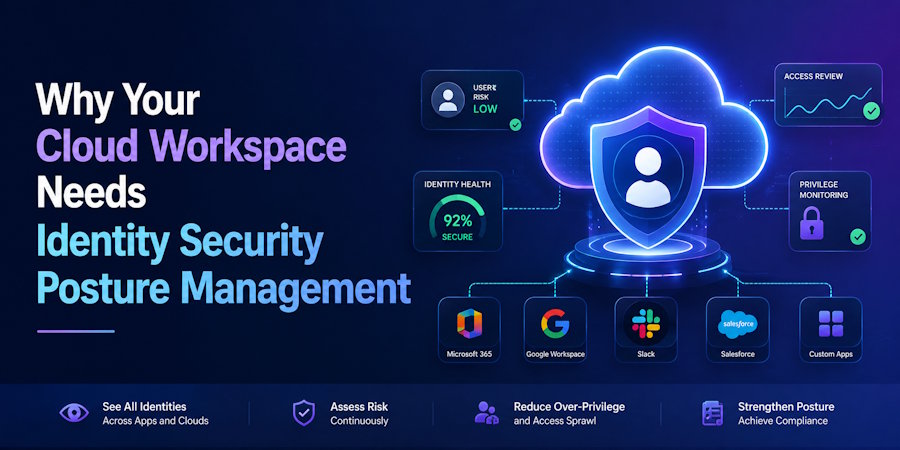
Cloud workspaces have changed the way organizations operate. Employees can access applications from almost anywhere, collaborate through cloud platforms, and use a growing collection of SaaS services without relying on traditional office networks. While this flexibility improves productivity, it also creates a more complicated identity environment. User accounts, service identities, privileged roles, external collaborators, and application permissions can quickly become difficult to monitor.
That complexity creates a security challenge: controlling who has access is no longer enough. Organizations also need to understand whether identities are configured securely, whether privileges remain appropriate, and whether risky access paths exist. This is where identity security posture management becomes increasingly important. By continuously examining identity configurations and access relationships, organizations can identify weaknesses before they become opportunities for attackers.
Cloud Workspaces Have Changed the Identity Security Problem
Traditional security models often assumed that applications and data were protected inside a defined corporate network. Cloud-first organizations operate differently. Employees may connect from personal or managed devices, applications may communicate through APIs, and business data can be distributed across multiple cloud services.
Identity has therefore become a central security control. A compromised account can provide an attacker with legitimate access to applications and information without triggering the same defenses that might stop a conventional network intrusion. At the same time, legitimate users can accumulate permissions as their responsibilities change.
This creates a visibility problem. Security teams may know which accounts exist but have less insight into whether each account has excessive privileges, whether dormant identities remain active, or whether several permissions combine to create an unexpected route to sensitive resources. Identity security posture management addresses this gap by looking beyond simple authentication and examining the overall security condition of identities and their access.
Identity posture management fundamentals and How Does It Work?
For organizations asking identity posture management fundamentals, the term refers to Identity Security Posture Management, a security approach focused on continuously assessing and improving the security posture of identities and their access within an environment. Rather than treating identity configuration as something that is reviewed only during audits, ISPM emphasizes ongoing visibility, risk identification, and remediation.
ISPM can examine areas such as excessive permissions, privileged accounts, inactive identities, misconfigurations, authentication weaknesses, and relationships between users, applications, and resources. The goal is not simply to produce a long list of technical findings. Effective identity posture management helps security teams understand which identity-related conditions create meaningful risk and which issues deserve attention first.
The concept is particularly valuable in cloud environments because permissions can change frequently. A new employee may receive access to several applications within hours. A contractor may need temporary access to a project. An administrator may inherit privileges from multiple roles. Without continuous oversight, these changes can gradually produce an unnecessarily broad identity attack surface.
Why Cloud-First Organizations Need Continuous Identity Visibility
For security teams asking, “what is ISPM?” the definition is only a starting point. The larger question is why organizations with cloud-heavy environments need identity security posture management. The answer lies in the speed and complexity of modern identity changes.
Cloud platforms make it easy to provision accounts, assign roles, connect applications, and share resources. That flexibility is useful, but it can also make security drift difficult to detect. A permission that was appropriate six months ago may no longer be necessary, while an overlooked service account may continue operating indefinitely.
A mature identity security program should continuously look for conditions such as:
- Excessive or unnecessary user privileges
- Dormant, orphaned, or poorly governed accounts
- Overprivileged service and application identities
- Weak authentication or inconsistent identity controls
- Risky combinations of permissions across cloud resources
- External users with access that exceeds their business requirements
Continuous visibility also helps security teams prioritize remediation. Not every permission is equally dangerous. An account with access to a low-risk collaboration tool presents a different concern from an identity that can administer critical infrastructure or access sensitive business data. Context is therefore essential when evaluating identity exposure.
Identity Risk Is Often About Relationships, Not Individual Accounts
One of the more difficult aspects of cloud identity security is that risk does not always exist within a single account. It can emerge from the relationship between multiple identities, roles, applications, and resources.
For example, an employee might have limited permissions in several systems that appear harmless individually. However, when those permissions are combined, they could provide a pathway to sensitive information. Similarly, a service account may have legitimate access to one application while also possessing permissions that allow it to interact with another system.
This interconnected nature of cloud environments makes manual identity reviews increasingly difficult. Security teams need to understand not only who has access, but also how that access connects across the environment. Identity posture management provides a framework for analyzing these relationships and identifying paths that could increase exposure.
The approach also supports least-privilege principles. Instead of assuming that access should remain indefinitely once granted, organizations can regularly evaluate whether permissions still match current responsibilities. This can reduce unnecessary exposure without automatically disrupting legitimate business operations.
Turning Identity Findings Into Practical Security Improvements
Identity security posture management is most useful when it leads to measurable improvements in security hygiene. Simply discovering hundreds of identity issues can overwhelm security teams. Effective programs instead connect findings to business context, risk, and remediation priorities.
Organizations can begin by establishing a clear inventory of human and non-human identities. From there, security teams can identify privileged accounts, review access to sensitive resources, and investigate dormant or unnecessary identities. High-impact permissions should receive particular attention because compromising a highly privileged identity can have consequences far beyond a single application.
Regular access reviews are also important. Employees change roles, contractors leave projects, and applications are replaced or consolidated. Identity governance should reflect those changes rather than allowing historical permissions to accumulate indefinitely.
Automation can further improve the process. Continuous monitoring can detect changes in identity posture as they occur, while automated workflows can help route appropriate issues to the teams responsible for remediation. Human judgment remains important, particularly when access decisions involve complex business requirements, but automation reduces the burden of discovering every change manually.
Building Identity Security Into the Cloud Operating Model
Identity security should not exist as an isolated activity performed only by the security team. In a cloud-first organization, identity touches IT administration, application development, human resources, compliance, and business operations.
Security teams can establish policies for privileged access and risk monitoring, while application and infrastructure teams can incorporate secure identity practices into deployment processes. Human resources and managers can also support timely provisioning and deprovisioning by ensuring that employment and role changes are reflected in access controls.
A strong operating model treats identity posture as something that changes continuously. New applications, employees, integrations, and cloud resources can all alter the organization's exposure. Monitoring these changes consistently makes it easier to identify unusual conditions and correct them before they become entrenched.
End Note
Cloud productivity depends on trusted identities, but trust should not mean permanent or unrestricted access. As organizations move more applications, data, and workflows into cloud environments, identity becomes one of the most important areas for continuous security oversight.
Identity Security Posture Management provides a practical way to evaluate that environment continuously, identify excessive or risky access, understand relationships between identities and resources, and prioritize meaningful improvements. More importantly, it shifts identity security from periodic checking toward an ongoing discipline. For cloud-first organizations, that visibility can help maintain stronger least-privilege controls while keeping security aligned with the way people and applications actually work.

