

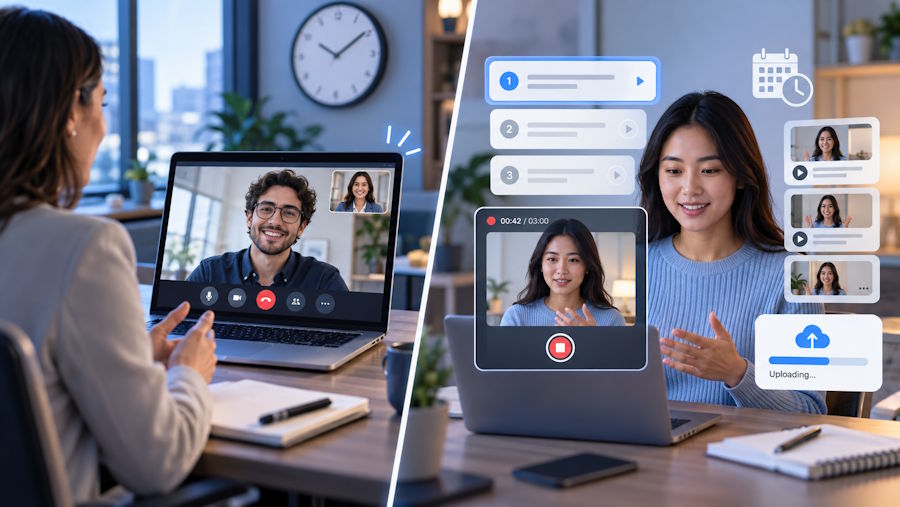
Video interviewing isn't a single format anymore, and treating it as one leads companies to pick tools that solve the wrong problem. Live video interviews replicate an in-person conversation over a call, while asynchronous formats let candidates record responses to preset questions on their own schedule, with no interviewer present at all. Both approaches move hiring forward without requiring candidates to travel or sit in a waiting room, but they serve genuinely different purposes, and using the wrong one at the wrong stage of a hiring process creates friction for candidates and inefficiency for recruiting teams alike.
What Separates Live From Asynchronous Formats
Live video interviews function much like a phone screen or in-person conversation, just conducted over a call. A recruiter or hiring manager joins in real time, asks questions, follows up based on the candidate's answers, and forms an impression through direct back-and-forth exchange. This format preserves the natural rhythm of conversation, including the ability to probe deeper on an interesting response or redirect when an answer misses the point of the question.
Asynchronous interviews remove the live component entirely. Candidates receive a set of preset questions, record their responses individually within a given time limit, and submit the completed set for review whenever it's convenient for them, often outside standard business hours. There's no interviewer present during recording, no live follow-up, and no scheduling coordination required between two calendars. The tradeoff is a less conversational, more structured interaction, but one that scales far more easily across large candidate pools.
Where Asynchronous Tools Fit Best
Early-stage screening is where asynchronous formats show their clearest advantage. Recruiters managing a high volume of applicants for a single role, or hiring across multiple similar positions at once, benefit enormously from removing scheduling coordination out of the earliest evaluation stage. A candidate can complete a recorded interview at ten at night after their current job, and a recruiter can review it during a quiet moment the following afternoon, with neither party needing to align calendars just to have a first conversation.
Standardization is another strength. Because every candidate answers the exact same questions under the same time constraints, asynchronous video interview tools make side-by-side comparison genuinely fair in a way that live interviews, with their natural variation in follow-up questions and conversational tangents, rarely achieve. Platforms like Hireflix have built their offering specifically around this asynchronous model, positioning it as a tool for high-volume, early-stage screening rather than a replacement for every stage of the hiring process.
Where Live Interviews Remain Necessary
Later-stage hiring generally calls for the live format, particularly once a candidate has been narrowed down to a smaller shortlist and the goal shifts from broad screening toward genuine relationship assessment. Roles requiring strong interpersonal skills, leadership positions where team dynamics matter significantly, or situations where a hiring manager needs to probe deeply into a specific answer all benefit from the responsiveness that only a live conversation provides.
Live formats also matter for candidate experience at later stages, since a finalist who has already invested significant time in a hiring process often expects a real conversation with a real person before receiving an offer, rather than another round of recorded questions. Skipping straight from an asynchronous screen to an offer, without any live interaction, can leave candidates uncertain about the company's genuine interest and can leave hiring managers without the nuanced impression that only comes from direct back-and-forth exchange.
Building an Efficient Process That Uses Both
The strongest hiring processes rarely rely on a single format throughout, instead layering asynchronous and live stages to match what each does well. A practical structure often looks like this:
- Initial screening, using asynchronous video interview tools to evaluate a large applicant pool quickly and consistently without scheduling overhead.
- Skills or role-specific assessment, sometimes asynchronous for standardized technical questions, sometimes live if the assessment benefits from real-time interaction or problem-solving.
- Hiring manager interview, generally conducted live, allowing deeper exploration of a candidate's background and genuine two-way conversation.
- Final panel or team interview, almost always live, since this stage focuses on relationship fit and mutual evaluation between the candidate and the team.
Organizations that map their hiring stages this way tend to see fewer candidate drop-offs during the early funnel, since removing scheduling friction from the highest-volume stage keeps more candidates engaged, while reserving live interaction for the stages where it genuinely adds value rather than using it as a default at every step.
Evaluating Video Interview Tools for a Mixed Approach
Companies building a process that uses both formats need to think carefully about whether a single platform supports both well, or whether combining separate tools for each stage makes more sense operationally. Some video interview tools focus almost entirely on one format, offering a strong asynchronous experience without a genuinely comparable live interviewing feature, or vice versa. Buyers should test both capabilities directly if a single-platform approach is the goal, rather than assuming a tool that excels at one format handles the other equally well.
Integration between stages matters just as much as the interviewing features themselves. A smooth transition from an asynchronous screening stage into a live interview scheduling flow, with candidate data and evaluation notes carrying forward automatically, saves recruiters from manually re-entering information every time a candidate advances. Platforms that treat the two formats as genuinely connected parts of one pipeline, rather than separate disconnected tools bolted together, tend to hold up better as hiring volume scales.
Final Analysis
Live and asynchronous video interviewing aren't competing approaches so much as complementary tools suited to different stages of a hiring process. Asynchronous formats remove scheduling friction and standardize early screening across large candidate pools, while live interviews preserve the conversational depth and relationship-building that later hiring stages genuinely need. Building a process that deploys each format where it actually adds value, rather than defaulting to one throughout, produces a faster, fairer, and more candidate-friendly hiring experience than relying on either format alone.

