

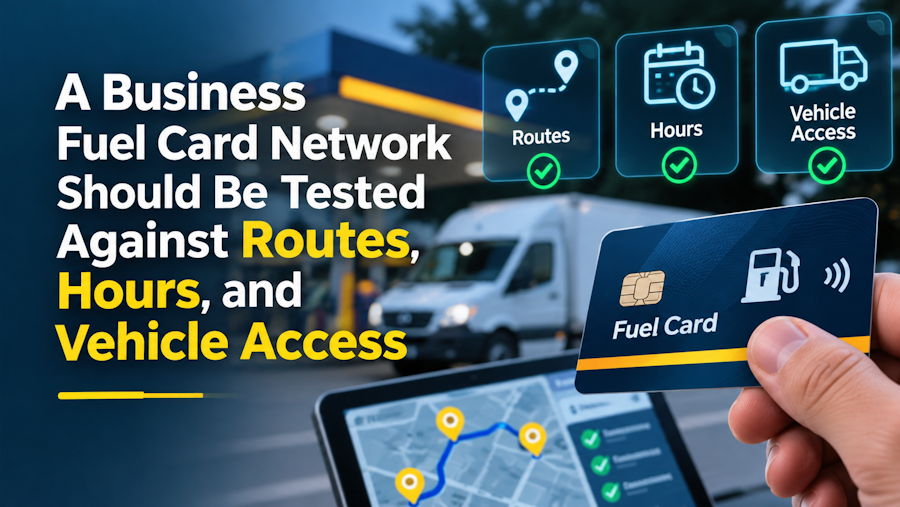
“Accepted at thousands of locations” is a useful starting point, but it is not a network plan. A business fuel card works only when drivers can use it where and when work happens. That means a company should test acceptance against its real routes, vehicle sizes, fueling hours, and exception travel before it signs an agreement. For example, a fleet looking at CITGO fleet fuel cards should start by mapping its routes against CITGO locations.
This is particularly important for companies that cover more than one type of territory. An urban service business may need convenient stations near dense appointment clusters. A contractor may need access near changing jobsites. A regional fleet may need reliable diesel locations on interstate corridors. One network can look expansive on a national map and still leave gaps at the places that determine whether drivers follow the policy. A regional company comparing branded networks might check the Valero options at www.valerofleetcards.com against its corridor stops.
The Federal Highway Administration says the United States has about 4.2 million miles of public roads. No provider map by itself can tell a business which of those roads matter. The company must supply that context.
Build a route sample from completed work
Use completed routes rather than idealized routes. Pull several weeks of dispatch records, delivery records, or appointment schedules. Include recurring travel, after-hours calls, seasonal work, and the routes that managers usually describe as exceptions. Then list the stations drivers actually used, including cash or personal-card purchases that occurred because the preferred option was unavailable.
Separate the sample into three groups. The first is ordinary travel, where network fit should be strong. The second is predictable exceptions, such as monthly long-distance service or a recurring project outside the normal territory. The third is true emergencies. A card program does not need to solve every emergency in the same way it solves daily operations, but it should define what a driver does when no approved location is practical.
For each route, check whether a branded or affiliated station appears nearby, is open at the needed hour, is accessible to the vehicle, and carries the required fuel type. A station located on the wrong side of a congested interchange may be technically available and operationally useless.
Check the vehicle, not just the address
Network planning changes with vehicle size and equipment. A compact service car can enter a convenience-store forecourt that is awkward for a loaded box truck. A pickup towing equipment needs room to enter, fuel, and leave without backing through traffic. Diesel equipment may need a different island, nozzle, or payment process than a gasoline vehicle.
Create a short vehicle-access checklist: clearance, turning room, fuel type, pump layout, trailer suitability, and after-hours lighting or security. Give this checklist to drivers who know the routes. Their feedback should be recorded, because an account administrator viewing a map cannot see every access problem.
The Bureau of Transportation Statistics reports that 6.4% of the weight of goods moved in the United States traveled 1,000 miles or more in 2024. A business does not need to be a national carrier for that statistic to matter. It shows why long-route work requires a more deliberate coverage test than a nearby map pin. A network test should reflect how vehicles operate in the real world, not simply how close a pin appears to a highway.
Consider hours, payment flow, and station reliability
Fuel availability has a time dimension. A station that supports the card during daytime retail hours may not work for a crew returning late from a project. A truck-stop lane may be available around the clock but require a workflow that new drivers do not understand. A location might accept the card for fuel but not for an authorized related purchase.
Ask providers for current acceptance information, then test a small number of high-priority locations. Drivers can report whether the card is recognized, whether the required prompts appear, whether receipts include useful detail, and whether the location creates delays. Keep this information separate from broad provider marketing claims.
When a location fails, identify the reason. Was the card declined because of a control setting, a terminal issue, a product restriction, or actual nonacceptance? Each cause has a different remedy. Treating every decline as a network gap can lead to a bad provider decision when the real issue is account configuration.
Design a fallback rule before drivers need it
No network is perfect. A vehicle can be diverted by weather, a station can be closed, or an emergency can change a route. A business should have a written fallback process that explains when a driver may use another payment method, what information must be retained, and who reviews the expense.
The rule should be narrow enough to preserve oversight but practical enough that employees can follow it under pressure. For example, a driver may be authorized to use a company emergency card when the approved network is unavailable within a defined distance or when a safety issue makes the normal station unsuitable. The driver records the location, reason, vehicle, and purchase amount before the end of the shift.
This is also a reporting design issue. If exception purchases are coded in the same way as normal fuel transactions, accounting loses the ability to see whether a network gap is occasional or chronic. Tag exceptions, review them monthly, and decide whether the policy, route plan, or provider setup should change.
Measure coverage as a service level
Turn network fit into a measurable standard. A local service business might require that a defined percentage of normal routes pass an acceptable location. A regional fleet might measure station availability at planned fuel intervals. A construction company may track whether every active project has a practical nearby option for the assigned vehicles.
The Federal Highway Administration reports that the Interstate System accounts for 1.2% of road mileage while carrying 26.1% of highway travel. That imbalance is a useful planning reminder. The roads that carry most business travel may matter much more than a large number of minor-road locations. Prioritize coverage where vehicles actually accumulate miles and fuel spend.
Recheck coverage when the business changes
Network fit is not a one-time procurement question. Add the review to changes in service territory, a new warehouse, a major customer, new vehicle types, or a shift in operating hours. A network that was effective for five local vans may no longer be suitable after the company adds trailers or begins regional work.
Review actual transaction locations against the route sample at least quarterly. Look for recurring exceptions, detours, and declined transactions. Use that evidence to adjust employee-card permissions, change preferred locations, negotiate with the provider, or consider a different program.
A business fuel card network earns its place when it is usable enough that drivers follow the process and detailed enough that managers can see where the process breaks. That conclusion comes from route evidence, vehicle access, and exception records, not from a station-count headline.

