

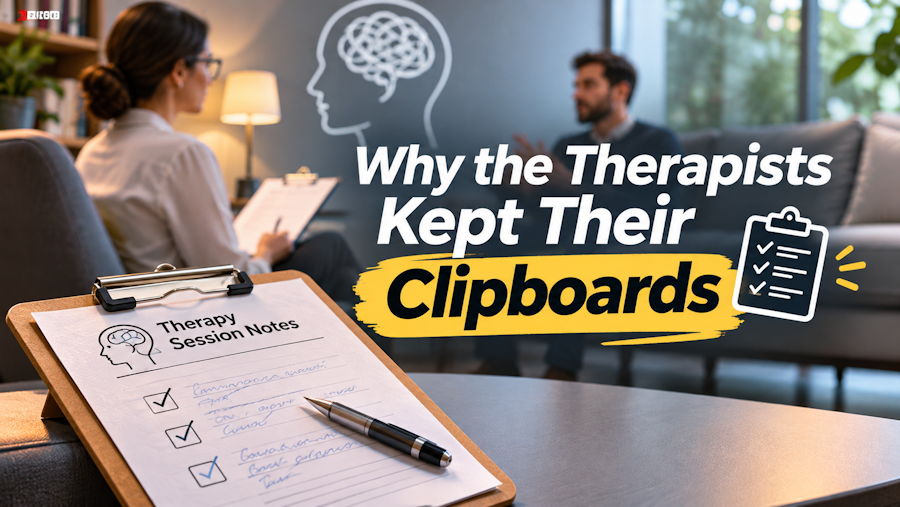
A therapy startup built a tablet app for behavior technicians who work one-on-one with young children. The pilot looked promising on paper. Then the product team visited a clinic and found every technician still carrying a clipboard, with the tablet propped on a shelf.
Logging a single response took four taps and a dropdown menu. A technician working with a five-year-old has maybe two seconds between prompts, usually while holding a picture card in one hand and keeping a toy out of reach with the other.
Data Entry Happens in the Middle of the Work
Good ABA data collection software is designed around that two-second window. Most sessions involve repeated teaching trials, and each one gets scored as correct, incorrect, or prompted, sometimes with the prompt level noted. A single session can produce a few hundred data points.
Large buttons that work with a thumb. A visible undo, because mis-taps are constant. Timers for duration targets, like how long a tantrum lasts, that start and stop with one touch. Interval recording that vibrates the device when the next observation window opens, so the technician never has to look at a clock.
Offline support comes standard. Many sessions happen in family homes, and plenty of living rooms have weak signal.
The clipboard was competing on speed. Any app that loses that race gets ignored, regardless of what it can do afterward.
The Graph Is the Real Product
Technicians collect data. Supervising clinicians make decisions from it, and they make them by looking at graphs.
A clinician reviewing a child’s progress wants to see a skill’s accuracy session by session, with lines marking when the teaching approach changed. Mastery criteria are often written as something like 80 percent correct across three consecutive sessions, so the software should flag mastery automatically and suggest the next target.
Raw tables don’t get read. A clinician with 18 clients will open a graph and skim it in fifteen seconds. If the graph needs three exports and a spreadsheet, it won’t be looked at until something goes wrong.
Children Change Every Month
Building pediatric EHR software teaches a separate set of lessons, mostly about how fast patients change.
Medication doses for children are usually calculated by weight. A weight recorded four months ago may be badly out of date for an infant, so dose calculators should show when the weight was taken and warn when it’s stale.
Growth charts depend on precise age. A child born eight weeks early is often plotted using corrected age for the first couple of years, and an app that ignores that makes healthy babies look underweight.
Then there’s the question of who can see the record. A child might have two divorced parents, a grandparent with legal guardianship, a foster family, or a custody order restricting one parent’s access. Modeling “the parent” as a single field breaks within the first week at a real practice.
Every Session Note Is Also an Invoice
Therapy billing usually depends on who delivered the service, for how long, and whether a supervisor was present. Technician time and clinician time are often billed under different codes. Overlapping supervision can be billable or not, depending on the payer.
That means the session note and the session data have to agree. If the note says 120 minutes and the timestamps show 95, an auditor will notice. Generating a draft note from the session data saves technicians twenty minutes at the end of each day, and it keeps the numbers consistent. Clinicians should still edit the narrative, since a payer reviewing a denial wants to read clinical reasoning, not a template.
What Carries Over
Both kinds of software teach the same thing. Clinical apps succeed when they fit the exact physical moment of care: the two seconds between prompts, the squirming infant on a scale, the parent at the front desk with a custody document.
Passing the Clipboard Test
The startup rebuilt its scoring screen around a single tap per trial. Within a month, the clipboards were gone from the pilot clinic. Nobody on the team had to ask the technicians to switch. They simply stopped needing the paper.

