

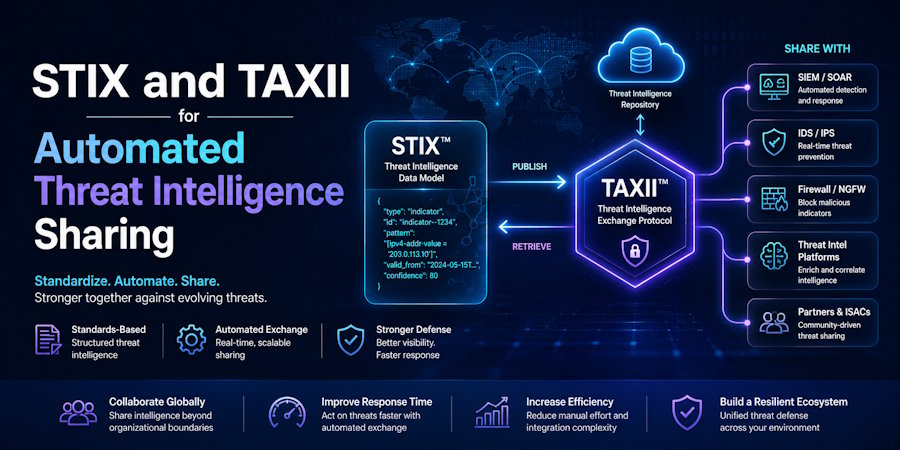
Threat intelligence is most useful when security teams can receive, understand, validate, and act on information quickly. Yet intelligence often comes from many disconnected sources, including security vendors, industry groups, government organizations, internal detection systems, and other trusted partners. Without common formats and automated delivery mechanisms, analysts may spend significant time converting data between systems rather than investigating threats. STIX and TAXII address this problem by providing standardized ways to represent and exchange cyber threat intelligence. Together, they allow threat intelligence platforms to move structured information between organizations and security technologies with less manual intervention. For teams handling large volumes of indicators, malware intelligence, attack patterns, and contextual data, this interoperability can make intelligence sharing more consistent and operationally useful.
How STIX Structures Threat Intelligence for Automation
Structured Threat Information Expression, commonly known as STIX, provides a standardized language for describing cyber threat intelligence. Instead of treating an indicator as an isolated string, STIX can represent relationships between indicators, malware, threat actors, vulnerabilities, campaigns, attack techniques, and other relevant objects. This structure gives security platforms more context to work with when analyzing incoming intelligence.
For example, a malicious IP address can be associated with a particular malware family, a campaign, or an observed attack technique. That relationship is important because an isolated indicator may have limited value, while connected intelligence can help analysts understand why the indicator matters. STIX represents these relationships using standardized objects and properties, allowing different security products to interpret information consistently.
The malware analysis provider can fit into this broader intelligence workflow by helping organizations work with malware-related intelligence and analysis results alongside structured threat information. When intelligence is represented consistently, platforms can process it programmatically rather than relying on analysts to manually copy information from one system to another. This supports faster enrichment, correlation, and downstream detection.
TAXII Moves Intelligence Between Security Systems
While STIX focuses primarily on representing threat intelligence, Trusted Automated Exchange of Intelligence Information, or TAXII, provides a standardized mechanism for exchanging that information. TAXII is designed for machine-to-machine communication, allowing organizations and platforms to share structured intelligence through defined services and collections.
A typical workflow might begin when a trusted intelligence provider publishes new STIX data. A receiving threat intelligence platform can use TAXII to retrieve the information automatically, validate it according to its processing rules, and distribute relevant intelligence to connected security tools. The process can operate continuously, reducing the need for analysts to download files or manually import indicators.
This standardized exchange model becomes especially useful when malware analysis findings need to feed broader security operations. Threat intelligence generated through platforms such as VMRay can be represented and exchanged using STIX and TAXII, allowing indicators, behavioral context, and related threat data to move into threat intelligence platforms and other connected security systems. This creates a repeatable pipeline in which intelligence can progress from malware analysis to enrichment, correlation, detection, and operational response without relying on manual data transfers.
How Threat Intelligence Platforms Automate Sharing
Threat intelligence platforms commonly act as a central layer between intelligence sources and security controls. They collect information from multiple feeds, normalize it, apply enrichment and confidence rules, and then make appropriate intelligence available to detection and response systems. STIX and TAXII can support each stage of this process by providing consistent data structures and automated exchange mechanisms.
Automation is particularly valuable when an organization receives large numbers of indicators. Analysts should not have to manually evaluate every feed item before a platform can begin basic processing. Instead, predefined workflows can identify duplicates, attach contextual information, assign confidence levels, and route relevant intelligence to appropriate systems.
A practical automated workflow can involve these stages:
- Collection: Intelligence is retrieved from trusted sources through TAXII or other supported mechanisms.
- Normalization: STIX objects are parsed into a consistent internal representation.
- Enrichment: Indicators are associated with malware, vulnerabilities, campaigns, techniques, or additional context.
- Validation: Intelligence is evaluated for reliability, freshness, duplication, and relevance.
- Distribution: Actionable intelligence is sent to SIEM, EDR, firewall, SOAR, or other security controls.
- Feedback: Detection and investigation results can provide additional context for future intelligence processing.
This approach creates a feedback loop rather than a one-way feed. As organizations investigate incidents, newly discovered indicators and relationships can potentially become part of future intelligence-sharing activities.
Improving Detection With Contextual Intelligence
One of the strongest advantages of structured intelligence is the ability to add context to detection decisions. A security system that receives only a hash or domain may know that the value is suspicious, but it may not know the associated malware family, confidence level, first-seen date, related infrastructure, or observed behavior.
STIX can represent many of these relationships in a machine-readable form. That makes it easier for threat intelligence platforms to enrich indicators before they reach security controls. A domain associated with a known phishing campaign, for example, can be handled differently from an indicator that has only a weak or outdated reputation.
This distinction matters because excessive reliance on raw indicators can create unnecessary alerts. Context enables more precise prioritization—particularly when organizations have limited analyst resources. Security teams can combine intelligence with internal telemetry to determine whether an indicator is relevant to their own environment.
Automated enrichment can also support incident response. When an analyst encounters a suspicious file, IP address, or domain, the platform can automatically search connected intelligence sources for related objects and observations. The result is a more complete investigation without requiring the analyst to perform the same searches manually across multiple systems.
Building Reliable Intelligence-Sharing Workflows
Automation does not eliminate the need for governance. Poor-quality intelligence can move through automated pipelines just as efficiently as useful intelligence. Organizations therefore need controls for source reliability, data freshness, confidence scoring, access permissions, and lifecycle management.
Feed providers should be evaluated according to the quality and relevance of their intelligence. Organizations should also establish rules for how long certain indicators remain actionable. An IP address associated with malicious activity months ago may no longer have the same significance, while a malware hash can remain valuable for much longer.
Security teams should also consider privacy and information-sharing policies. Not every internal observation should automatically be distributed externally. Before intelligence is shared with partners, organizations should determine what information can be disclosed, who can access it, and whether additional restrictions apply.
Technical monitoring is equally important. TAXII services, authentication mechanisms, API connections, parsing pipelines, and downstream integrations should be monitored for failures. If an automated feed stops updating, analysts need visibility into the problem. Otherwise, they may assume that current intelligence is being received when the pipeline is actually inactive.
From Intelligence Exchange to Operational Security
The real value of STIX and TAXII is not simply standardization. Their importance comes from enabling intelligence to move through security operations with less friction. A common representation makes it easier for different platforms to understand shared information, while an automated exchange mechanism reduces dependence on manual transfers.
Organizations can use this foundation to connect external intelligence with internal telemetry, malware analysis, detection engineering, and incident response. When these systems exchange information reliably, threat intelligence becomes part of operational security rather than remaining in a separate repository used mainly by analysts.
However, successful implementation requires more than enabling a protocol. Teams need clear data-quality policies, carefully selected intelligence sources, appropriate automation rules, and mechanisms for measuring whether shared intelligence actually improves detection or investigation outcomes. Automation should reduce repetitive work while preserving human judgment for decisions that require organizational context.
Final Analysis
STIX and TAXII provide an important foundation for automated threat intelligence sharing. STIX gives organizations a structured way to describe threats and their relationships, while TAXII enables systems to exchange that information programmatically. Used together within a well-governed threat intelligence architecture, they can reduce manual processing, improve contextual enrichment, and help security controls receive relevant intelligence more efficiently.
The strongest implementations treat these standards as components of a broader intelligence lifecycle. Collection, validation, enrichment, distribution, detection, and feedback all need to work together. When that lifecycle is designed carefully, structured intelligence can move from external sources to operational security systems with greater consistency and speed—helping defenders spend more time investigating meaningful threats and less time managing disconnected data.

