

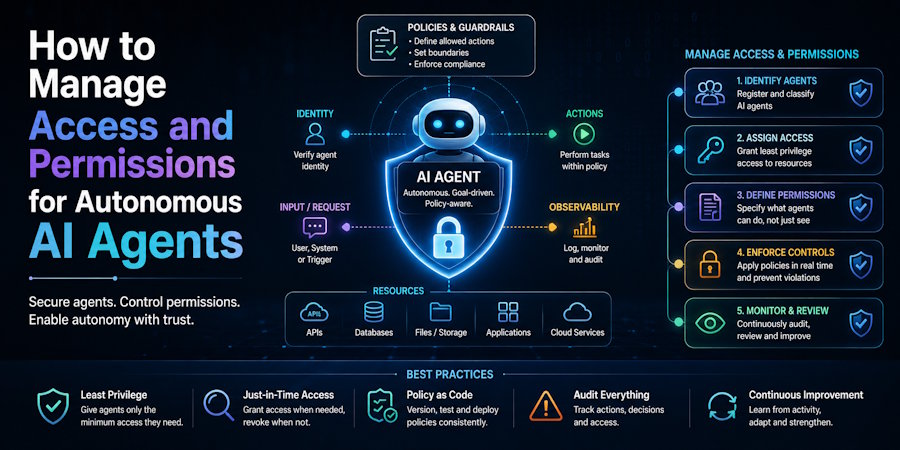
Autonomous AI agents can do far more than answer questions. They can retrieve records, call APIs, update databases, send messages, execute workflows, and interact with other software with limited human intervention. That capability creates a fundamental security challenge: an organization must control not only who or what an agent is, but also exactly what it can access and which actions it can perform.
Traditional identity and access management practices provide an important foundation, but autonomous agents introduce new complications. Their behavior can change according to prompts, retrieved information, connected tools, and runtime conditions. As a result, permissions that appear reasonable during deployment can become excessive when an agent encounters a different task. Effective access management therefore requires narrowly scoped identities, contextual authorization, continuous monitoring, and rapid revocation mechanisms.
Give Every Autonomous Agent a Distinct, Verifiable Identity
The first step in controlling an autonomous agent is establishing a unique identity. Treating multiple agents as one shared service account makes accountability difficult because security teams cannot reliably determine which agent performed a particular action. A compromised credential can also provide access far beyond what any individual agent requires.
Each agent should instead have an identifiable machine identity associated with a defined purpose and accountable owner. Credentials should preferably be short-lived or otherwise tightly controlled rather than relying indefinitely on static API keys. This approach makes authentication more attributable and provides a foundation for authorization decisions.
The network access provider describes AI agents as non-human identities that require access controls comparable to those applied to users and devices, while recognizing that agents operate at considerably greater speed and scale.
Identity alone, however, does not determine what an agent should be allowed to do. Authentication answers the question of who is making a request; authorization determines whether that particular request should succeed.
Apply Least Privilege at the Tool and Action Level
Least privilege is particularly important for autonomous agents because an agent can potentially chain several actions together. Giving an agent broad access simply because it might need that access someday increases the consequences of an error, compromised credential, or malicious instruction.
Permissions should therefore be tied to the agent's actual function. A customer-support agent that summarizes tickets may need read access to a particular ticket system but have no reason to modify financial records. Likewise, an analytics agent might need access to selected datasets without having permission to delete, alter, or export them.
Guidance from Portnox emphasizes applying least privilege at a granular level, with permissions scoped to individual tools, resources, and actions rather than broad service-level access. This approach helps ensure that an agent can perform the tasks it was designed for without automatically inheriting unnecessary capabilities that could increase the impact of misuse or compromise. A practical permission model should therefore answer several questions before an agent is deployed:
- Which applications and data can the agent access?
- Which specific operations can it perform?
- Which resources are explicitly outside its scope?
- Under what conditions can elevated access be granted?
- How quickly can permissions be revoked?
This model also helps organizations identify permission creep. As an agent's purpose changes, its access should be reduced or redesigned rather than allowing old privileges to accumulate indefinitely.
Use Context-Aware Authorization Instead of Static Roles
Role-based access control remains useful for predictable workloads, but autonomous agents are not always predictable. The same agent may make different tool calls depending on the user's request, information retrieved during execution, or the results of previous actions. Consequently, assigning a fixed role may not provide enough control.
A stronger model evaluates contextual information whenever an agent requests access. Identity, resource, requested action, device or workload posture, location, risk signals, and other relevant attributes can influence the authorization decision. Policy-based controls can then enforce centralized rules consistently across applications and environments.
Just-in-time access is particularly valuable for sensitive operations. Instead of permanently granting an agent permission to modify a production database, an organization can require narrowly defined, time-limited authorization for a specific task. Once the task or approved period ends, the privilege expires automatically.
On-behalf-of delegation requires similar caution. When an agent acts for a human user, simply inheriting that user's complete permission set can create unnecessary exposure. The delegated identity should be restricted to the specific resources and operations required for the agent's task. A successful user authentication should never become a blank check for autonomous activity.
Enforce Zero Trust Across Agent Connections
Network and application boundaries provide another important layer of control. An authenticated agent should not automatically receive broad access to an internal network. Instead, access should be limited to the applications, APIs, and data sources required for its assigned function.
A Zero Trust approach treats every access request as something that must be evaluated rather than assuming that an authenticated agent is trustworthy indefinitely. Portnox highlights Network Access Control and Zero Trust Network Access as enforcement mechanisms that can restrict agents to authorized applications and resources instead of exposing entire networks.
This distinction matters when an agent is compromised. If an attacker gains control of an agent with broad network connectivity, the compromised identity may become a pathway into unrelated systems. Application-level segmentation and narrowly defined connections reduce that potential blast radius.
Zero Trust should also extend beyond initial authentication. Authorization decisions may need to be reassessed when the agent's context changes, especially during long-running workflows. An access token issued earlier should not automatically justify every subsequent action if risk, posture, requested resource, or behavior has changed.
Monitor Agent Activity and Review Permissions Continuously
Access management does not end when permissions are granted. Autonomous agents can operate continuously and generate activity at a scale that makes manual oversight impractical. Comprehensive logging is therefore essential.
Security teams should record authentication events, authorization decisions, tool calls, data access, administrative changes, and significant workflow actions. Logs should identify the specific agent rather than merely showing a generic service account. This creates an audit trail that can support incident investigation and compliance requirements.
Behavioral monitoring can provide an additional layer of protection. For example, an agent normally limited to reading customer tickets might suddenly attempt to access payroll data or make administrative changes. Such deviations should trigger investigation, additional verification, or automatic blocking according to organizational policy.
Permission reviews should occur on a defined schedule and whenever an agent's purpose changes. Old credentials should be revoked, unused permissions removed, and ownership information kept current. The goal is to prevent access from silently expanding as integrations and workflows evolve.
Build Access Controls Into the Agent Lifecycle
Effective governance begins before an agent reaches production. Organizations should maintain an inventory of agents, document their owners and purposes, identify connected systems, and establish approved permission boundaries. Security teams should also account for agents created outside formal IT processes, since unmanaged or "shadow" agents can otherwise bypass established controls.
During development, broad permissions may sometimes be necessary for testing, but those permissions should not automatically follow the agent into production. Production credentials, network paths, and data access should be deliberately constrained before deployment.
Revocation must also be treated as a standard lifecycle capability. An agent may need to be disabled because its purpose has changed, its credentials are suspected of compromise, or its behavior violates established policies. The organization should be able to terminate access quickly without depending on a lengthy manual process.
Final Analysis
Managing autonomous AI agents requires a shift from simply authenticating machine identities to continuously governing what those identities can do. Unique identities, least-privilege permissions, contextual authorization, Zero Trust connectivity, detailed monitoring, and recurring access reviews work together to create meaningful control.
The central principle is straightforward: an agent should receive only the access required for a specific purpose, under defined conditions, and for only as long as that access is justified. As autonomous systems become more capable, treating permissions as dynamic security decisions rather than permanent credentials will be essential to keeping their benefits from becoming an unmanaged source of organizational risk.

