

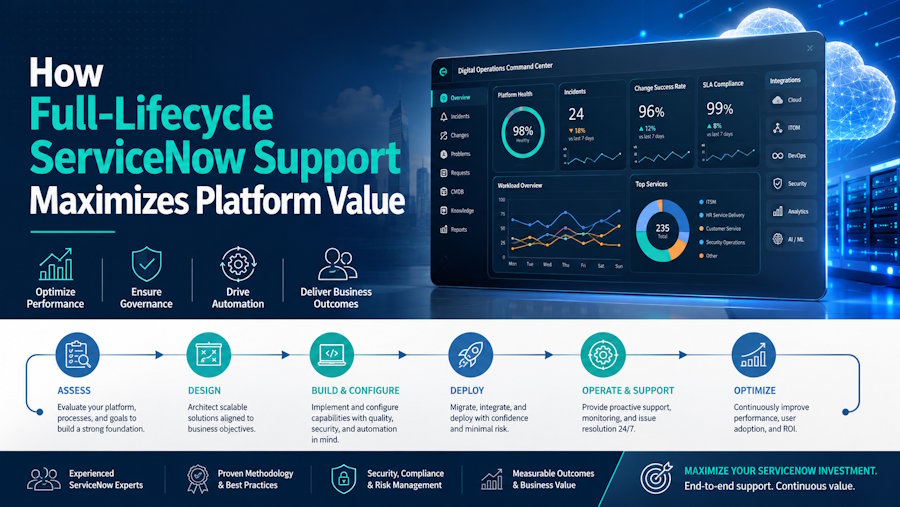
ServiceNow can become a central platform for managing IT services, workflows, employee experiences, customer operations, and other business processes. However, the value of the platform depends on more than completing an initial implementation. Organizations also need effective adoption, ongoing optimization, governance, integration management, and support as business requirements change. Without that continuity, even a well-designed ServiceNow environment can become difficult to maintain or gradually drift away from operational needs. Full-lifecycle support addresses this challenge by connecting implementation decisions with long-term platform management. Instead of treating deployment as the finish line, it views ServiceNow as an evolving business capability that requires attention throughout its useful life.
Building a Strong Foundation During Implementation
Implementation establishes the technical and operational foundation on which future ServiceNow performance depends. This stage involves more than configuring workflows and applications. Teams must understand existing processes, identify opportunities for standardization, define appropriate roles and permissions, plan integrations, and establish governance before large-scale deployment.
An end-to-end ServiceNow services approach helps organizations make these decisions with future operations in mind. Configuration choices should be maintainable, upgrades should be considered early, and customizations should have a clear business justification. Excessive customization can create technical debt and increase the effort required to maintain the platform. Conversely, thoughtful use of standard capabilities can make future enhancements easier.
Implementation support should also include testing and knowledge transfer. Business users need opportunities to validate workflows before launch, while administrators require sufficient documentation and training to understand how the environment has been configured. This creates a more sustainable platform rather than one that depends entirely on the original implementation team.
Improving Adoption Through Continuous Support
A technically successful deployment does not automatically produce strong user adoption. Employees may avoid new workflows if they are confusing, poorly communicated, or disconnected from everyday responsibilities. Adoption therefore needs to be treated as an ongoing operational objective rather than a one-time training exercise.
End-to-end ServiceNow services can help organizations monitor how the platform is being used and identify areas where users encounter friction. Feedback from service desk personnel, managers, administrators, and business users can reveal where workflows need clarification or refinement. Small improvements can have a meaningful effect when they remove unnecessary steps from frequently used processes.
Effective adoption also depends on communication. Users should understand why processes are changing, what is expected of them, and how ServiceNow supports their work. Training can then focus on relevant tasks instead of overwhelming employees with technical details.
Several practices can strengthen adoption over time:
- Provide role-specific training and practical documentation.
- Monitor recurring support requests for evidence of usability problems.
- Gather structured feedback after major workflow changes.
- Communicate important platform updates before they affect users.
- Review unused or underused capabilities to determine whether they need redesign.
This continuous feedback loop helps turn ServiceNow from a system employees are required to use into a platform that supports consistent business processes.
Maximizing Long-Term Platform Performance
ServiceNow environments rarely remain static. Organizations add applications, integrate new systems, change organizational structures, introduce new compliance requirements, and revise operational processes. Consequently, a platform that performs well immediately after implementation may require substantial adjustment several years later.
Maintaining a ServiceNow environment over time requires more than resolving individual incidents or configuration issues. Organizations seeking full ServiceNow lifecycle support can benefit from an approach that spans strategy, implementation, integration, adoption, optimization, and ongoing managed services. This broader model helps ensure that workflows, integrations, and platform capabilities continue to align with changing business requirements rather than gradually becoming outdated or difficult to maintain.
Regular platform reviews are especially important. Administrators and stakeholders can examine whether workflows still reflect actual business practices, whether integrations remain reliable, and whether custom configurations continue to justify their maintenance costs. They can also evaluate new platform capabilities against genuine business requirements rather than adopting features simply because they are available.
Upgrade planning is another important consideration. ServiceNow releases introduce changes that can affect configurations, integrations, applications, and user experiences. A structured support model can prepare environments for these changes through impact assessment, testing, remediation, and post-release validation. This reduces disruption while helping organizations take advantage of relevant improvements.
Strengthening Governance, Security, and Scalability
Long-term platform value also depends on disciplined governance. As more teams use ServiceNow, configuration ownership can become complicated. Different departments may request overlapping workflows, inconsistent data structures, or custom solutions that solve short-term problems but create long-term maintenance challenges.
A governance framework establishes decision-making principles for these situations. It can define who approves changes, how configurations are documented, when customization is appropriate, and how competing priorities are resolved. Strong governance does not have to prevent innovation. Instead, it provides a structure for introducing change without compromising platform stability.
Security deserves similar attention. Roles and access permissions should reflect job responsibilities and follow the principle of least privilege. Organizations should periodically review access, monitor significant changes, and ensure that integrations are managed appropriately. These practices become increasingly important as ServiceNow connects with identity systems, enterprise applications, and other sources of business data.
Scalability should also be considered beyond infrastructure. A scalable platform needs processes that can accommodate new users, departments, workflows, and integrations without creating unnecessary complexity. Continuous architectural and operational reviews help organizations expand their use of ServiceNow while maintaining consistency.
Measuring Business Value Beyond Technical Metrics
Platform success should ultimately be evaluated in business terms. Technical stability matters, but organizations also need to understand whether ServiceNow is improving service delivery, reducing manual work, accelerating processes, or creating better visibility into operations.
Useful measurements vary by implementation. Organizations might examine service resolution times, workflow completion rates, automation levels, employee satisfaction, request volumes, or the percentage of processes handled through standardized workflows. Comparing these measures over time can reveal whether platform investments are producing practical improvements.
Importantly, measurement should not become a collection of disconnected dashboards. Metrics should relate to clearly defined operational objectives. If an organization wants to reduce manual approvals, for example, it should measure both automation progress and the resulting effect on processing time. This creates a clearer connection between platform activity and business outcomes.
Professional support can provide additional perspective when internal teams need assistance with complex changes, optimization initiatives, or evolving platform requirements. The most effective model complements internal knowledge rather than replacing it. Internal stakeholders retain ownership of business priorities while experienced specialists can contribute technical expertise and structured methodologies when appropriate. ServiceNow services from SDI Presence
Sustaining Value as the Platform Evolves
The strongest ServiceNow environments are managed as living platforms rather than completed projects. Their configurations evolve with business needs, users receive continued guidance, governance adapts as adoption expands, and performance is reviewed against meaningful objectives.
This lifecycle perspective also encourages organizations to distinguish between necessary maintenance and strategic improvement. Routine support keeps operations dependable, while periodic optimization ensures the platform continues to solve relevant business problems. Together, these activities reduce the risk of stagnation and help preserve the value of earlier implementation investments.
End Note
ServiceNow can deliver substantial operational value when implementation, adoption, governance, optimization, and ongoing support are treated as connected responsibilities. Full-lifecycle management provides the continuity needed to keep the platform aligned with changing processes and organizational priorities. Rather than measuring success solely by whether an implementation went live, organizations can evaluate how effectively the platform continues to support people, processes, and measurable business outcomes over time. That long-term perspective is what turns ServiceNow from a technology deployment into a durable operational capability.

