

Autonomous AI agents are no longer experimental tools confined to research labs. They now schedule meetings, query databases, execute code, move money, and make decisions that used to require a human in the loop. That shift brings real productivity gains, but it also introduces a class of security problems that traditional application security frameworks were never built to handle. An agent that can reason, plan, and take action on its own behalf is a fundamentally different attack surface than a static web form or API endpoint.
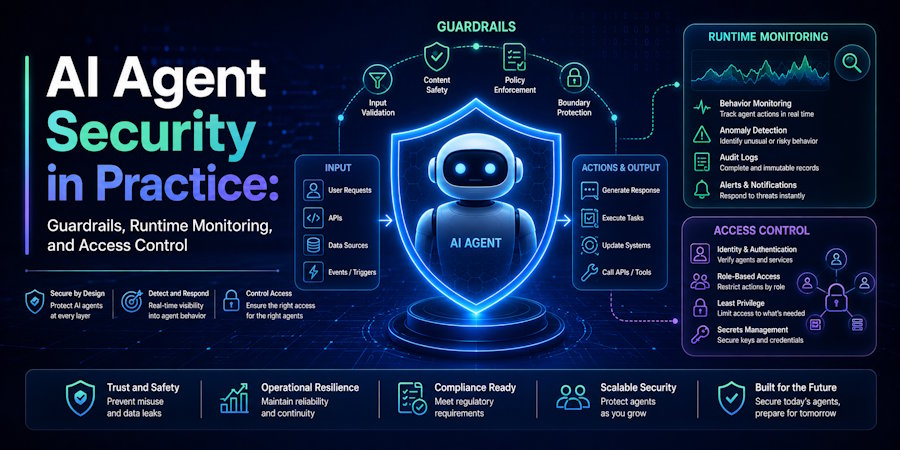
This article looks at how organizations are approaching AI agent security today, focusing on three practical pillars: guardrails, runtime monitoring, and access control. Vendors in this space, including companies like Noma Security, have built tooling around these exact problems, and their approaches offer a useful lens for understanding what agent security looks like in practice, not just in theory.
Why Agents Break Traditional Security Models
Conventional security tooling assumes predictable inputs and outputs. A user submits a form, the application validates it, and a database returns a result. AI agents disrupt that assumption in a few ways:
- They generate their own instructions mid-task, often based on content pulled from external sources (a webpage, an email, a document) that the agent didn't originate and can't fully verify.
- They chain multiple tool calls together, meaning a single compromised step can cascade into unintended actions several steps later.
- They often operate with standing credentials or API keys that were provisioned for convenience rather than least-privilege access.
- Their behavior is probabilistic, not deterministic, so the same prompt can yield different action sequences on different runs.
This is why prompt injection has become one of the most discussed risks in the field. Research from groups studying large language model security has repeatedly shown that adversarial text embedded in a document, webpage, or even an image can hijack an agent's reasoning and cause it to perform actions the user never requested. Unlike a SQL injection attack, which exploits a parsing flaw, prompt injection exploits the model's core function: following instructions written in natural language.
Guardrails: The First Line of Defense
Guardrails are rules and filters applied before, during, or after an agent's reasoning process. They are not a silver bullet, but they reduce the frequency and severity of bad outcomes. In practice, guardrails tend to fall into three categories:
- Input guardrails — screening incoming content (user prompts, retrieved documents, tool outputs) for injection patterns, malicious code, or policy violations before the agent processes them.
- Output guardrails — checking what the agent produces or intends to do before it's executed, such as blocking an agent from sending an email to an external domain that wasn't in its original task scope.
- Behavioral guardrails — constraining the agent's action space entirely, so certain tool calls (like deleting a production database) simply aren't available regardless of what the model decides.
The challenge with guardrails is that they need to be specific enough to catch real threats without being so rigid that they block legitimate work. Overly aggressive filtering leads teams to disable protections out of frustration, which defeats the purpose. Effective guardrail design usually involves iterative tuning based on observed agent behavior rather than a one-time policy write-up.
Runtime Monitoring: Watching What Agents Actually Do
Guardrails address known risks, but agents frequently do things nobody anticipated. This is where runtime monitoring comes in, the practice of observing an agent's actions, tool calls, and decision paths as they happen, rather than only reviewing logs after an incident.
Effective runtime monitoring for agents generally tracks:
- Which tools and APIs the agent invoked, and in what sequence
- Whether the agent's actions matched its stated task or drifted into unrelated territory
- Anomalies compared to the agent's typical behavioral baseline
- Data flows — specifically, whether sensitive information moved somewhere it shouldn't have
Platforms built for this purpose, such as Noma Security, combine runtime monitoring with guardrails and threat detection to give security teams visibility into agent behavior as it occurs rather than relying solely on post-incident log analysis. This matters because agent-related incidents can unfold in seconds. A single malicious tool call can expose data or trigger an unwanted transaction long before a human reviewer notices a log entry. The faster an anomaly is detected, the smaller the potential blast radius of a compromised agent session.
It's worth noting that monitoring alone doesn't prevent harm, it shortens the time between something going wrong and someone finding out. Pairing monitoring with automated circuit breakers, such as halting an agent session when it attempts an out-of-policy action, is what turns visibility into actual protection.
Access Control: Limiting What an Agent Can Touch
Perhaps the most foundational, and most frequently underbuilt, layer of agent security is access control. Many organizations still grant agents broad, standing permissions because scoping access precisely takes more upfront engineering work. This is a mistake with a long history in security: the same principle-of-least-privilege lessons learned from human account management apply directly to agents, arguably with higher stakes given how fast agents can act.
Sound access control for agents typically includes:
- Scoped, task-specific credentials that expire after a session rather than persisting indefinitely
- Separation between an agent's read and write permissions, so information retrieval doesn't automatically imply the ability to modify data
- Human approval checkpoints for high-impact actions, such as financial transfers or irreversible deletions
- Clear audit trails tying every agent action back to a specific session, task, and credential
Organizations working with frameworks similar to those from Noma Security often describe access control as the layer that limits damage even when guardrails and monitoring fail, because no detection system is perfect, and a compromised agent with narrow permissions can only do narrow damage.
Putting the Pieces Together
None of these three pillars work well in isolation. Guardrails without monitoring mean you have no way to know when guardrails are being circumvented. Monitoring without access control means you can watch an incident unfold but can't limit its impact. Access control without guardrails means you're relying entirely on permission boundaries to catch problems that better filtering could have stopped earlier.
A layered approach, sometimes called defense in depth in traditional security circles, remains the most defensible strategy for agent deployments handling anything sensitive. Security teams evaluating this space, whether building in-house tooling or evaluating vendors, tend to ask the same core question: if this agent were compromised or simply made a bad decision right now, what's the worst thing it could do, and how quickly would we know?
Final Analysis
AI agent security is still a young discipline, and best practices are evolving as fast as the agents themselves. What's clear so far is that guardrails, runtime monitoring, and access control each address a different failure mode, and skipping any one of them leaves a meaningful gap. Organizations don't need to solve every problem on day one, but they do need a realistic inventory of what their agents can access, what they're doing in production, and what happens when something goes wrong. That groundwork — more than any single tool or vendor — is what determines whether an agent deployment is resilient or fragile under pressure.

