

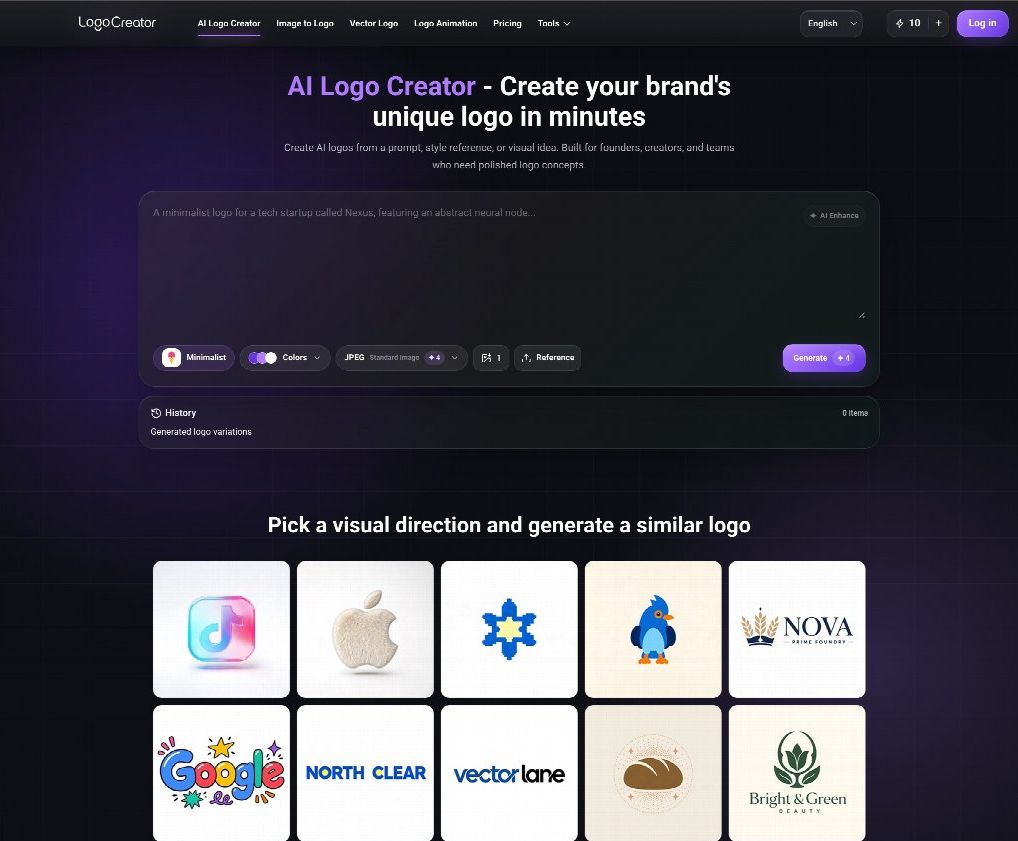
Early brand work is often described as a visual problem, but the first obstacle is usually interpretive. A founder may have a rough phrase, a mood board, a product photograph, and a half-formed description of the people they want to reach. Turning those fragments into a useful direction requires more than producing attractive symbols. It requires an AI Logo Creator workflow for comparing signals, naming choices, and learning what survives contact with real constraints. That is where an AI Logo Creator can become part of the thinking process rather than a last-minute decoration.
The important shift is not that software can make more options. It is that multimodal systems can let a team begin with different kinds of evidence and translate them into a common visual conversation. The team still owns the judgment. The tool helps make that judgment faster, more explicit, and easier to revise.
The brief is becoming a collection of signals
Traditional logo briefs tend to privilege written language. That is convenient for documentation, but it can flatten the useful ambiguity in an early idea. A founder might say “quiet confidence” while pointing to a rough interface, a material sample, or an image of a particular street. Those references carry information that a paragraph may fail to preserve.
An AI Logo Creator can help the team put these signals beside one another. A short phrase can establish the business promise, an image can suggest texture or proportion, and a few exclusions can prevent the AI Logo Creator exploration from drifting toward familiar category cliches. The result is not a finished brief. It is a more inspectable starting set for the AI Logo Creator. That AI Logo Creator context keeps the source material visible during review.
Separate the source from the interpretation
The team should record which part of an idea came from the source material and which part is an interpretation. “Rounded forms” might be visible in a reference image, while “friendly” is the team's reading of those forms. Keeping those layers separate prevents a generated direction from becoming an unquestioned fact.
This distinction also makes feedback more useful. Instead of saying that a direction “feels wrong,” a reviewer can ask whether the issue is the source, the interpretation, or the way the two were translated into a mark. An AI Logo Creator is most helpful when the AI Logo Creator process makes those questions easier to ask.
Exploration needs a comparison structure
More alternatives do not automatically produce better decisions. Without a comparison structure, a team can mistake novelty for relevance or keep selecting the most polished option at first glance. A disciplined session defines a small set of criteria before the first review: recognition at small sizes, relationship to the product category, room for future applications, and the emotional emphasis the brand actually wants to own.
The team can then use an AI Logo Creator to generate or organize directions around one variable at a time. One round may change the symbol family while holding the tone steady. Another may test a different balance of wordmark and icon. A third may examine whether the idea still works when color is removed. This AI Logo Creator round is closer to a visual experiment than a gallery browsing session.
Use controlled variation, not random abundance
Controlled variation gives every round a reason. If the first direction explores compact geometric forms, the next could test a more open structure with the same level of visual restraint. If the first version relies on a literal object, the next could explore an abstract cue linked to the same customer need. The goal is not to force a winner; it is to reveal which design decisions are carrying meaning.
A useful review sheet can give each direction a short label, a hypothesis, and one unresolved question. For example, a direction might be labeled “calm utility,” hypothesize that low contrast communicates reliability, and ask whether the shape remains distinctive without its color treatment. An AI Logo Creator makes the AI Logo Creator loop useful when the team treats each output as evidence for a question.
Multimodal input does not replace brand judgment
There is a temptation to treat multimodal capability as an objective interpreter of a founder's intent. It is not. Images contain cultural associations, words contain local meanings, and visual conventions can be read differently by different audiences. A generated direction may faithfully combine the inputs while still making an inappropriate assumption about the people who will encounter it.
That is why an AI Logo Creator should sit inside a review practice that includes human context. Ask what the mark suggests to an unfamiliar viewer, what it might accidentally resemble, and which part of the story is doing too much work. When a team cannot explain why a direction is relevant without pointing to the AI Logo Creator generation process, it probably needs another round of reasoning.
Test recognition before polishing
Early testing should be deliberately unglamorous. Show a small, neutral version for a few seconds. Ask viewers what they remember, what category they infer, and which detail they noticed first. Do not lead them with the brand story. The gap between intended meaning and observed meaning is often more valuable than another refinement pass.
An AI Logo Creator can make this test easier by helping the team produce comparable versions quickly. The test should still evaluate the idea, not the AI Logo Creator. A direction that only works when explained at length is a weak candidate for a mark that must travel across interfaces, packages, and social contexts.
Turn the exploration into a reusable decision record
The most durable output of early ideation is not a single image. It is a record of the decisions that made one direction more appropriate than another. Keep the original signals, the criteria used for review, the rejected assumptions, and the tests that changed the team's view. This record protects the brand from starting over whenever a new stakeholder joins.
It also changes how the team uses an AI Logo Creator over time. A later session can begin with lessons from the first one rather than repeating the same broad search. The AI Logo Creator becomes a way to explore a bounded design space, compare hypotheses, and expose weak reasoning before the cost of change rises.
The best early-stage workflow is therefore neither fully manual nor fully automated. It combines human framing, multimodal exploration, controlled comparison, and small-scale observation. When the team keeps those roles clear, an AI Logo Creator helps turn scattered inspiration into a sequence of decisions that a growing brand can understand and defend. The AI Logo Creator session remains a means of reasoning, not a substitute for it.
The starting point for that AI Logo Creator process is an AI Logo Creator used as a visual thinking partner, with the final direction earned through evidence rather than accepted because it was generated.

