

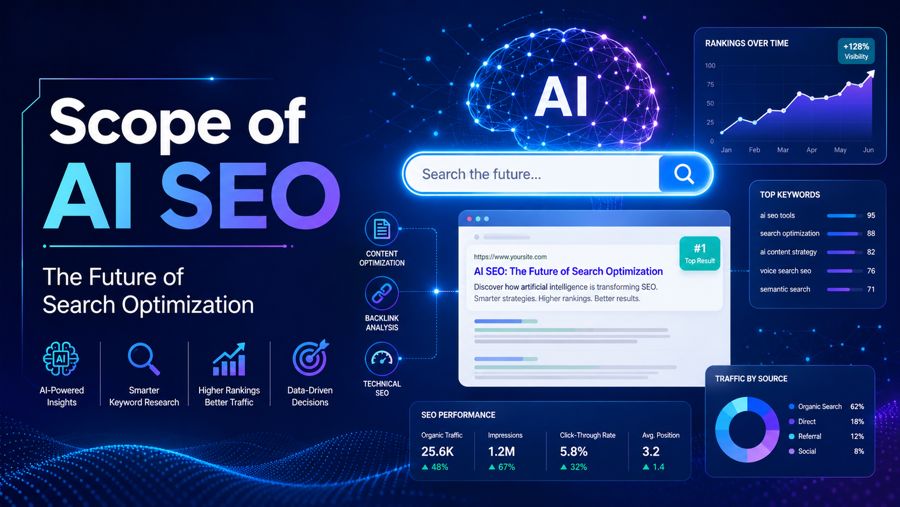
Search engines are evolving rapidly, and artificial intelligence is changing the way people discover, evaluate, and consume information online. Traditional SEO focused heavily on keywords, backlinks, technical optimization, and search rankings. Today, businesses must also consider how AI systems understand content, identify trustworthy information, and generate answers for users.
This emerging approach is commonly described as AI SEO. It combines traditional search engine optimization with artificial intelligence, semantic understanding, automation, data analysis, and optimization for AI-powered search experiences. The scope of AI SEO is expanding quickly, creating new opportunities for businesses, marketers, content creators, and SEO professionals.
What Is AI SEO?
AI SEO refers to the use of artificial intelligence in the process of improving a website's visibility across search engines and AI-driven discovery platforms. It can involve using AI tools to research topics, identify search intent, analyze competitors, optimize content, detect technical issues, and predict changes in search behavior.
At the same time, AI SEO is not simply about producing large amounts of AI-generated content. Its broader purpose is to make information more relevant, understandable, useful, trustworthy, and discoverable by both traditional search engines and AI systems.
Why Is AI SEO Becoming Important?
Search behavior is moving beyond traditional lists of blue links. Users increasingly expect direct answers, conversational results, summaries, recommendations, and personalized information.
AI-powered search systems can interpret the meaning behind a query rather than relying only on exact keyword matches. As a result, websites need to create content that clearly addresses topics, questions, entities, and user intent.
This creates a significant shift in SEO. Instead of asking only, "How can I rank for this keyword?" marketers increasingly need to ask, "How can I become a reliable source for this topic?"
Major Areas of AI SEO
1. AI-Powered Keyword and Topic Research
AI can process large amounts of search and content data to identify keyword relationships, emerging topics, long-tail queries, and patterns in user intent.
Rather than targeting isolated keywords, SEO professionals can use AI to build comprehensive topic clusters. This allows websites to cover a subject from multiple perspectives and address the questions users are likely to ask.
2. Search Intent Analysis
Understanding search intent is one of the most important areas of modern SEO.
AI can classify queries according to different purposes, such as informational, commercial, navigational, or transactional intent. It can also analyze the language used in queries to determine what users actually want.
For example, a search for "best laptops for students" suggests comparison and purchasing research, while "how to clean a laptop screen" indicates informational intent. Content designed around these different intentions is more likely to satisfy users.
3. Intelligent Content Optimization
AI can help analyze existing content and identify opportunities to improve structure, readability, topical coverage, and relevance.
However, successful AI SEO requires more than automatically generating articles. High-quality content should demonstrate expertise, provide original insights, use reliable information, and offer genuine value to readers.
Human expertise combined with AI-assisted optimization can therefore become a powerful content strategy.
4. Optimization for AI Search and Answer Engines
One of the most significant developments in AI SEO is optimization for systems that generate answers rather than simply displaying traditional search results.
AI systems may extract information from multiple sources to formulate an answer. This makes it increasingly important for websites to present information clearly and logically.
Well-structured headings, concise explanations, factual statements, descriptive language, and strong topical relevance can make content easier for automated systems to understand.
5. Semantic SEO
AI systems are becoming better at understanding relationships between words, concepts, entities, and topics.
Consequently, modern SEO is moving away from excessive keyword repetition toward semantic relevance.
A page about digital marketing, for example, may naturally discuss SEO, content marketing, analytics, search intent, backlinks, conversion rates, and audience research. These related concepts help establish the overall context of the page.
6. Automated SEO Audits
AI can analyze websites at scale and identify potential technical and content-related problems.
It can assist with finding broken links, duplicate content, missing metadata, weak internal linking, inconsistent headings, slow pages, and other optimization opportunities.
Automation can reduce the time SEO teams spend on repetitive analysis and allow them to focus more heavily on strategy.
The Role of AI in Local SEO
AI SEO also has considerable potential in local search.
Businesses can use AI to analyze local search trends, understand customer questions, optimize location-specific content, and identify opportunities for improving their online presence.
For local businesses, creating useful pages that clearly communicate services, locations, frequently asked questions, and customer needs can become increasingly important as AI-powered search becomes more conversational.
AI SEO and E-Commerce
E-commerce is another area where AI SEO has a broad future.
AI can help online stores optimize product descriptions, understand customer search patterns, organize product information, identify content gaps, and improve product discovery.
As consumers increasingly use conversational queries to research products, businesses will need to provide detailed and accurate product information rather than relying solely on short keyword-focused descriptions.
Future Career Scope of AI SEO
The growth of AI SEO is likely to create new opportunities for professionals with a combination of SEO, content, data, and AI skills.
Potential roles include:
- AI SEO specialist
- SEO strategist
- AI content strategist
- Search data analyst
- Technical SEO specialist
- Content optimization specialist
- AI search visibility consultant
- Digital marketing strategist
The most valuable professionals will not necessarily be those who simply know how to operate AI tools. They will be those who understand why a strategy works, can evaluate AI-generated outputs, and can combine automation with human judgment.
Benefits of AI SEO for Businesses
AI SEO can provide several advantages:
Faster Research
AI can process large volumes of information much faster than manual research, helping marketers identify trends and opportunities.
Better Content Planning
AI can uncover related questions and topics, allowing businesses to create more comprehensive content strategies.
Greater Efficiency
Repetitive SEO tasks can be automated, reducing workload and allowing teams to concentrate on creative and strategic activities.
Improved Personalization
AI can help businesses understand different audience segments and create content that addresses their specific needs.
Data-Driven Decision Making
AI can identify patterns within large datasets, helping businesses make SEO decisions based on evidence rather than assumptions.
Challenges of AI SEO
Despite its potential, AI SEO also presents challenges.
One major concern is the production of generic or inaccurate content. If businesses depend entirely on automation, their websites may become repetitive and fail to provide original value.
Another challenge is the rapidly changing nature of AI-powered search. Search platforms are continually developing their algorithms and interfaces, meaning SEO strategies must remain flexible.
There are also important concerns surrounding factual accuracy, originality, transparency, privacy, and responsible use of AI.
For these reasons, human oversight remains essential.
AI SEO vs. Traditional SEO
Traditional SEO is not disappearing. Instead, it is becoming part of a broader search optimization ecosystem.
Technical SEO, backlinks, website performance, keyword research, internal linking, and quality content remain important. AI SEO adds another layer by focusing on semantic understanding, automation, user intent, machine-readable information, and visibility within AI-powered search experiences.
The future is therefore less about AI replacing SEO and more about AI expanding what SEO can accomplish.
The Future Scope of AI SEO
The future of AI SEO is likely to become increasingly sophisticated. Search engines and AI assistants may become better at understanding conversations, context, preferences, and complex questions.
Businesses that want to remain visible will need to build strong digital authority rather than relying on individual keywords alone.
The focus is likely to move toward:
- Topical authority
- First-hand expertise
- Trustworthy information
- Structured and understandable content
- Strong technical foundations
- User experience
- Original research and insights
- Optimization across traditional and AI-powered search
In this environment, the strongest SEO strategy will be one that serves both people and intelligent search systems.
Conclusion
The scope of AI SEO is much broader than automated content creation. It represents a major evolution in how businesses approach search visibility, content strategy, data analysis, and online discovery.
AI can make SEO faster, more analytical, and more scalable, while human expertise provides originality, judgment, credibility, and strategic direction. Businesses that successfully combine these strengths will be better positioned to adapt as search continues to evolve.
Ultimately, the future of SEO will not belong solely to those who use AI. It will belong to those who use AI intelligently while continuing to create genuinely useful experiences for people.

