

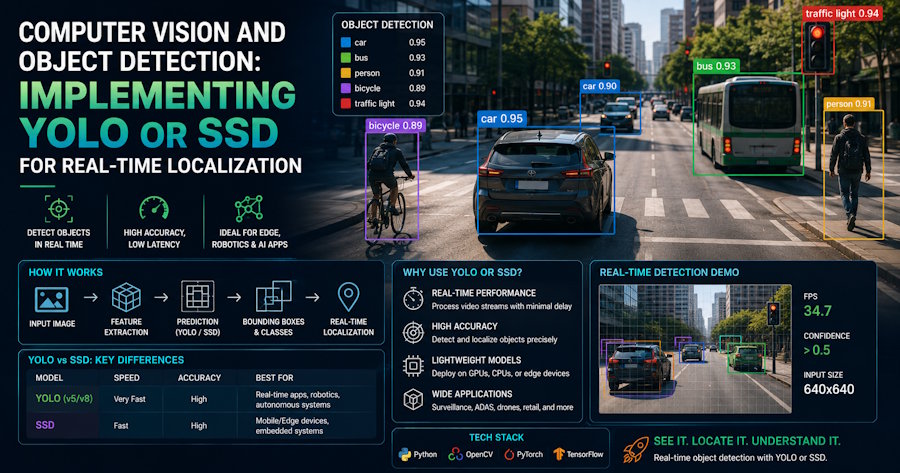
Computer vision has become one of the most practical branches of artificial intelligence because it allows machines to interpret images and video in ways that support real-world decisions. One of its most important applications is object detection, where a system not only identifies what is present in an image but also locates it using bounding boxes. This capability is widely used in traffic monitoring, retail analytics, autonomous systems, security surveillance, healthcare imaging, and industrial inspection.
Among the many object detection models, YOLO and SSD are especially well known for real-time performance. Both models are designed to detect and localise objects quickly, which makes them suitable for applications where speed matters as much as accuracy. For learners exploring an AI course in Bangalore, understanding how these models work offers a strong foundation in practical computer vision and deployment-focused AI development.
What Makes Object Detection Different from Image Classification
Image classification tells us what an image contains as a whole. For example, a model may classify an image as containing a car, a dog, or a pedestrian. Object detection goes a step further. It identifies multiple objects within the same image and marks their locations with bounding boxes. This makes the output more useful in dynamic environments where systems need to respond to what is happening in specific regions of a frame.
For instance, in a traffic monitoring system, it is not enough to know that a road scene contains vehicles. The system must identify how many vehicles are present, where they are located, and whether they are moving into restricted zones. This is why object detection is a more advanced and operationally valuable task than simple classification.
Real-time object detection adds another requirement. The model must process incoming frames quickly enough to support continuous decision-making. This is where YOLO and SSD have become important because both are built to balance speed and detection quality.
Understanding YOLO and SSD for Real-Time Detection
YOLO, which stands for You Only Look Once, is designed to detect objects in a single pass through the image. Instead of applying separate stages for region proposal and classification, YOLO predicts bounding boxes and class probabilities directly from the input image. This design makes it very fast and suitable for live video analysis. Over time, different YOLO versions have improved both speed and accuracy, making the model popular in production environments.
SSD, or Single Shot MultiBox Detector, follows a similar principle of single-pass detection but uses feature maps at multiple scales to detect objects of different sizes. This helps SSD perform well when images contain both large and small objects. SSD is also known for being relatively efficient and easier to integrate into systems that need quick inference.
The main idea behind both models is that they avoid the slower two-stage process used by earlier object detection methods. Because of this, they are commonly chosen for applications such as CCTV analytics, warehouse automation, smart cameras, and robotics.
Steps Involved in Implementing Real-Time Object Localization
Implementing object detection with YOLO or SSD usually begins with dataset preparation. A dataset for object detection must include images along with annotations that define the position and class of each object. These annotations are typically stored as bounding box coordinates and category labels. Good quality data is essential because inaccurate labels can reduce the performance of the model.
Once the dataset is ready, the next step is model training or fine-tuning. In many cases, teams start with a pre-trained YOLO or SSD model and adapt it to a specific use case. This approach saves time and requires less data than training from scratch. For example, a retail system may fine-tune a model to detect shopping carts, shelves, and product categories, while a traffic system may focus on cars, buses, bikes, and pedestrians.
After training, the model is evaluated using measures such as precision, recall, and mean average precision. These metrics help determine whether the detector is identifying objects correctly and locating them accurately. In real-time systems, inference speed is also critical. A model that is highly accurate but too slow may not be suitable for production.
The final stage is deployment. The model may run on a cloud server, edge device, embedded system, or GPU-powered machine depending on the application. Deployment decisions often involve trade-offs between speed, hardware cost, and accuracy.
Key Challenges in Real-Time Object Detection
Although YOLO and SSD are powerful, real-world object detection is not without challenges. Lighting changes, occlusion, motion blur, background clutter, and small object size can all reduce detection quality. For example, detecting a distant pedestrian in low light is much harder than detecting a parked car in a clear daytime scene.
Another challenge is balancing speed and accuracy. Lightweight models can process frames faster but may miss fine details. Larger models may detect objects more accurately but require stronger hardware and more latency. Teams need to choose the right version of YOLO or SSD based on the application’s constraints.
Model bias and dataset diversity also matter. If the training data does not represent real deployment conditions, the model may perform poorly when exposed to new environments. This is why careful data collection and testing are just as important as model selection.
These practical considerations are often explored in an ai course in bangalore, where learners move beyond theory and study how AI systems behave under operational constraints.
Conclusion
Computer vision and object detection have become essential for systems that need to interpret and respond to visual data in real time. YOLO and SSD are two important models in this space because they enable fast and practical object localisation without relying on slow multi-stage pipelines.
By understanding how these models process images, how they are trained, and how they are deployed, developers can build systems that detect objects efficiently in real-world settings. As industries continue to adopt vision-based automation, knowledge of YOLO and SSD remains highly relevant for anyone interested in applied artificial intelligence and intelligent visual systems.

