

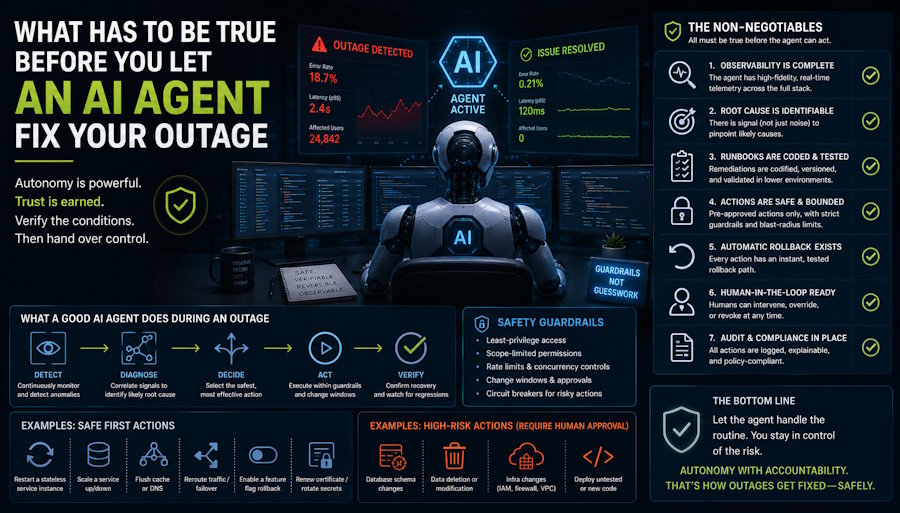
For years the promise of AI in IT operations was that it would help engineers see problems faster. Now the promise has moved. The pitch is no longer detection or diagnosis. It is action. Agents that notice an outage, work out what caused it, and fix it, all without waking anyone up.
It is a compelling idea, and it is closer than many operations teams realise. But there is a step the industry has skipped over on the way to it.
An agent that takes action is only as safe as the information it acts on. Give it a partial view and a stream of false alarms, and you have not removed human error from the process. You have automated it, and you have made it faster.
So before any organisation hands an agent the authority to change a live production system, five things have to be true. Get them right and autonomy becomes a genuine advantage. Skip them and you have built a quicker way to cause damage.
1. The agent can see the whole system, not slices of it
Most monitoring was built in pieces. One tool for infrastructure, another for applications, another for the network, and something separate again for what the customer actually experiences. Engineers spend a good part of every incident stitching those views together in their heads.
A person can hold that ambiguity and reason across the gaps. An agent cannot. It acts on the data in front of it. If that data covers only one layer, the agent diagnoses with one eye closed, and it acts with the same confidence whether the picture is complete or not.
Correlated visibility across the application, the infrastructure beneath it, the network between them and the experience at the edge is not a nice-to-have for autonomy. It is the precondition. Application performance monitoring that works across those layers, rather than reporting on each one in isolation, is what turns a partial view into a complete one. An agent that cannot see the whole system should not be trusted to change it.
2. The signal is clean enough to trust
Every operations team knows the feeling of an alert console that cries wolf. Most experienced engineers have quietly learned which alerts to believe and which to ignore.
That instinct does not transfer to a machine. An agent treats a false alarm with the same seriousness as a genuine failure, and it responds at machine speed. A team that has not done the work to separate signal from false positives is not ready to automate action on top of that signal. You would simply be acting on the wrong thing, faster.
The uncomfortable test is this. If your engineers do not trust your alerts today, an agent has no business acting on them tomorrow.
3. Diagnosis is causal, not just correlational
A dashboard can tell you that two things happened at the same time. It takes something more to tell you that one caused the other.
This distinction matters more with an agent than with a person. When a human sees a spike and a slowdown together, they investigate. When an agent sees the same pattern, and its logic is built on correlation rather than cause, it may act on a symptom and leave the actual fault untouched. The outage moves rather than resolves, and now it is harder to trace because an automated change sits on top of it.
Autonomous remediation is only as good as the root cause analysis underneath it. If the cause is a confident guess, the fix is a gamble.
4. The action space is bounded, reversible and able to escalate
Trust in autonomy does not come from giving an agent free rein. It comes from the opposite. The agents worth deploying operate inside clear limits.
That means a defined set of pre-approved actions rather than open-ended access. It means changes that can be rolled back. It means limits on how much of the estate a single automated action can touch, so that a mistake stays small. And it means a low-confidence threshold that hands the incident back to a human rather than pressing ahead.
Autonomy on a leash is not a weaker form of automation. It is the only responsible form of it. The goal is not an agent that can do anything. It is an agent that can do the right narrow things reliably, and knows when to stop and ask.
5. Every action is explainable, and a person stays accountable
When an agent makes a change, someone will eventually ask why. That question might come from an engineer the next morning, from a customer, or from a regulator.
In Australia this is no longer abstract. Under APRA's CPS 230, regulated entities in banking, insurance and superannuation are expected to maintain their critical operations through disruptions and to manage operational risk with clear accountability. The standard has been in force since July 2025. It does not accept "the agent did it" as an answer. Accountability for a critical system stays with a named person, whatever tooling sits underneath.
So every automated action needs to be logged, auditable and explainable in plain terms. Not because the technology demands it, but because the people who answer for the outcome do.
The sequence is the whole point
None of this is an argument against autonomous operations. The direction of travel is clear, and the payoff for teams that reach it is worth having. Fewer late-night escalations, faster recovery, and engineers freed from the repetitive first hour of every incident.
But the order matters. Visibility, signal quality and sound diagnosis come first. Autonomy comes second, and it inherits every weakness in the layer beneath it.
The organisations that will benefit most from agentic operations are not the ones moving fastest to deploy an agent. They are the ones doing the less glamorous work first: unifying their monitoring, cleaning up their alerts, and getting their root cause analysis right. They are earning the right to hand over the keys.
An AI agent will happily act on whatever you give it. That is exactly why what you give it has to be sound before you let it act at all.
Amit Shingala is Co-Founder and CEO of Motadata, an IT operations software company. Its platforms, ObserveOps for observability (Network Monitoring) and ServiceOps for IT service management, help enterprises monitor performance and manage IT services across their environment.

