

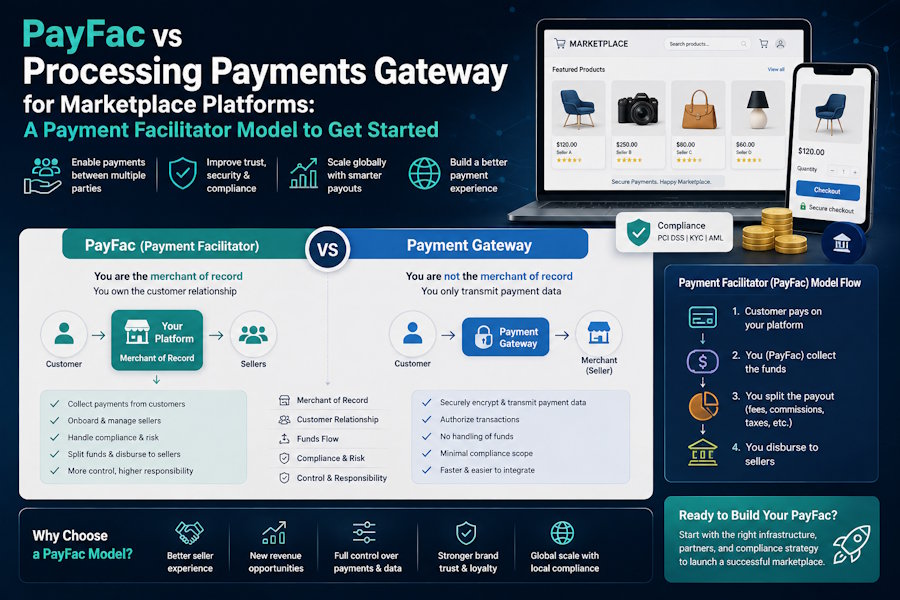
An online payments gateway is an option through which the platform gets the functionality to make online payments possible. A payment facilitator or PayFac performs additional services. It helps in signing up sellers and in managing their payment process.
The above two types of options are completely different and may not be used together all the time. It depends on the payment requirements of the platform whether the platform wants to adopt any one of these or both.
While a gateway simply helps in connecting the platform to the payment processor, PayFac will perform the additional function of adding sellers to the system and account management.
What Is a Payment Facilitator?
A PayFac, or payment facilitator, is a company that helps a platform add sellers (onboarding process) and enable payment acceptance. Instead of giving each seller a separate merchant account, the PayFac uses one master merchant account and adds the sellers as sub-merchants. The basic process is simple:
- PayFac works with an acquiring bank or payment processor.
- It checks and onboard each sub-merchant.
- The platform utilizes the PayFac model to start processing payments.
- PayFac helps manage settlement or payouts to each sub-merchant.
The responsibilities of PayFac are higher compared to those of a gateway, since PayFac must also ensure compliance with payment regulations. It is able to assess sellers, manage risks, monitor transactions, and monetize payment-related activity. In addition, it manages the interaction between the payment system and the sellers.
PayFac does not simply send the data about a transaction from a checkout to a processor. It also manages sellers and payment processes. This is relevant to a platform when making decisions on how much control it should have over payments.
What Does an Embedded Payments Gateway Do?
A gateway can be defined as an intermediary that helps embed payment processing infrastructure into the checkout system. Gateways securely transfer data associated with a payment, such as a debit card number. Gateways may also transfer the results of payment to a checkout system. In particular, a customer submits the required information on a debit card during the checkout process.
The gateway transfers the required data to the payment processor, so transactions move seamlessly through the system. The latter contacts the acquiring bank and other financial institutions in order to obtain the authorization. A platform uses such a solution to be able to accept electronic payments without developing the infrastructure for the processing.
Gateways can be viewed as services that securely transfer payment information from one system to another, supporting any transaction volume the platform handles. Gateways rarely perform the function of being merchants of record. Additionally, gateways do not check or register sellers who use the payment system.
Such functions can be performed by PayFac solutions. Financial gateways can be used to help platforms provide customers with a seamless payment experience. However, a financial gateway is not a bank or a payment processor. It does not do all the things that PayFacs are doing.
PayFacs vs Gateway: Key Differences of Payment Processor
The main difference is who manages merchants, risks, funds, and payment operations. See the table right here:
| Area | Gateway | PayFac |
|---|---|---|
| Role | Payment technology | Payment operating model |
| Merchant relationship | Merchant uses its own provider | PayFac manages sub-merchants |
| Merchant onboarding | Usually handled by merchant/PSP | Merchant onboarding by PayFac |
| Risk ownership | Shared by merchant and PSP | More risk sits with PayFac |
| Compliance | Mainly merchant/PSP | PayFac carries more duties |
| Funds flow | Customer → PSP/payment provider → merchant | Customer → PayFac → sub-merchant |
| Monetization | Gateway fees | Payment and platform revenue |
| Time to market | Less | More |
Last but not least, a gateway is an infrastructure for secure routing of transactions and a PayFac is a business model based on this infrastructure. This choice will affect the amount of payment traffic supported by the platform.
The gateway could be a good solution for the operators who need payment infrastructure without getting involved in seller operations. The PayFac would be the appropriate option for a platform looking to have more control over sellers, onboarding, risks, and money flows.
Control, Revenue, and Customer Experience
A PayFac may bring more control over the full payment journey. With such a model, the operator can utilize branded onboarding and shape the payment experience. It may also set pricing, manage traditional payment UX, access more details about transfers, and take part in monetization. Such an approach improves customer experience when sellers need simple transaction services in one place.
A gateway-led model typically gives the platform less control over merchant setup and pricing. The gateway provider handles much of the financial technology, while merchants manage their own transaction fees and provider relationships.
PayFac economics are not guaranteed. They depend on payment volume, pricing, risk losses, risk management, and partner terms. A platform should also consider the costs of running payments online and other financial services.
Onboarding, Risk, and Compliance Ownership
A PayFac can streamline merchant onboarding and give the platform more control over the application process. However, it also takes on more work and risk. The program must support KYC and KYB checks, due diligence, chargebacks, underwriting, ongoing risk monitoring, and fraud prevention.
This setup can simplify a payment facilitator model because the marketplace controls most of the process. However, this control also brings greater operational responsibility. PCI DSS requirements also need careful attention.
In case the gateway-driven model is used, the duties described above will be performed by different participants of the process. Thus, the merchant handles its own business data and internal checks, while the PSP or acquirer typically manages underwriting, KYC/KYB, fraud controls, and dispute handling. The platform must be aware of which participant performs specific duties and which data should be provided.
In case the all-in-one payment system is considered, the description of duties will be important for selecting the model of business operation.
Cost, Complexity, and Time to Market
In general, a gateway is easier from a business perspective. All the work that needs to be done is integration of the platform with the gateway as well as any related financial services. A PayFac program will have many additional aspects.
First, it is possible that the platform would need sponsorship and acquisition, which could include legal, licensing, compliance, risk, and operations. In addition, there will be a need for merchant monitoring and dispute management.
A PayFac program might also include repeated audits and payment review compliance, which might incur recurring expenses. All such expenses need to be taken into account while considering the total expense of the model.
The proper model will depend upon 3 factors: platform, market, and volume of transactions. A gateway might be easier for a platform that would like to start with minimal internal responsibilities. A PayFac program might become a challenge if the platform lacks the manpower to manage the process.
There is no universal timeline or cost. Assess the customer base, goals, risks, and resources. Pick a scalable and compliant model. Some costs may recur, so tailor the approach to the business.
Insight: When Should a Platform Choose a Gateway or a PayFac Model?
It is also important to choose the right one, based on the goal of the platform and other factors such as the payment volume, merchants involved, and the geographies covered. Some of the specifics, including the payment modes, have to be taken into consideration as well.
Some of the gateway-led signals are:
- You need to launch and start accepting payments quickly with limited preparation, without facing a major hurdle to get going.
- A merchant base is small or highly diverse, making standardized PayFac onboarding harder.
- A team has limited risk and compliance capacity.
- Your priority is the core product rather than running merchant services or adding payments within online operations.
- You prefer a third-party provider to handle more of the payment infrastructure.
PayFac signals include:
- You cater to an elastic target customer base with repeatable onboarding requirements.
- There is enough volume of payments to make the business case and model work.
- Control over onboarding, pricing, payments flow, and merchant experience is needed.
- You have enough risk appetite and capacity to handle compliance, underwriting, monitoring, and support.
- You need better visibility and more control over the payment services activity and commercial model.
A hybrid or managed PayFac approach can provide a middle path. It can give an online business more control over transactions while an operator supports selected risks or operational functions.
A Practical Decision Checklist for Platform Teams
Start with the payment strategy and then test whether the model fits your resources and growth plans. Before selecting a gateway, PayFac, or combination, answer these questions:
- What are our payment strategy goals?
- Which geographies and payment options are required?
- What payment volume do you expect?
- What is your risk appetite for fraud and losses?
- What operational capacity and unit economics support greater ownership?
- How much compliance investment can you make, and what customer experience do you want?
It is dependent on both the operational capability as well as business intent. A gateway can provide a platform an opportunity to begin accepting payments without having to build everything from scratch, whereas a PayFac can give you more control with a master account. Both of these can co-exist in a payment facilitation compliance model.

