

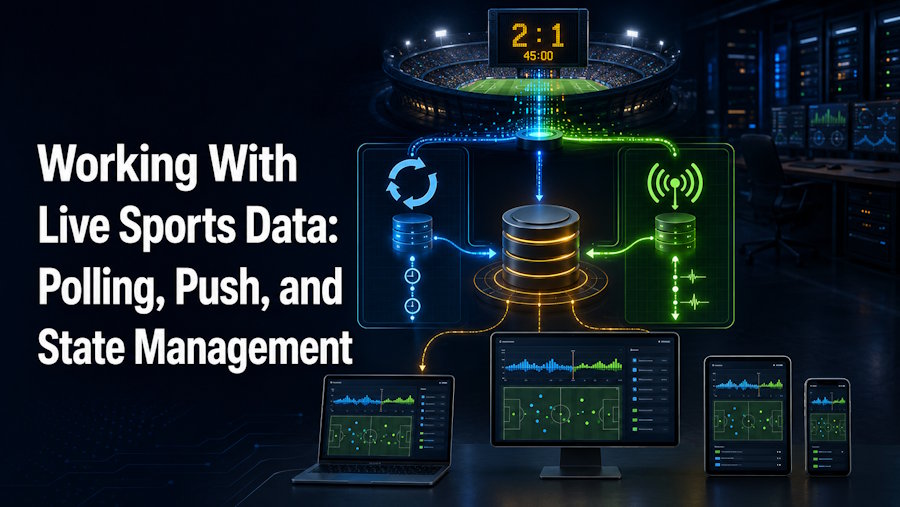
Working With Live Sports Data: Polling, Push, and Not Corrupting Your Own State
Live sports data looks simple from the outside — hit an endpoint, get a score, show it on screen. The complexity shows up once you're running this in production: rate limits that don't forgive bursts, scores that get corrected after the fact, matches that transition between states in ways your code didn't anticipate, and a growing bill for requests that mostly return data that hasn't changed. None of this is exotic. It's the same category of problem as any external API integration, just with a live clock attached.
Polling vs. Push, and Why the Choice Isn't Really Yours Alone
The polling-versus-push decision often gets framed as an architectural preference, but in practice it's usually dictated by what the API tier actually offers. A free or entry-level tier typically exposes REST endpoints only — you ask, it answers, and you're responsible for asking again at a sensible interval. Push delivery, via WebSocket or webhooks, tends to be reserved for paid tiers, since it requires the provider to maintain persistent connections and fan out updates to every subscriber in real time, which costs them more to run than a stateless REST call.
This matters for how you design the client from day one. If you're building against a free tier — for example, a tennis API offering live scores, current matches, players, and fixtures on a no-card free plan capped at 30 requests per minute and 100 per day — your architecture has to be built around REST polling within that budget, not around an assumption that push is available. Point-by-point data and streaming access typically sit behind paid tiers precisely because they demand a different backend commitment from the provider.
Budgeting Requests Against a Hard Rate Limit
A 100-requests-per-day ceiling sounds generous until you do the math against a busy match day. If you're polling GET /matches?status=live every 30 seconds during a single 2-hour match, that's 240 requests on its own — more than double your entire daily allowance, before you've even fetched an individual score.
The fix isn't polling faster within your budget; it's polling less blindly. A few practical rules:
- Poll the list endpoint infrequently, individual match endpoints more precisely. Check which matches are live once every few minutes via the list endpoint, then poll
GET /matches/{id}/scoreonly for matches you're actually displaying, and only while they're live. - Back off between points, not just between requests. Tennis scoring doesn't produce evenly spaced events — there are long stretches between games and short bursts during a tiebreak. A fixed interval wastes budget during quiet stretches and misses updates during busy ones. A better approach polls a live match on a modest fixed interval (say, every 45–60 seconds against a 100/day budget) and accepts that sub-point-level granularity isn't achievable on a free tier.
- Track your remaining budget explicitly, rather than discovering you've hit the ceiling from a 429 response. Log request counts per day against the known limit and throttle proactively as you approach it.
Example in Python:
import time
import requests

DAILY_LIMIT = 100
requests_made_today = 0

def safe_get(url, headers):
    global requests_made_today
    if requests_made_today >= DAILY_LIMIT:
        raise RuntimeError("Daily request budget exhausted")
    resp = requests.get(url, headers=headers)
    requests_made_today += 1
    resp.raise_for_status()
    return resp.json()
This is deliberately unglamorous. The goal isn't clever request-shaving tricks — it's making the budget a first-class variable in your code instead of an afterthought you discover via an error response.
Handling Score Corrections and State Transitions Idempotently
Live sports data gets corrected. A point gets overturned after a challenge, a scorer fixes a data-entry mistake, a match that looked suspended actually resumes. If your code treats every poll as an unconditional "apply this new state," corrections become bugs — a UI flickering back and forth, a database with duplicate or contradictory rows, a notification firing twice for the same game point.
The reliable pattern here is the same one used for any external event stream: treat every incoming payload as a full state snapshot, not a delta, and write your update logic so that applying the same snapshot twice produces the same result as applying it once.
Example in Python:
def apply_match_state(db, match_id, new_state):
    current = db.get_match_state(match_id)
    if current == new_state:
        return  # no-op, nothing changed
    db.upsert_match_state(match_id, new_state)
    if current and current["status"] != new_state["status"]:
        handle_transition(current["status"], new_state["status"], match_id)

def handle_transition(old_status, new_status, match_id):
    # only fire side effects on genuine transitions, never on repeats
    if old_status != "live" and new_status == "live":
        notify_match_started(match_id)
    elif old_status == "live" and new_status == "completed":
        notify_match_completed(match_id)
Two things matter in this pattern. First, upsert rather than insert or blind overwrite — the match ID is your idempotency key. Second, side effects (notifications, cache invalidation, downstream events) fire only on an actual detected transition, compared against your own last-known state, not on every poll regardless of whether anything changed. A score correction that reverts a set score, for instance, should update the stored state cleanly without re-triggering a "match completed" event if the match was never actually marked complete in your own records.
Caching What Doesn't Change Separately From What Does
Fixtures and player records change on the order of days or weeks. Live scores change on the order of seconds. Caching both with the same TTL is the single most common mistake in this kind of integration, and it wastes request budget in one direction or serves stale data in the other.
A simple two-tier approach:
- Static-ish data — fixtures, player profiles, rankings — cache aggressively, with a TTL measured in hours, and refresh on a schedule rather than on every page load. There's no reason to hit
GET /players/{id}more than once a day for a player whose bio and ranking rarely change intraday. - Live data — scores, match status — cache briefly if at all, with a TTL matched to your polling interval, and treat the cache purely as a way to avoid redundant re-fetches within a single short window (e.g., multiple parts of your app needing the same score within the same few seconds), not as a way to reduce actual API calls over time.
Keeping these in separate cache namespaces with separate invalidation logic means a slow-changing fixtures cache doesn't get needlessly busted every time a live score updates, and your live-data cache doesn't accidentally serve a score from ten minutes ago because it inherited a fixtures-appropriate TTL.
Putting It Together
None of these four concerns — transport choice, budget discipline, idempotent state handling, and tiered caching — are unique to sports data specifically. What's specific to this domain is the combination: a hard rate limit on the affordable tier, genuinely time-sensitive data, and a real possibility of retroactive corrections that naive polling code handles badly. Designing for all three from the start, rather than retrofitting idempotency after the first duplicate notification ships to production, is the difference between a live scores feature that's mildly annoying to maintain and one that quietly breaks in ways you only notice when a user reports it.

