

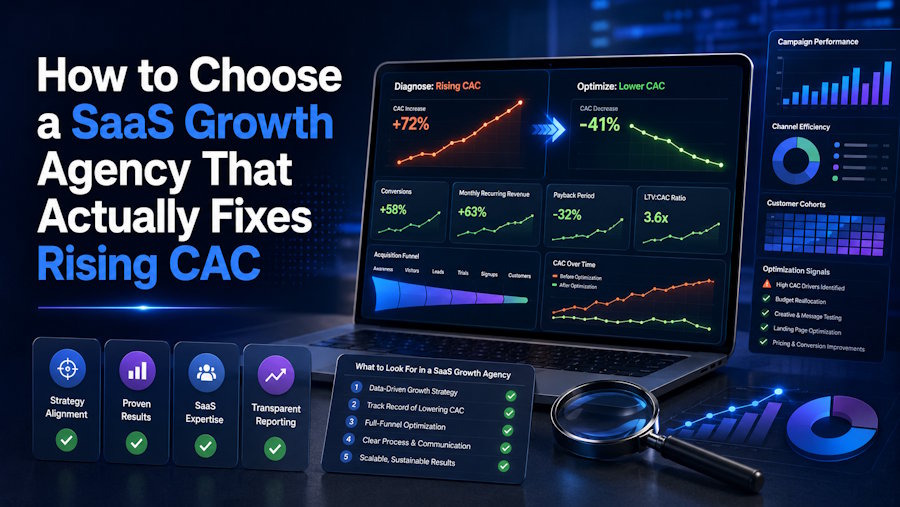
A Series A founder posted something recently that sums up a problem almost every growing SaaS company runs into.
They were spending about $50,000 a month on paid ads. Their team executed well. But CAC kept climbing, and LTV:CAC kept getting worse.
Nothing was obviously broken. The spend just stopped working the way it used to.
That's not a rare story. It's close to the default experience for SaaS companies somewhere between $1M and $10M in ARR.
It's also exactly the moment founders start searching for a SaaS growth agency, hoping someone outside the building can see what's invisible from inside it.
Here's the catch: hiring the wrong kind of agency at this stage doesn't just waste a retainer. It can hide the real problem for months while spend keeps climbing.
This article breaks down:
- Why CAC rises even when execution looks fine
- Whether you actually need an agency (or something else)
- What separates a good SaaS growth agency from one that optimizes the wrong numbers
What Does a SaaS Growth Agency Actually Do?
A SaaS growth agency helps software companies acquire customers profitably.
That usually means some mix of:
- Paid acquisition (Google, Meta, LinkedIn)
- Offer and positioning refinement
- SEO and AI-search visibility (AEO)
- GTM strategy
- Sales enablement to turn pipeline into closed revenue
That's a different job than general marketing.
SaaS runs on recurring revenue. So the real success metric isn't a click, a lead, or a signup, it's whether that customer sticks around and expands enough to be worth more than it cost to acquire.
A generalist agency can hit every number on a dashboard while your unit economics quietly get worse. A SaaS-specific agency builds around CAC, LTV, payback period, and pipeline-to-revenue from day one.
Why CAC Rises Even When Your Team Is Executing Well
This is the part most agencies skip. It's also the part that decides whether hiring one will actually help.
Rising CAC with a competent team usually traces back to one (or more) of five causes.
1. You're comparing against a cheaper era, not a broken campaign
If CAC was lower six months ago simply because you spent less into an under-saturated audience, nothing is broken.
The cheap inventory just got expensive first. That's normal channel maturity, it calls for diversification, not panic.
2. Creative and offer fatigue
Same audience. Same ad. Same offer. Month after month.
Conversion rates decline regardless of how good your targeting is. Many teams keep tweaking bids when the real lever, a sharper offer, hasn't moved in a year.
3. Blended LTV is hiding the real problem
This is the most common blind spot in SaaS reporting.
Founders often calculate LTV across the whole customer base, organic, referral, and paid customers blended together.
If paid-acquired customers retain worse than organic ones (common), a blended number can make paid CAC look fine when it isn't.
Fix: measure LTV by channel and by cohort. Not as one company-wide average.
4. It's a retention problem wearing a CAC costume
Drop month-six retention by even 10–15%, and LTV falls. Suddenly the same CAC looks unaffordable — with zero change to your ad spend or targeting.
Before blaming the ad account, check your cohort retention curves.
5. Funnel and sales-handoff gaps downstream of the ad
Ads amplify what's already there. They don't fix it.
Weak landing pages, slow lead follow-up, reps working low-intent traffic because targeting is too broad, more spend just amplifies an inefficient funnel faster.
Quick gut-check before spending another dollar: Can you say, with confidence, what CAC and LTV look like by channel and by cohort? Not blended across the whole business?
If not, that's the first thing to fix. Regardless of who you hire.
Do You Need an Agency, Or Something Else?
Not every rising-CAC situation needs a full agency engagement.
Be honest about which of these fits before you start vetting vendors:
- You need execution help. Your team knows what's wrong but doesn't have the hours. An agency or specialized contractor fits.
- You need a diagnosis, not more hands. If nobody can explain why CAC is rising, a short strategic audit beats a full retainer.
- You need cross-functional authority. If the issue spans marketing, sales, and positioning, a fractional CMO or growth partner may fit better than an agency that only touches ad accounts.
- You need a new funnel built from scratch. This is where an agency's GTM and paid acquisition expertise adds the most leverage.
What to Look For in a SaaS Growth Agency
If the diagnosis points to "we need outside acquisition expertise," here's what separates a real fit from an expensive detour.
They ask for CRM and pipeline data before recommending channels. An agency that proposes a media plan before looking at your close rates or retention is optimizing for activity, not revenue.
They report on pipeline and revenue, not just clicks and leads. CPC and CPL are inputs, not outcomes. Ask for cost per qualified demo and lead-to-demo conversion rate instead.
They understand PLG vs. SLG, and don't run one playbook for both. Product-led growth converts through free trials and self-serve signups. Sales-led growth converts through demos and pipeline. Different funnels. Different ad objectives. Different definitions of "qualified."
They treat offer and positioning as part of the job. Paid acquisition amplifies whatever sits behind it. A weak offer with efficient media buying just gets you to a bad landing page faster.
Their fee structure doesn't quietly work against you. Percentage-of-spend pricing grows an agency's revenue when your spend grows — whether or not efficiency improves. At $30–50K/month and up, that can mean 10–20% in fees stacked on top of media spend. Ask directly: does this fee reward lowering my CAC, or increasing my budget?
They can show SaaS-specific results. B2B SaaS buying behavior doesn't match ecommerce or local-service buying behavior. Case studies should show demos booked, trials activated, ARR added, not generic lead-gen wins from unrelated industries.
For context on what SaaS-specific outcomes look like: SaaSLaunch, a growth agency working exclusively with B2B and B2C SaaS companies, reports an average 3.9X return across engagements, more than $100M in qualified pipeline generated, and 31+ clients who doubled revenue in 2025. Those are pipeline-and-revenue numbers, not clicks or impressions, which is the reporting standard this section is describing.
A 4-Question Framework for Any Agency Proposal
Before signing with any SaaS growth agency, ask them to answer these using your actual numbers:
- What's our CAC and LTV by channel and cohort — not blended?
- What's the plan if this is a retention or funnel problem, not a targeting problem?
- How does PLG or SLG show up in the funnel you're proposing?
- What does success look like in 90 days — in pipeline and revenue, not clicks?
Agencies that answer all four with specifics, using your numbers, are far more likely to move the needle than ones offering a standard media package.
Common Mistakes SaaS Companies Make When Hiring
- Hiring for channel execution when the real problem is offer or positioning
- Judging agencies on case study logos instead of case study mechanics
- Signing a long contract before a short diagnostic engagement or pilot
- Ignoring retention in the CAC conversation
- Choosing based on cost-per-lead instead of cost per qualified pipeline dollar
FAQs
Is a SaaS growth agency worth it if our CAC is already rising? Depends on the cause. If it's offer fatigue, funnel gaps, or under-optimized targeting, a SaaS-focused agency can usually fix it. If it's retention or product-market fit, no amount of acquisition spend will — that has to be solved first.
What's the difference between a SaaS growth agency and a general marketing agency? A SaaS growth agency builds around CAC, LTV, payback period, and pipeline-to-revenue, and understands PLG vs. SLG motions. A general agency usually optimizes for lead volume or CPC, without accounting for retention or deal quality.
Should we hire an agency, a fractional CMO, or build in-house? Hands-on execution across channels → agency. Strategic ownership gap → fractional CMO. Budget for it and a well-understood growth motion → in-house hire, though it ramps slower.
How do you calculate true LTV:CAC instead of a misleading blended number? Segment customers by acquisition channel and cohort (monthly or quarterly). Track retention and expansion per group. Compare each cohort's LTV against the CAC specific to that channel.
What ad spend level makes a percentage-of-spend fee worthwhile? No universal number. Under roughly $15–20K/month, percentage fees can eat a disproportionate share of budget. At higher spend, the real question is whether the fee rewards efficiency or just a bigger budget.
How long until results show up? Reliable signal on paid channels: 4–8 weeks. Structural changes like offer repositioning or funnel rebuilds: often a full quarter before pipeline and revenue clearly move.
Do SaaS growth agencies work with both PLG and SLG companies? They should, but the funnel and definition of "qualified" look very different for each. Ask any agency to explain, specifically, how their approach changes between a self-serve trial funnel and a demo-based sales funnel.
What should be included beyond ad management? At minimum: conversion tracking and attribution, landing page and messaging direction, and reporting tied to pipeline or revenue — not just channel performance.
The Bottom Line
Rising CAC is rarely a single-cause problem. It's almost never solved by spending more efficiently on the same channels.
The founders who get unstuck diagnose whether the issue sits in acquisition, offer, funnel, or retention before hiring anyone. Then they choose a partner whose reporting, fee structure, and process are built around pipeline and revenue — not clicks.
That diagnostic-first approach is what separates a useful SaaS growth agency from one that keeps campaigns running without ever asking why the economics stopped working.
Agencies like SaaSLaunch, which build engagements around offer refinement, GTM strategy, and paid acquisition together — rather than treating ad management as an isolated service — reflect the full-funnel approach this problem actually requires. Whichever agency you evaluate, the four-question framework above is the fastest way to find out if they're the right fit before you sign anything.

