

An AI application is only as current as the least current thing it reads. A support agent answering from a knowledge base rebuilt nightly will tell a customer their order is still processing six hours after it shipped. A fraud model scoring against features refreshed hourly misses the account compromised forty minutes ago. Neither failure looks like a data engineering problem from the outside. It looks like the AI being wrong.
Real-time data pipeline platforms are the machinery that prevents that, and they are not interchangeable with one another. Getting changes out of a production database is a different engineering problem from moving events across a network, transforming them, or serving the result to an application in milliseconds. Most production stacks combine three or four.
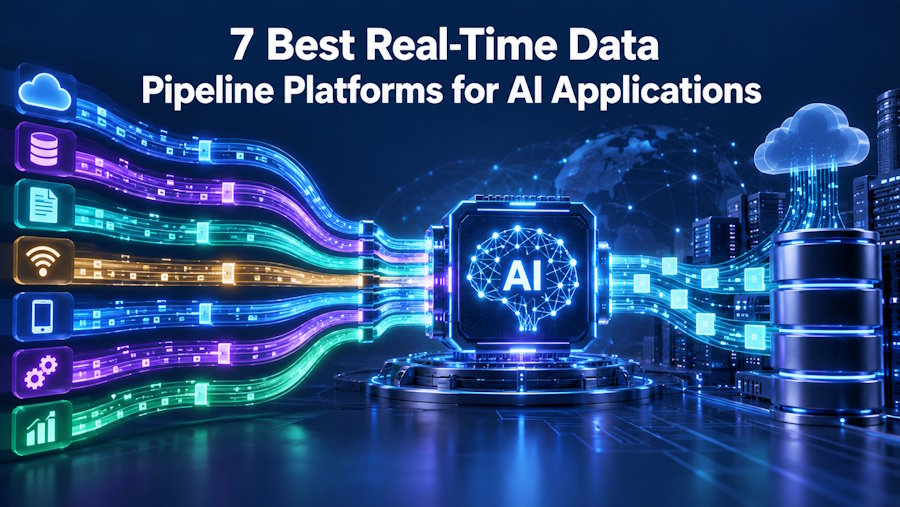
How Data Reaches an AI Application, One Hop at a Time
Freshness is the sum of five hops, and understanding them explains why platforms in this category solve such different problems.
- Capture. A row changes in a production database and something has to notice. Log-based change data capture reads the transaction log, so every insert, update, and delete is captured as it commits without adding query load to the source.
- Transport. The change event crosses a network to wherever it will be processed, usually through a streaming platform that buffers and orders events so a slow consumer does not become a fast producer’s problem.
- Processing. Events get joined, aggregated, filtered, or enriched into something usable, which is where windowing, late arrivals, and state management stop being theory.
- Landing. The result is written into a warehouse, lakehouse, or analytical store, with updates and deletes applied properly rather than appended and reconciled later.
- Serving. The application, model, or agent reads it, typically through an API or a query that has to return in milliseconds rather than seconds.
A pipeline is real-time only if every hop is. The platforms below occupy different hops, which is why the useful question is not which one is best but which hop is currently slowest.
The 7 Best Real-Time Data Pipeline Platforms for AI Applications
1. Artie
Artie is a fully managed change data capture platform that streams changes from production databases into cloud warehouses and lakehouses continuously. It reads the database transaction log rather than polling tables, capturing every insert, update, and delete as it commits without adding load to the system of record. This is the first hop, and it sets the ceiling on how fresh everything downstream can be.
The engineering that matters here is unglamorous. Artie handles schema changes in flight, so a column added to a Postgres table on Tuesday afternoon propagates to the destination without a pipeline failure and without an engineer rebuilding a connector. It applies MERGE and DELETE operations correctly at the destination rather than appending raw change events and leaving reconciliation to somebody else, which is the difference between a table that mirrors production and one that slowly diverges from it.
It also buffers internally through Kafka, so a slow destination or a downstream incident creates backpressure inside the pipeline rather than against the source database. That property matters during traffic spikes, because the failure mode of a naive pipeline is degrading the production system it was meant to observe. Backfills are free, which removes the usual financial disincentive to reload history when a model or a vector index needs rebuilding.
Sources include Postgres, MySQL, MongoDB, DynamoDB, and Oracle, with destinations spanning Snowflake, BigQuery, Databricks, Redshift, Microsoft Fabric, and Apache Iceberg. Teams with data residency or compliance constraints can run Artie inside their own cloud, with PII encryption and hashing in the pipeline, SOC 2 Type II certification, and HIPAA support. Founded in 2023 and backed by Y Combinator alongside a $12 million Series A, the platform moves more than 700 billion rows a year.
Where it fits an AI stack:
- Keeping vector database content current with the production records it was built from
- Feeding feature stores from operational databases without waiting for a batch window
- Giving agents warehouse-side data that reflects the last minute rather than last night
- Sub-minute latency from commit to destination, with schema evolution handled automatically
- Replacing nightly database ELT jobs while leaving SaaS ingestion where it already runs
2. Redpanda
Redpanda is a streaming data platform that speaks the Kafka protocol while replacing the underlying implementation. It runs as a single binary with no JVM and no ZooKeeper dependency, which removes much of the operational work that made Kafka clusters a specialist responsibility rather than ordinary infrastructure.
For teams building AI features on event streams, the appeal is protocol compatibility without that burden. Existing Kafka clients, connectors, and tooling keep working, and tail latencies are typically lower and more predictable, which matters when an inference path waits on an event rather than a dashboard. It transports whatever a producer publishes, so capturing database changes correctly and landing them properly remain separate problems.
Where it fits an AI stack:
- Event transport between capture, processing, and serving layers
- Buffering bursts so downstream consumers are not overwhelmed
- Kafka-compatible integration with existing connectors and clients
- Lower operational overhead than a self-managed Kafka cluster
3. Apache Flink
Apache Flink is a distributed stream processing engine for stateful computation over continuous data. It handles the transformations between raw events and something usable: joining two streams, aggregating over a rolling window, enriching an event with reference data, or maintaining running state per entity.
Its strength is correctness under difficult conditions. Flink handles event time properly, so records arriving out of order land in the window they belong to rather than the one they showed up in, and checkpointing preserves state across failures. For feature computation feeding real-time models, that rigor is why it remains the reference engine. Self-managed operation demands real expertise in state backends and checkpoint tuning, which is why most teams reach it through a managed offering.
Where it fits an AI stack:
- Real-time feature computation from event streams
- Stream joins and windowed aggregations with event-time correctness
- Stateful processing that survives failures without losing position
- Complex enrichment before data lands in a serving layer
4. Materialize
Materialize is a streaming database that keeps SQL views continuously up to date as their inputs change. Rather than recomputing a query when asked, it maintains the result incrementally, so reading a complex join or aggregation costs a lookup rather than a scan.
For AI applications, this suits derived state that must always be current and is expensive to recompute: a customer risk score assembled from several tables, an inventory position across warehouses, a session summary an agent needs mid-conversation. The interface is standard SQL, which puts real-time transformation within reach of analytics engineers rather than only streaming specialists. It computes and serves rather than ingesting, so the freshness of a view is bounded by whatever feeds it.
Where it fits an AI stack:
- Always-current derived state defined in SQL
- Incrementally maintained joins and aggregations
- Low-latency reads of expensive computations
- Real-time transformation without a dedicated streaming team
5. ClickHouse
ClickHouse is a columnar database built for analytical queries at high speed, and it has become a common serving layer for applications that need aggregate answers fast enough to sit inside a user-facing request. It ingests continuously and answers queries over large volumes in fractions of a second.
AI applications use it where an agent or a feature needs an aggregate rather than a row: how many failed payments this customer has had this month, what the error rate looked like across the last hour, which segments a user belongs to. Those questions are painfully slow against a transactional database and trivial here. It is a destination and a query engine, so the ingestion path that keeps it current is a separate decision.
Where it fits an AI stack:
- Sub-second aggregate queries inside application request paths
- High-volume continuous ingestion of event and change data
- Historical context retrieval for agents and models
- Analytical workloads that would overwhelm a transactional database
6. Tinybird
Tinybird turns streaming data into low-latency APIs that application developers can call directly. A developer defines a SQL query over ingested data and publishes it as an endpoint, removing the work of building and operating a service layer between the data platform and the product.
That model fits AI applications well, because an agent needing a fresh fact usually needs it through an API call rather than a warehouse connection. Publishing a parameterized query as an endpoint is far quicker than standing up a microservice for the same purpose. Its focus is the serving edge, so getting production data in reliably, with deletes applied and schema changes handled, remains an upstream responsibility.
Where it fits an AI stack:
- SQL queries published as low-latency APIs for agents and applications
- Parameterized endpoints without a custom service layer
- Real-time metrics and lookups inside product features
- Fast iteration on serving logic without redeploying application code
7. Google Cloud Dataflow
Google Cloud Dataflow is a managed execution service for Apache Beam pipelines, running the same pipeline definition in streaming or batch mode with autoscaling handled by the platform. For teams standardized on Google Cloud, it removes cluster management from stream processing entirely.
Its integration with the surrounding platform is the practical draw, particularly the path into BigQuery and the operational tooling around it. A pipeline written once can run against historical data and live streams without maintaining two implementations. The Beam programming model carries its own learning curve, and like the other processing layers here it transforms and moves data rather than capturing it correctly from a source database.
Where it fits an AI stack:
- Managed streaming and batch processing with automatic scaling
- Unified pipeline code across historical and live data
- Tight integration with BigQuery and Google Cloud services
- Reduced operational overhead for teams already on that platform
Where the Seconds Actually Go in a Real-Time Pipeline
Teams frequently discover that their real-time pipeline is real-time in three places and hourly in one. Freshness is set by the slowest hop, not the average, and the delay usually hides somewhere unglamorous.
Trace it honestly. A row commits in Postgres, the change is captured, the event crosses a broker, a transformation runs, the result lands in a warehouse, an index or feature table updates, and only then can the application read it. Log-based capture and streaming transport are typically measured in seconds. A scheduled transformation job in the middle adds fifteen minutes on its own. A nightly index rebuild adds up to a day.
Before evaluating any platform, measure current end-to-end lag from commit to application read. Most teams estimate it in minutes and measure it in hours, and the gap is almost always one batch step nobody thought of as batch.
What a Duplicate Row Does to a Model
Delivery semantics sound like a distributed systems debate until they reach a model. At-least-once delivery means a record may be processed more than once after a retry or failover, and downstream that becomes a duplicate row, a double-counted feature, or the same document embedded twice in a vector index.
Analytics tolerates some of this. A dashboard reading one percent high is a nuisance. A feature counting transactions per hour that occasionally counts them twice teaches a model something false, and a retrieval index holding duplicates returns the same passage in several slots, crowding out the context an agent actually needed.
Deletes deserve equal attention. A pipeline that propagates inserts and updates but treats deletes as optional leaves records alive downstream after they were removed upstream, which is both a correctness problem and, for personal data, a compliance one. Applying MERGE and DELETE operations properly at the destination is the difference between a mirror and an accumulating approximation.
Frequently Asked Questions
What is a real-time data pipeline?
A real-time data pipeline moves data continuously from where it is created to where it is used, rather than in scheduled batches. In an AI context that usually means capturing database changes as they commit, transporting and transforming them within seconds, and landing the result somewhere an application or model can read immediately.
Why does data freshness matter for AI applications?
Because a model or agent cannot know what it was not given. Stale inputs produce confident wrong answers, and users experience that as the AI being unreliable rather than as an infrastructure delay. Freshness requirements vary by use case, and almost every conversational or decisioning application needs better than nightly.
How do I keep a vector database in sync with production data?
Capture changes at the source with log-based CDC, then trigger re-embedding only for records that changed rather than rebuilding the whole index. Rebuilds are expensive and leave the index stale between runs, while incremental updates driven by a change stream keep retrieval current within minutes of a production write.

