

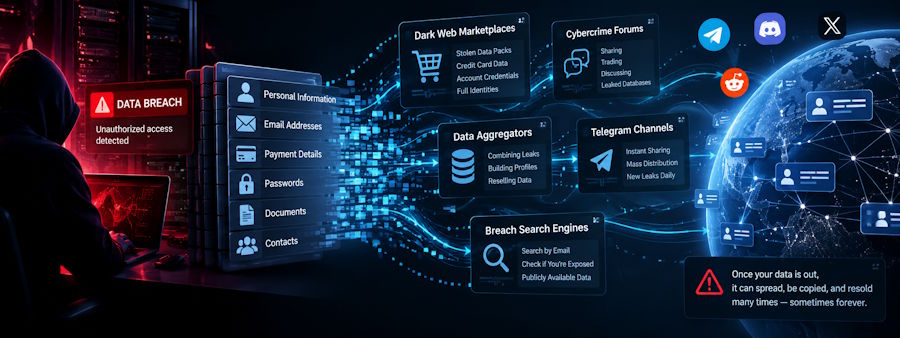
Data breaches have become so common that many people have grown numb to the news. A company announces that millions of accounts were compromised, people change their passwords, and then the story fades. But the journey of your stolen data does not end there. Understanding what actually happens to that information after it leaves the breached server is both important and alarming.
The Immediate Aftermath of a Data Breach
In the hours and days immediately following a breach, the stolen data is usually held by whoever carried out the attack. They assess what they have collected, sort it by type and value, and decide what to do with it. Names and email addresses alone are worth very little. Full identity packages containing name, address, date of birth, Social Security number, and financial information are worth significantly more.
Not all data breaches are carried out by sophisticated criminal organizations. Some are the work of individual hackers, some are nation-state operations, and some are inside jobs. The type of attacker often determines what happens next with your data.
How Stolen Data Moves to the Dark Web
This is where understanding dark web basics becomes relevant for ordinary users. The dark web is not just a haven for criminals, but it does host a significant number of marketplaces where stolen data is bought and sold.
After a breach, the stolen data often appears on dark web forums and marketplaces within days or weeks. It is typically sold in batches. Buyers purchase these batches for various purposes, from identity theft to targeted phishing campaigns. The seller may sell the same batch to multiple buyers, meaning your data could be in the hands of dozens of different people without you knowing.
Prices vary based on the type and freshness of the data. Freshly stolen credit card numbers with verified balances are worth much more than old data that has already been widely circulated and likely cancelled. Identity packages with full personal details command premium prices.
What Buyers Do with Your Stolen Data
Different buyers purchase breached data for different reasons. Financial criminals use stolen credit card numbers to make fraudulent purchases before the cards are cancelled. Identity thieves use full identity packages to open new lines of credit, file fraudulent tax returns, or take over existing financial accounts.
Other buyers are looking for email and password combinations. If you use the same password across multiple accounts, criminals will try your stolen credentials on hundreds of different websites in a process called credential stuffing. They are looking for accounts where your username and password still work, particularly banking and shopping accounts with stored payment methods.
A third category of buyer uses the email addresses from breach data for spam and phishing campaigns. These campaigns are highly targeted because they know the victim has an account with the breached company, which makes phishing emails pretending to be that company far more believable.
How Long Does Your Data Stay in Circulation?
For anyone trying to understand how to access dark web resources or monitor their own data's exposure, the timeline is important to understand.
Your stolen data does not disappear after a few months. Data from major breaches that occurred a decade ago is still in circulation on various dark web platforms. Once your information has been posted or sold, it tends to spread across multiple platforms over time, making it essentially impossible to fully contain.
Even data that is years old retains some value. Old email addresses are used in phishing campaigns. Old passwords are tried against new accounts in the hope that someone reused them. Old personal details are combined with newer data to build more complete identity profiles.
The Aggregation Problem
One of the most serious aspects of the post-breach data journey is aggregation. Data from different breaches is combined and cross-referenced to create increasingly detailed profiles of individuals. A breach of a fitness app might seem harmless. A breach of an online retailer might seem low risk. But combined with each other and with data from a health insurance company, a social media platform, and a banking app, these pieces create a comprehensive picture of a person's life that can be used for sophisticated fraud.
Criminal organizations that deal in stolen data invest significantly in this kind of aggregation work because a complete profile is worth far more than the sum of its parts.
Public Exposure Beyond the Dark Web
Not all breached data stays on the dark web. Some breach data ends up on open internet forums and paste sites where it is accessible to anyone without any special software or knowledge. This kind of public exposure is particularly damaging because it removes even the barrier of knowing how to access dark web marketplaces.
Security researchers regularly monitor these paste sites and dark web forums specifically to detect new breach data and alert affected individuals and organizations. Services that notify you when your email address appears in a new breach rely on exactly this kind of monitoring.
How Companies Respond and Why It Is Often Insufficient
When a company discovers a breach, they are typically required by law to notify affected users. However, this notification often comes weeks or months after the breach actually occurred. By the time you receive an email telling you your data was compromised, it has often already been sold multiple times on dark web markets.
The standard advice given after a breach notification, to change your password and enable two-factor authentication, addresses only a small part of the problem. The password you just changed was already sold. The new password might be safer, but your name, address, phone number, and other personal details are still out there.
What You Can Do to Protect Yourself
Using unique passwords for every account is the single most effective defense against credential stuffing attacks that exploit breached data. A password manager makes this practical by generating and storing complex passwords so you do not have to remember them.
Sign up for breach notification services so you know quickly when your email address appears in newly discovered breaches. This allows you to act faster than if you wait for companies to notify you through official channels.
Freeze your credit with the major credit bureaus. This prevents new lines of credit from being opened in your name even if someone has your full personal information. Unfreezing your credit temporarily when you need to apply for something is a minor inconvenience compared to the damage of identity theft.
Be alert to phishing attempts in the months following any breach notification you receive. Criminals who have your data know which companies you have accounts with, and they will use that information to craft believable phishing messages.
Monitoring the Dark Web for Your Own Data
There are legitimate services that monitor dark web markets and forums for your personal information. Some of these are offered by cybersecurity companies, credit monitoring services, and even certain email providers. These services alert you when your email address, password, or other identifying information appears in newly discovered breach data.
While no monitoring service can guarantee that it will catch every instance of your data appearing online, having this kind of early warning system in place gives you significantly more time to respond and protect yourself before the damage escalates.
Frequently Asked Questions
How quickly does breached data appear on the dark web?
In many cases, breached data appears on dark web forums and marketplaces within days of a breach. Sometimes it is sold privately before being listed publicly, which means it could be in criminal hands even faster. Companies often do not discover breaches immediately, which means there can be a significant gap between when your data was stolen and when you are notified.
Can I get my data removed from the dark web?
Once your data has been posted on dark web forums or sold to multiple buyers, removing it is essentially impossible. Some cybersecurity services offer dark web removal as part of their packages, but this typically means they have negotiated removal from certain indexed sources, not that the data is gone from everywhere it has been copied and sold.
Is all breached data immediately valuable to criminals?
Not all breached data has immediate value. Email addresses without passwords have limited use on their own. Old passwords that most people have already changed are less useful than fresh credentials. However, personal details like names, addresses, and dates of birth retain value for identity theft purposes for many years.
How do I know if my data has been breached?
Services like Have I Been Pwned allow you to enter your email address and check whether it has appeared in any publicly known data breaches. Many email providers and security software packages now include built-in breach notification features. You can also set up alerts to notify you when your personal information appears in new breach datasets.
Does changing my password after a breach fully protect me?
Changing your password protects you from credential stuffing attacks that use the stolen password, but it does not undo the exposure of other personal information included in the breach. Your name, address, phone number, and any other details that were stolen remain in circulation. This is why a comprehensive response to a breach includes monitoring for identity theft, not just a password change.
What types of breached data are most dangerous?
The most dangerous breached data is a complete identity package containing name, address, Social Security number or national ID, date of birth, and financial account information. This type of combination enables full identity theft. Financial credentials like banking usernames and passwords are also highly dangerous because they enable direct theft of funds.

