

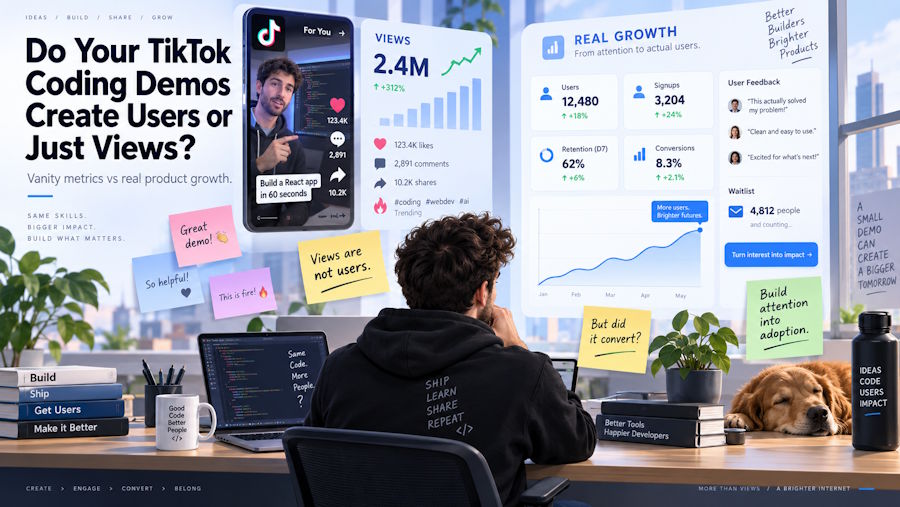
You publish a short demonstration of a developer tool. One clip attracts attention; another sends people to the application. Which one deserves a follow-up?
The answer depends on what happens after the video. For a browser-based utility, a useful first objective is not a larger public counter but a successful first use. That requires connecting the promise in the opening seconds to an observable action inside the product, without pretending the connection is more precise than it is.
Define success before writing the hook
Consider a browser-based JSON-to-TypeScript converter. Define activation as a browsing session in which someone supplies JSON and successfully generates output. Opening the homepage, pressing a button that returns an error, or watching the demonstration would not qualify.
This is a deliberately limited measure. An activated session is not necessarily a new person, a returning user, or a paying customer. It is evidence that the product's core workflow was completed.
Keep four categories separate in the report:
- Distribution: Where the clip was published and whether advertising or another outside intervention affected its exposure.
- Visible counts: Reported views and likes, recorded as context rather than proof of adoption.
- Meaningful engagement: Questions about supported inputs, reported limitations, and requests for examples that reveal what viewers need.
- Product outcomes: Successful sessions first; repeat use or purchases later, when those match the product's purpose.
TikTok's Studio documentation describes account and content analytics, including post metrics such as views, likes, and shares. Use those for the platform side of the report. Keep the product's event data alongside them, rather than assuming a platform counter measures what happened in the application.
Connect each clip to a measurable session
Give each video a distinct route on your own website, such as /try/a, /try/b, or /try/c. All three should open the same tool, with the same interface and sample data. Show the matching route in its video and use it in any clickable placement available to the account.
A single shared destination cannot identify which clip prompted a visit. Do not assign a video simply because it was the latest one published. Preserve unattributed sessions as unknown, and remember that a copied or shared route identifies the entry path, not proof that its visitor watched the original clip.
Use a small event contract: an event identifier, a pseudonymous session identifier, the clip identifier, a timestamp, and an input mode distinguishing sample data from user-supplied data. Define three events:
- landing_loaded: The tool screen is ready to use.
- conversion_succeeded: The converter has produced output, not merely received a button click.
- output_copied: The application has confirmed a successful copy action, providing an optional follow-through signal.
For the activation calculation, include only successful conversions using user-supplied input. Keep sample runs as a separate onboarding diagnostic. Do not send the JSON itself, generated code, credentials, or other customer content into analytics.
Deduplicate retries by event identifier, then count each session at most once per funnel stage. Both sides of the calculation must come from the same attributed landing-session cohort:
Session activation rate = activated landing sessions ÷ measured landing sessions × 100
Report counts beside the rate, and show “not enough data” when the denominator is zero. Repeated visits can produce multiple sessions, so label the result as sessions rather than unique developers.
Before publishing, test the whole path on a phone: open each route, run sample input, submit user-supplied input, trigger an error, and retry. Confirm that only the intended events count. Respect visitors' tracking choices and document missing measurement rather than bypassing them.
Run a three-video comparison
Suppose the goal is to learn which opening attracts people likely to try the converter. Keep the demonstration, approximate duration, caption style, destination experience, and call to action consistent. Change the opening's framing.
- Video A: Result first. Open with the generated interface beside the input: “Turn this JSON response into a TypeScript interface.”
- Video B: Friction first. Show someone retyping fields: “Still writing interfaces for API responses by hand?”
- Video C: Question first. Ask, “Would you trust types generated from a single JSON sample?” Then show the conversion and a field worth reviewing.
Each version should deliver the same honest demonstration: paste sample JSON, generate an interface, inspect the result, and invite viewers to try their own input. Keep the review step in all three so that the question-led version does not promise a different lesson.
Choose the review window before publishing. For this example, compare the first seven days after each post and count events within that window. This is an experiment-design choice, not a TikTok benchmark. Log publication times and interruptions, and keep advertising and third-party count services out of this initial comparison.
The following figures are entirely hypothetical and illustrate the decision process; they are not platform averages or campaign results.
| Opening | Reported views | Landing sessions | Activated sessions | Session activation |
|---|---|---|---|---|
| A: Result first | 12,000 | 120 | 12 | 10% |
| B: Friction first | 4,800 | 96 | 24 | 25% |
| C: Question first | 8,000 | 80 | 8 | 10% |
Video B is the strongest candidate for a follow-up under this objective. It produced the most activated sessions and the highest activation rate among measured arrivals, despite having fewer reported views.
That does not establish a causal improvement or statistical significance. Three separately published posts are not a randomized test: their viewers, timing, and surrounding circumstances may differ. The rates describe the people who arrived through each route, not everyone who saw each video.
Repeat the promising framing with a new example before committing the content calendar to it. Do not divide website sessions by reported video views and call the result a click-through rate; these measurements do not establish a matched set of viewers and clicks.
Keep purchased counts outside the experiment
When auditing an existing campaign, record any third-party view service separately. A2G Store, for example, offers a TikTok view-count service, and its service page explicitly distinguishes additional views from automatic recommendation-feed exposure. That deliverable is different from a measured visit, a successful conversion inside the tool, or an ongoing audience relationship.
Do not treat a purchased count increase as evidence that an opening improved. Exclude affected posts from the clean comparison rather than subtracting an ordered quantity from the dashboard total and treating the remainder as an uncontaminated baseline. The purchase record alone cannot establish which activity came from interested developers.
There is also a separate policy question. TikTok's integrity and authenticity rules prohibit services that artificially boost engagement or manipulate recommendations. Check the method against those rules; separating its numbers in a spreadsheet does not make a prohibited practice permissible.
Diagnose the next change, not just the winning clip
Attention without visits: Review whether the opening identifies a developer problem, whether the demonstration fulfills its promise, and whether the next step is clear. Inspect available watch-time or retention data as diagnostic evidence, not a universal pass mark. A complete educational answer may be useful even when it produces no product visit.
Visits without successful runs: Check mobile input, confusing controls, error messages, and the difference between the demonstrated task and the actual tool. Test these explanations before concluding that the video attracted the wrong audience. In the hypothetical results, investigate A's unactivated sessions before discarding its opening.
Successful runs without continued use: Investigate whether the tool solves a recurring problem. Follow-up clips could answer questions about nested objects, reviewing generated fields, or fitting the output into a project. For a genuinely one-off utility, repeat use may be the wrong success measure; for a subscription product, first use is only the beginning.
Maintain a publishing schedule the team can sustain, and carry one clear question into the next comparison. The purpose of measurement is to choose what to explain or fix next. A larger counter cannot replace a useful concept, a working product, or the repeated work of understanding an audience.

