

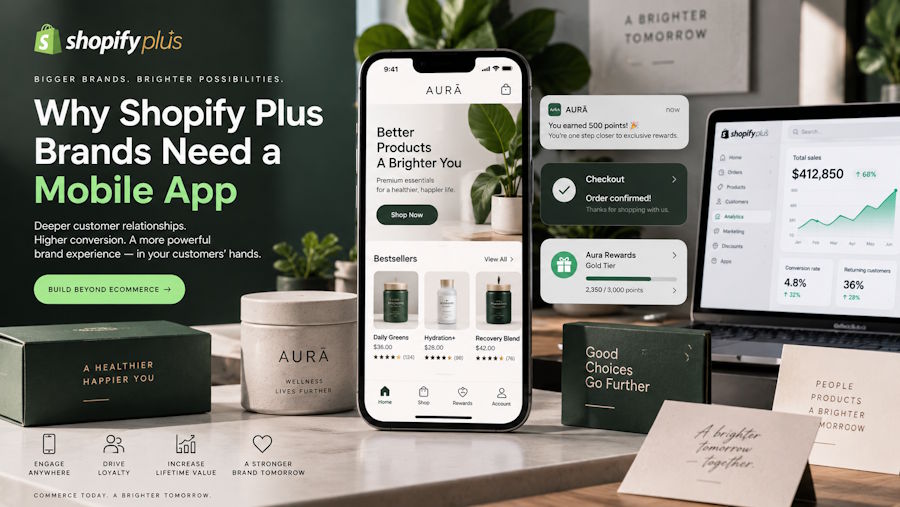
When you're running an established Shopify Plus brand, a lot of work has already gone into getting customers through your checkout. You've invested in your product line, refined your store, and found ways to introduce your brand to people who might love it.
As your business grows, the relationship after that first purchase starts to deserve more attention. You want customers to remember you when they need a refill, see your next collection, and feel that buying from you again is an easy choice.
In that context, a mobile app is one of the best channels you can have. Yet a low percentage of Shopify Plus stores have their own app; in some cases, because they’re not aware of the value, and in others, because it seems more difficult to launch an app for a highly custom Shopify Plus store.
Keep reading and we’ll present all the answers: why your brand should have an app, and how to do it the right way.
The Short Version
A mobile app is a channel for your best customers. Not all your customers will install it, but those who do will be closer to you, and spend at multiples of what they do on the mobile web.
At the volume of a typical Shopify Plus store, your app could easily be a seven-figure sales channel.
The catch for Shopify Plus is that highly customized stores often don’t fit with standard app builders. If you want to carry over all your custom features and improvements into your app, you’ll need a platform like MobiLoud that directly converts everything on your site into an app.
Why the App Opportunity Is So Big for Shopify Plus Brands
For an established business running on Shopify Plus, there’s a clear and real case for launching a mobile app.
The main reason being, you have all the elements for a successful app: an existing customer base, traction, and the scale that means even a niche user base can contribute a significant amount of revenue through your app.
Perhaps you launch seasonal collections, sell products customers replenish, or have a loyalty program people already use. Your app can build around those habits. You have people to introduce it to and a reason for them to come back after downloading it.
It’s different from trying to force feed the app upon a small group of customers who don’t really want it.
When you’re selling at the scale of a Shopify Plus store, the business case is almost certainly there. The only tricky part is executing.
You Don't Need Many Downloads for an App to Pay Off
Most objections to an app come down to adoption. Only a fraction of our customers will ever download it.
That’s true. But you don’t need the majority of your users on the app.
You might have less than 10% of your customers actually downloading the app after you launch it. This segment is exactly who the app is for.
It’s for your best customers; those who want an easier path back to your store, so they can shop and buy more often.
And they will. Data from MobiLoud shows the following benchmarks:
- 3-7x longer session duration
- 4.2x more products viewed per session
- 10-50% higher average order value than mobile web
- Conversion rates several times higher than mobile web
- 3.5-7x higher revenue per user
For a small store doing $500K in annual revenue, these improvements might not move the needle that much.
But for a brand on Shopify Plus, the revenue increase from an app is more than worth the decision to build it.
Your Customers Want an Easier Way to Buy Again
Let’s get into the real reasons why an app delivers value.
Think about what actually happens when a repeat customer decides to buy again.
They're running low. They open a browser, type part of your name, wait for the page, find the product, sign in, check out. Six steps, and every one is a chance to get distracted or land somewhere else.
Same customer with your app: tap the icon, already signed in, order history right there, card saved.
The app removes friction from the exact moment friction costs you most, which is when a customer has already decided they want to buy from you.
It makes everything easier. Reordering, shopping for new items, managing subscriptions, accessing your loyalty program; all areas where reducing difficulty leads to more repeat purchases.
Push Notifications Give You Another Way to Bring Customers Back
Your other retention channels keep getting worse, and you already know it.
Email deliverability is a moving target. SMS costs money on every send, and the more you use it the faster people opt out. Retargeting means bidding in an auction for the right to speak to a customer you already paid to acquire.
Push notifications land on the lock screen. No per-send cost, no inbox filter, no auction.
It’s the best channel for high-impact or time-sensitive messages:
- A restock on the product someone has checked three times
- Early access to a drop, twelve hours before the email goes out
- A refill reminder timed to their actual purchase cycle
- A failed subscription payment, caught before it churns
Push doesn't replace your other channels, but it gives you a stronger supplement and a more direct touchpoint for people who download your app.
You can still use email for longer, story-driven messages, and SMS for wider reach and immediacy.
But push notifications can be the cheapest and most efficient channel you'll ever own.
Your Best Customers Have More Reasons to Stay Close to Your Brand
Once customers have your app, you have an opportunity to make it feel like a useful part of their relationship with your brand. That gives you something to build on beyond occasional product announcements.
If you run a fashion brand, you could give app users early access to a collection. Someone who follows your releases gets a practical benefit: they can browse and buy before you announce the launch more widely.
You can also make loyalty balances easy to find, highlight relevant member benefits, or give customers helpful content about products they own. A skincare routine guide or instructions for caring for a garment can make a return visit worthwhile even when someone isn't ready to buy.
All of this comes from having a channel that lives in your customer’s pocket. It’s the closest touchpoint you have; and a powerful way to increase retention from the customers who matter the most.
Small Improvements in Repeat Business Matter at Scale
An app brings you a direct line to your customers in push notifications, lower purchase friction, and a semi-permanent touchpoint that lives on your customer’s phones.
All of this contributes to more repeat business; people buying more frequently, people staying customers for longer.
And at your scale, this is massive.
On one hand, just a small increase in purchases can add up to a large amount of revenue. And even better, it’s revenue that comes with more control and higher margins.
You’re not paying for ads to get these people to come back, you’re not ceding control to a third-party platform. You control the conversation and a greater share of the profits.
So the more revenue you get coming from repeat customers, through your app, the healthier your business becomes overall.
The Hard Part of Launching a Mobile App for Shopify Plus Brands
The ironic part is that, while most Shopify Plus brands are at the ideal scale where a mobile app makes sense, launching an app is actually a fair bit harder than for a standard Shopify store.
For a simpler store, there are dozens of no-code tools that can help you spin up a simple app that’s consistent with your site.
But if you’re on Shopify Plus, it’s usually because you want a higher level of customization and features.
And these same app builders usually can’t support all these custom features.
You can launch an app with these tools still, but you’ll have to accept a watered-down version of your store - which is not ideal, when your app is supposed to be a hub for your best customers.
So there are two realistic ways to get an app that measures up to what you’ve built on your site:
- Build custom on Shopify's APIs. You get total control to build the app you want, and recreate everything you do on your site; but it becomes a massive, costly project.
- Find an app builder that supports full parity for Shopify Plus brands. The choices here are more limited; MobiLoud is one of the few Shopify mobile app builders that actually lets you convert everything from your website into a native app.
Your goal, when launching a mobile app, should be to ensure it’s at least as good as your mobile website.
If you’re missing key features or customizations that exist on the web, you risk the app being a kind of lite version of your site.
Doing that is not impossible. But it takes some thought, and choosing the right path to get there.
The Bottom Line
On Shopify Plus, you’re past the point where a mobile app is a speculative bet. You have the repeat demand, the customer base, and an audience you can reach to tell them it exists.
You also have a store custom enough that the usual app builders will cost you part of it.
So the real question was never whether to have an app. It's how to get one that doesn't take a step backwards from the site you already built. Answer that, and the app could soon be your most efficient and powerful retention channel.

