

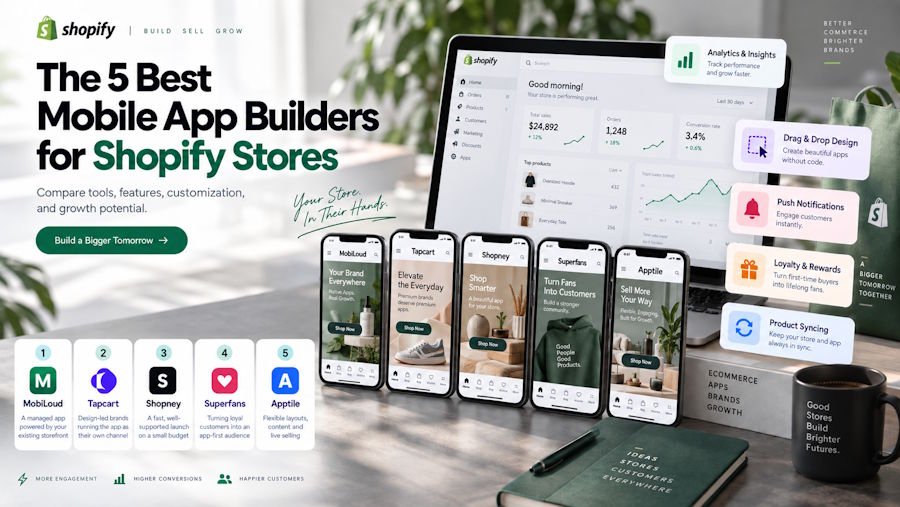
The Shopify mobile app builder market is exploding. Every week, several new players are coming up, offering software tools that let you convert your Shopify store into a branded native app.
That just makes it harder to choose the right tool.
For a channel as important as a mobile app, getting this decision right is crucial. The wrong choice can severely limit your app’s potential, and potentially have you writing off the channel as a whole, when it was really the platform that capped your upside.
Luckily, there are a number of platforms you can trust to deliver a high-level app, aligned with your brand and your vision. Find the five best below.
The Five Best Shopify Mobile App Builders: At a Glance
| App builder | Best for |
|---|---|
| MobiLoud | A managed app powered by your existing storefront |
| Tapcart | Design-led brands running the app as their own channel |
| Shopney | A fast, well-supported launch on a small budget |
| Superfans | Turning loyal customers into an app-first audience |
| Apptile | Flexible layouts, content and live selling |
Three Questions to Ask Before You Make a Choice
The first thing you need to understand, before diving into a decision or a demo call, is how the app builder category works as a whole.
Not every app builder works the same way. And not every app builder is the best option for every type of brand.
There are a few questions to have in your pocket before you go ahead and compare individual platforms against each other.
- Does your app stay in sync with your site by default, or by effort?
Most builders connect to Shopify for catalog and orders, then have you rebuild the storefront inside their editor. That means two storefronts. Every theme change, landing page, and new feature gets built twice, forever.
A smaller number run the app off your existing site, so changes flow through on their own.
Neither is wrong. But decide how much double-work you're signing up for before you sign. - What happens to your non-Shopify-native features?
Your catalog will sync. That's the easy part. Your subscription tool, loyalty program, reviews widget, product finder quiz and custom checkout are the hard part, and support varies enormously; sometimes by plan tier within the same vendor.
This is important because you want your app to at least be able to do everything your website can do. Otherwise, it can be difficult to make the case why someone should use it. - Who does the work after launch?
Some of these are tools you operate. Some are services someone else operates. That distinction costs or saves you more than the price difference between plans.
The Top Shopify Mobile App Builders, Compared
Now let’s get into the best options for Shopify brands looking to launch a native app for their store.
1. MobiLoud
Best for: Brands that want a native app built and managed for them, running on the storefront they already have.
Starting price: $1,499/mo plus a one-time setup fee.
MobiLoud is the outlier on this list, because it doesn't force you to rebuild what you already have.
It takes your existing website and turns it into a mobile app. Your website is the foundation of the app, while MobiLoud’s native layer gives you all the native features you expect from an app (push notifications, native navigation & UI tweaks, and the ability to publish your app in the App Stores).
Your app does everything your website does, and more.
It’s also fully synced with your website; so most of the changes you make to your site go live in your app automatically, without your team having to go in and duplicate each web update in your app.
MobiLoud is more expensive than most other app builders, at least at the entry-level. So if you’re a smaller store, it might not be a fit. But for high-end, enterprise and Shopify Plus brands, it’s the best way to get an app.
2. Tapcart
Best for: Design-forward brands with the in-house resources to run the app as its own channel.
Starting price: $500/mo, rising through higher tiers and a custom enterprise plan.
Tapcart is one of the most established DIY app builders for Shopify.
You build your app inside its block-based App Studio editor, and Tapcart produces the native iOS and Android apps around it. The app connects to Shopify and syncs product and order info in real time.
It has a deep integration list, covering the loyalty, reviews, subscription and attribution tools most Plus brands already run. It has also leaned hard into personalization and AI recently, with a personalized product feed, AI-drafted push campaigns and generated app imagery.
Tapcart is a good way to build a unique, feature-rich mobile app; but the downside is that the more unique your app is, the more work it takes to run it.
3. Shopney
Best for: Smaller and mid-sized stores that want a credible app live quickly, with a lot of hands-on help.
Starting price: $149/mo, rising to enterprise plans starting at $1,299/mo.
Shopney is built around speed and support.
You start from an industry-specific theme, customize it in a no-code editor, and Shopney's team helps you launch, including handling the app store submissions. The home screen is fully editable; product, cart and checkout screens follow set layouts, which is part of why launches are fast.
The feature set covers the essentials well - unlimited push on every plan, in-app live chat tied to Shopify Inbox, multi-currency and multi-language. The live chat is genuinely useful for categories where people ask before they buy: fit questions on a jacket, ingredients on a supplement.
What customers single out, over and over, is the support. It holds a 5.0 out of 5 across roughly 740 Shopify App Store reviews, and the reviews are mostly about people rather than features.
Overall, it’s a solid and versatile platform. Entry-level pricing is very reasonable for smaller stores, while it offers more powerful plans for brands with higher level requirements.
4. Superfans
Best for: Brands whose best customers already follow every launch, and who want an app built around that relationship.
Starting price: $150/mo, rising to $1,000/mo.
Superfans gives you a drag-and-drop builder that turns your store into native apps with real-time sync; much like the standard approach of most Shopify mobile app builders.
The distinctive parts are what sits around it: live selling, in-app and on Facebook, with shopping built into the stream. App-exclusive drops and discounts. Unlimited segmented push. In-app chat. Onboarding is hands-on, with a dedicated design manager on the top plan.
It holds a 4.9 out of 5 across more than 850 Shopify App Store reviews (many accumulated under the original Vajro brand name).
The model has a prerequisite worth stating plainly: it works when you have a steady supply of things to launch. Drops, restocks, collaborations, live sessions. The platform provides the mechanism; your brand has to provide the reason anyone tunes in. A store that launches twice a year will not get value from a live selling engine.
5. Apptile
Best for: Brands that want design flexibility and content in the app, not just a product grid.
Starting price: $249/mo, rising to custom plans for enterprises.
Apptile builds apps from customizable blocks it calls tiles (more than 100 of them) which gives you more room to arrange the app than most no-code editors allow. Its Tile AI can generate a section from a text prompt.
The apps are native, with real-time over-the-air updates, and higher tiers offer code-level and source code access for teams that want to go past the visual editor. Alongside that sit live selling with in-stream checkout, automated push flows and app-only discounts. Harney & Sons and Monos are among its customers, and it holds a 4.9 out of 5 across 125 Shopify App Store reviews.
Flexible layouts only pay off if you have content to put in them. If videos, guides or demonstrations are already part of how you sell, this is a strong fit. If not, you're paying for a design ceiling you won't reach.
How to Choose the Right Shopify Mobile App Builder for Your Store
Once you’ve narrowed down the list, think again about what you really need from your app, and the resources you want to dedicate to it.
Do you want the app to be a standalone channel, with a unique user experience? Or a natural extension of your existing store?
Do you want to dedicate a team to building and running it? Or have it naturally follow the changes you make to your site?
These questions will tell you a lot about which option is best for your business.
Add on top of that the cost question.
How much do you want to spend on your app? How much makes sense from an ROI perspective?
Don’t just think about the cost you see on a pricing table. Think as well about the cost of your team’s time, any custom development costs, success fees, and anything else that’s going to round out the total cost of owning and operating your mobile app.
The Bottom Line
There's no single best Shopify app builder, and anyone who tells you otherwise is selling one.
There is a best fit, and it comes down to a decision you should make before you look at any pricing page: do you want a second storefront, or an extension of the one you have?
If you want the app to be its own channel with its own design and merchandising, Tapcart, Superfans and Apptile are built for that, and Shopney is the affordable way in.
If you want the store you've already built, running on a phone, without maintaining it twice, that's a different model and MobiLoud is the clearest example of it.
Decide that first. Everything else on the comparison table follows from it.
[a] image files https://drive.google.com/drive/folders/1p0y9HUoMCj-b1cLS6W9XPWzPFZ27pcql?usp=sharing

