

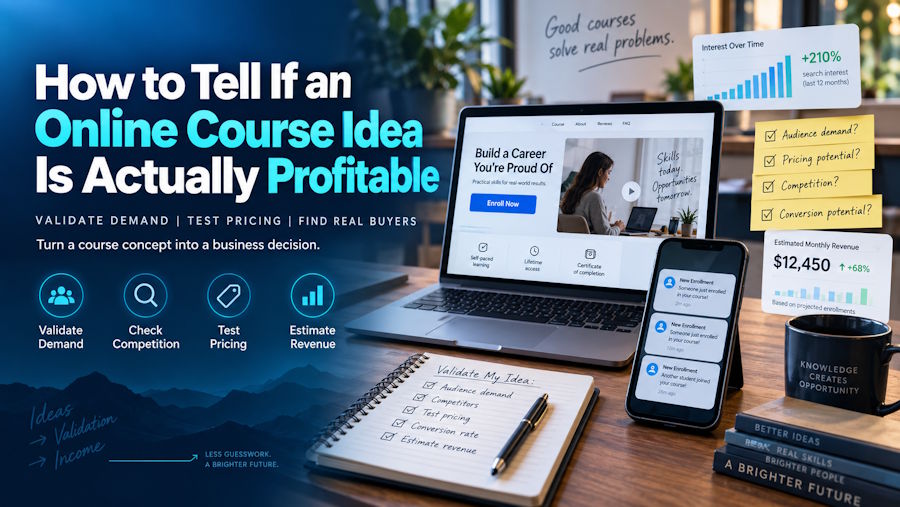
Key Takeaways:
- Social media praise, likes, and polite comments are vanity metrics that do not indicate buying intent.
- Healthy competition signals active spending; complete market silence usually signals an absence of buyers.
- Pre-selling a beta version is the only foolproof method to verify commercial viability prior to production.
- Compare your concept against the top online course ideas for 2026 to ensure your niche has sustained momentum.
Most course creators spend four months in isolation filming forty video lessons, editing slide decks, and building complex membership portals. Then launch day arrives, and they hear crickets. They assume their marketing failed, but the real failure happened on day one: they built something nobody was desperately looking to buy.
Creating an educational product on a whim is an expensive gamble. Profitability is not a mystery discovered after launch; it is an engineered outcome verified through real customer behaviors long before you hit record on your camera.
The Difference Between Passive Interest and Commercial Intent
Creators constantly confuse general enthusiasm with buying behavior. If you post on LinkedIn or X asking, "Would you buy a course on advanced project management?", dozens of people will say yes. That positive reinforcement feels incredible, but it costs them zero dollars to be supportive.
Passive interest focuses on general curiosity. Commercial intent occurs when someone experiences a specific, urgent bottleneck that is costing them time, peace of mind, or revenue right now. When evaluating an idea, you must differentiate between topics people find "nice to know" and problems people need solved immediately.
Look at your topic through the lens of tangible transformation. If a student finishes your program, what measurable result do they achieve? Can they negotiate a higher salary, streamline business operations, or fix a painful personal dilemma? If the outcome is ambiguous, the perceived value collapses.
Four Litmus Tests for Course Profitability
Before investing hundreds of hours into curriculum design, run your prospective topic through these four strict market tests.
1. The Urgent Pain Index
People buy solutions to acute problems far more readily than they buy aspirational upgrades. High-margin courses target clear pain points where delay causes active frustration. Ask yourself what happens if your target student does nothing for six months. If the answer is "not much," your concept lacks commercial urgency.
2. The Active Marketplace Check
Beginners often search for an idea that no one else has ever touched. That is almost always a trap. If no books, software tools, coaching packages, or rival courses exist in your proposed niche, there is likely no addressable budget there. Existing competitors validate that a paying market is thriving.
Your goal is never to invent an entirely untouched category. Instead, study existing offerings, dissect their weak spots, and position your program around a superior methodology or a neglected audience segment.
3. Search Volume and Intent Signals
Examine what prospective students are typing into search engines and community forums. Look for transactional and problem-focused phrasing rather than surface-level queries. When thousands of people ask how to fix specific software errors, pass licensing exams, or overcome operational hurdles, demand is already concentrated.
- High-intent forum discussions where users ask for paid tool recommendations or consulting help.
- Targeted keywords on YouTube and Google featuring phrases like "how to fix," "step by step guide," or "workflow tutorial."
- Active job postings listing specific skills that professionals currently lack and need to acquire quickly.
4. The Upfront Financial Commitment
The ultimate test of demand is an exchange of currency. Before creating an entire curriculum, publish a detailed outline of your course with a clear syllabus, open a pilot cohort of ten seats, and accept payments. If you cannot persuade ten qualified prospects to buy at an early-bird rate, building three dozen videos will not change their minds.
Mastering this pre-sale phase requires understanding how to price an online course so that your beta tier offers clear incentive while anchoring premium value.
Evaluating Profitability: The Validation Matrix
Use the matrix below to score your prospective course topic across essential commercial dimensions before moving into production.
| Validation Metric | Weak Indicator (Red Flag) | Strong Indicator (Profitable) |
|---|---|---|
| Transformation Clarity | Broad concepts like "learn to be more creative" | Concrete results like "build a portfolio that lands client retainers" |
| Market Competition | Zero existing courses, books, or tools in the niche | Multiple established programs with room for differentiated positioning |
| Target Audience Purchasing Power | Hobbyists expecting everything for free | Working professionals, freelancers, or business owners investing for ROI |
| Validation Response | Polite comments saying "Looks cool, good luck!" | Early beta deposits and direct inquiries asking when doors open |
Executing the "Minimum Viable Course" Strategy
Never record forty hours of finished content for version 1.0. Instead, build a Minimum Viable Course (MVC). Deliver the core curriculum live via weekly video workshops to your initial cohort of beta students.
Teaching live allows you to see where participants get stuck in real time. You will quickly discover which explanations resonate, which exercises cause confusion, and what additional resources students need. You get paid to refine the exact product your market wants, eliminating the risk of building unwanted content.
Once the live cohort finishes and achieves the intended outcome, edit those recordings, package them with your templates and worksheets, and transition the offer into an evergreen product. You now possess verified student case studies, battle-tested materials, and concrete proof of profitability.
Frequently Asked Questions
How many pre-sales do I need to confirm profitability?
For a cohort or standard digital course, aim for 10 to 15 paid pre-orders from an audience that is not solely of close friends or family. Securing double-digit paid transactions at your target price point proves that buyers find the transformation valuable enough to part with real capital before seeing the finished product.
What if competitors already have massive courses on my topic?
Heavy competition is proof of existing cash flow in that niche. Instead of backing away, look at their 2-star and 3-star reviews to find what they missed. Build your curriculum specifically around solving those unaddressed pain points for a well-defined sub-niche.
Is free survey data reliable when checking demand?
Surveys alone are dangerously misleading. People easily answer yes when asked if they would buy something hypothetical. You should only treat a survey response as valid signal when it leads directly to an interview or a discounted deposit for the upcoming beta.
Can I test profitability without an existing audience?
Yes. You can run small paid search campaigns directing traffic to a landing page with a detailed syllabus and a waitlist deposit, or engage directly in niche communities by solving individual problems through private consults before packaging the curriculum.

