

Search is no longer limited to a list of blue links.
People now research products, compare companies, evaluate services, and ask buying questions through Google’s AI experiences, ChatGPT, Gemini, Perplexity, and other AI-powered discovery tools. That shift has created a new challenge for businesses: being easy to find in traditional search is important, but it may no longer be enough.
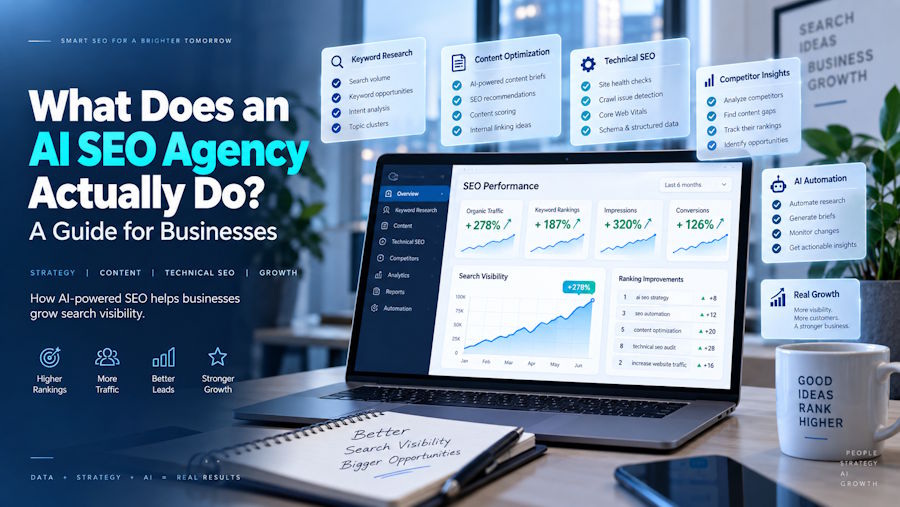
An AI SEO agency helps a business improve its visibility across both traditional search engines and AI-driven search experiences. That work can include technical SEO, content strategy, entity optimization, structured data, authority building, AI-search monitoring, and conversion-focused optimization.
The goal is not simply to “rank in ChatGPT.” A stronger objective is to make a company easier for search engines and AI systems to discover, understand, evaluate, cite, and recommend when relevant.
That distinction matters because effective AI SEO is built on solid search fundamentals—not shortcuts or special tricks.
What Is an AI SEO Agency?
An AI SEO agency is a search marketing company that combines traditional search engine optimization with strategies designed to improve visibility across AI-assisted search and answer platforms.
Traditional SEO typically focuses on areas such as:
- organic rankings
- keyword visibility
- crawling and indexing
- content optimization
- backlinks
- organic traffic
- conversions
An AI SEO agency should still handle those fundamentals, but it also considers how a brand appears when prospective customers use AI systems to research products, services, companies, and solutions.
That can involve:
- tracking brand mentions across AI platforms
- analyzing which sources AI systems cite
- improving entity and brand clarity
- creating authoritative content around customer questions
- strengthening third-party authority signals
- identifying commercially relevant AI-search prompts
- measuring AI-assisted visibility alongside standard SEO metrics
Not every provider approaches these areas in the same way. Some focus heavily on content production, while others emphasize technical SEO, entity optimization, AI visibility tracking, digital PR, or conversion strategy. Businesses evaluating potential partners can use this comparison of leading AI SEO agencies to see how different providers approach AI search optimization and which capabilities may matter most for their specific goals.
Terms such as AEO (Answer Engine Optimization) and GEO (Generative Engine Optimization) are often used to describe parts of this work.
However, businesses should be cautious about treating AEO or GEO as replacements for SEO.
Google's guidance makes that distinction particularly important: its generative AI search experiences continue to rely on core Search ranking and quality systems, meaning established SEO principles remain relevant to visibility in AI-powered search.
What Does an AI SEO Agency Actually Do?
The exact service mix varies between agencies, but a capable AI SEO provider will usually work across several interconnected areas.
1. Audit Your Visibility Across AI Search Platforms
Before improving AI visibility, an agency needs to understand the starting point.
Traditional SEO audits examine rankings, pages, backlinks, technical health, and organic traffic. An AI-search audit may add another layer: testing the kinds of questions potential customers are asking AI systems.
For example, a software company might care about prompts such as:
- What is the best accounting software for freelancers?
- Which CRM is best for a small consulting business?
- What are the best alternatives to [competitor]?
- Which project management platform is easiest for small teams?
A local service business might instead track questions about recommended providers, locations, services, costs, or comparisons.
The agency may then evaluate:
- whether the brand appears
- which competitors appear
- whether the company's website is cited
- which third-party websites are used as sources
- how frequently the brand appears across a defined prompt set
- whether AI systems understand what the business actually offers
This creates a baseline for future measurement.
It is important, however, not to treat AI prompt tracking as perfectly deterministic. Results can vary depending on the platform, location, personalization, model changes, wording, and timing.
2. Fix the Technical SEO Foundation
AI SEO does not eliminate technical SEO.
If important pages cannot be crawled, indexed, rendered, or discovered properly, sophisticated content strategies will have limited value.
An AI SEO agency may therefore review:
- robots.txt rules
- indexing directives
- canonical tags
- XML sitemaps
- internal linking
- duplicate pages
- JavaScript rendering
- page performance
- mobile usability
- crawl paths
- site architecture
- structured data
For Google's AI search experiences, pages still need to be accessible and eligible for traditional search discovery. There is no special technical shortcut that bypasses normal crawling and indexing requirements.
AI platforms may also use their own crawlers or discovery mechanisms. Businesses therefore need to understand whether important content is technically accessible to the systems through which they want to be discovered.
One of the least glamorous parts of AI SEO is also one of the most important: making sure machines can reliably find and understand the content in the first place.
3. Create Content That Serves Searchers and AI-Assisted Discovery
Weak AI SEO strategies often focus on producing large amounts of AI-generated content.
That is the wrong objective.
The better goal is to create information that offers something genuinely useful, credible, specific, and easy to understand.
That might include:
- clear definitions
- expert explanations
- original research
- firsthand experience
- industry data
- comparison tables
- decision frameworks
- case studies
- pricing explanations
- practical examples
- FAQs
- well-supported recommendations
Law firms are a clear example of this — those that invest in consistent content marketing for a law firm, built around real case insights, jurisdiction-specific guidance, and attorney expertise, are far better positioned to be cited by AI engines than firms relying on generic blog posts written without genuine legal depth
“AI-friendly content” should not be interpreted as robotic writing filled with repetitive question-and-answer blocks.
Clear headings, direct answers, concise explanations, tables, and logical structure can make information easier to navigate and interpret, but the page still needs substance.
AI systems do not need another generic article repeating what hundreds of competing pages already say.
A stronger content strategy gives both readers and search systems a reason to regard the source as useful.
4. Improve Entity and Brand Clarity
Keywords tell search systems what a page discusses.
Entities help establish who or what the information is about.
An AI SEO agency may therefore work to make relationships clearer between a company, its products, services, founders, specialists, locations, customers, and areas of expertise.
That can involve improving:
- About pages
- author profiles
- service descriptions
- organization information
- consistent brand naming
- product information
- location information
- expert biographies
- structured data
- third-party company profiles
For example, a website may mention a founder's name, a company, and several services without clearly establishing how those entities relate to one another.
Improving those relationships can make the site's meaning less ambiguous.
Structured data can support this process when it accurately describes visible page content. But schema should not be treated as a magic AI-visibility switch.
There is no special “AI SEO schema” that automatically earns a brand a place in AI-generated answers.
Entity optimization is ultimately about making a business's identity, expertise, offerings, and relationships consistent and verifiable across its digital presence.
5. Build Authority Beyond Your Own Website
A company can say it is an expert.
That does not mean the rest of the web agrees.
This is where off-site authority becomes important.
Depending on the business, an AI SEO agency may work on:
- digital PR
- relevant backlinks
- expert contributions
- industry publications
- interviews
- research citations
- trusted directories
- professional profiles
- partnerships
- community visibility
The objective should not be to manufacture hundreds of low-quality mentions.
A better approach is to earn credible references in places that both prospective customers and search systems have legitimate reasons to trust.
Backlinks, citations, mentions, reviews, and expert references are different signals, and they should not all be treated as interchangeable.
What they have in common is that they establish information about a business beyond what the company says on its own website.
This is especially important for topics where customers need evidence before trusting a provider's expertise.
6. Target Commercial AI Search Behavior
Many businesses focus almost entirely on high-volume informational keywords.
An AI SEO strategy should also examine the questions people ask while evaluating a purchase.
These may include prompts such as:
- What is the best software for X?
- Which company provides X?
- X vs. Y: which is better?
- What are the best alternatives to X?
- How much does X cost?
- Which X service is best for a small business?
- What should I look for when hiring an X provider?
- Which providers are recommended for X?
These questions can represent meaningful commercial intent.
An agency can map them to appropriate assets such as:
- comparison pages
- alternatives pages
- buyer guides
- product pages
- service pages
- pricing pages
- case studies
- location pages
- implementation guides
The important part is not creating a separate page for every possible wording variation.
A stronger strategy is to understand the underlying decision the customer is trying to make and create an authoritative resource that addresses that decision comprehensively.
7. Analyze Which Sources AI Systems Rely On
This is an increasingly important part of AI-search research.
If a business is not being mentioned for an important commercial prompt, an agency can investigate which websites, publications, directories, reviews, and other sources appear to influence the answer.
For example, an AI-generated recommendation may draw information from:
- industry publications
- comparison websites
- company websites
- review platforms
- authoritative organizations
- product documentation
- news coverage
- community discussions
That information can reveal an authority gap.
Perhaps the business already has excellent content on its own site but has almost no independent third-party coverage.
Or perhaps competitors have been included in trusted comparison resources while the company has not.
Understanding the source landscape helps an agency determine whether the next priority should be content, digital PR, backlink acquisition, profile development, brand consistency, or something else entirely.
8. Measure AI Visibility Alongside Business Outcomes
Traditional SEO measurement usually includes:
- impressions
- rankings
- clicks
- organic sessions
- conversions
- revenue
AI-search measurement may add:
- brand mentions
- citations
- prompt visibility
- competitor mentions
- recommendation share
- AI referral traffic
- landing pages receiving AI traffic
These measurements can help businesses understand whether their search presence is expanding beyond conventional results.
But visibility metrics should not become the final goal.
Being mentioned by an AI platform is interesting.
Being mentioned when a prospective customer is actively comparing solutions is more valuable.
Being mentioned and then generating qualified traffic, leads, subscriptions, bookings, or sales is more valuable still.
An effective agency should therefore connect AI visibility with business outcomes wherever measurement allows.
AI SEO Agency vs. Traditional SEO Agency
The difference is best understood as an expansion of scope rather than a completely different discipline.
|
Traditional SEO Agency |
AI SEO Agency |
|
Tracks keyword rankings |
Tracks rankings plus AI-search visibility |
|
Focuses primarily on search queries |
Evaluates queries plus conversational prompts |
|
Measures organic clicks |
Measures clicks plus AI mentions, citations, and referrals |
|
Optimizes web pages for search |
Optimizes content for search and AI-assisted discovery |
|
Builds backlinks and authority |
Builds backlinks plus broader third-party authority signals |
|
Focuses heavily on Google |
May monitor Google, ChatGPT, Gemini, Perplexity, and other platforms |
|
Reports traffic and conversions |
Adds AI visibility while connecting work to business outcomes |
The strongest AI SEO agencies should still be capable of excellent traditional SEO.
If an agency talks extensively about GEO or AEO but cannot explain indexing, site architecture, internal linking, content quality, technical SEO, or authority development, that should be a warning sign.
What Should You Look for in an AI SEO Agency?
Businesses should evaluate AI SEO agencies based on capabilities rather than terminology.
At minimum, consider the following areas.
Technical SEO
Can the agency diagnose crawling, indexing, rendering, site architecture, performance, and internal-linking problems?
AI-search terminology does not compensate for a technically weak website.
AI Visibility Measurement
Can the agency explain:
- which platforms it monitors
- which prompts it tracks
- how prompts are selected
- how frequently testing occurs
- how citations and mentions are measured
- what limitations exist in the data
A credible provider should be able to explain its methodology without hiding behind proprietary terminology.
Content Strategy
Does the agency create genuinely useful resources, or does it simply generate large quantities of AI-written pages?
Ask how content opportunities are identified and what the agency adds that competing pages do not already provide.
Entity Optimization
Can the provider improve how clearly the business, its people, services, products, locations, and expertise are represented online?
Authority Building
Does the agency have a credible approach to:
- backlinks
- digital PR
- citations
- expert contributions
- third-party mentions
- relevant industry visibility
Avoid providers that equate authority building with purchasing large quantities of low-quality links.
Reporting
Can the agency distinguish meaningful outcomes from vanity metrics?
A report showing hundreds of tracked prompts means little if those prompts have no connection to the company's actual customers.
Commercial Alignment
Does the strategy address the questions potential customers ask while evaluating a purchase?
The best AI-search strategy is not necessarily the one that generates the largest number of mentions.
It is the one that improves visibility where it can influence relevant customer decisions.
Questions to Ask Before Hiring an AI SEO Agency
Before signing a contract, ask questions that reveal how the agency actually works:
- Which AI-search platforms do you monitor?
- How do you select the prompts you track?
- How do you measure AI mentions and citations?
- What traditional SEO work is included?
- How do you approach technical SEO?
- How do you decide what content should be created or updated?
- How do you improve entity and brand clarity?
- How do you build third-party authority?
- Can you show examples of your reporting methodology?
- How do you connect AI visibility with traffic, leads, or revenue?
- How do you adapt when AI platforms change?
- What would realistic progress look like during the first several months?
Be cautious if the answer focuses primarily on guaranteed ChatGPT rankings, secret AI markup, mass-generated content, or proprietary metrics that cannot be clearly explained.
Search and AI systems change too frequently for responsible agencies to guarantee a particular recommendation, citation, or position.
Does Every Business Need an AI SEO Agency?
No.
Some companies have more fundamental problems to solve first.
For example, a business may need to prioritize:
- fixing a technically broken website
- establishing product-market fit
- improving core service or product pages
- creating basic search-focused content
- correcting serious conversion problems
- strengthening local search visibility
- establishing basic brand authority
AI SEO becomes particularly relevant when prospective customers already use online research to compare products, businesses, services, professionals, or solutions.
It can also become more important in markets where customers frequently ask recommendation-oriented questions before choosing a provider.
The more a buying decision depends on research, comparison, and trusted recommendations, the more useful it becomes to understand how a brand appears across both traditional and AI-assisted discovery.
Final Thoughts
An AI SEO agency should do much more than generate content with artificial intelligence.
Its real role is to strengthen the technical, informational, entity, authority, and measurement foundations that determine whether a business can be discovered and understood across modern search experiences.
AI-powered search is changing how people research companies, but that does not make traditional SEO obsolete. In many cases, it makes the fundamentals even more important.
Businesses evaluating AI SEO providers should therefore look beyond promises of “ranking in ChatGPT.”
The better questions are whether an agency can improve discoverability, build credible authority, create genuinely valuable information, measure visibility responsibly, and connect that work to meaningful business outcomes.
Those capabilities are much more likely to remain valuable even as individual AI platforms, interfaces, models, and algorithms continue to change.

