

Binary is one of the most important concepts in computer science and digital technology. Computers process information using combinations of two digits, 0 and 1, while people normally work with the decimal system. Learning how these two systems relate to each other is essential for students studying computing and can also be valuable for programmers working with technical data.
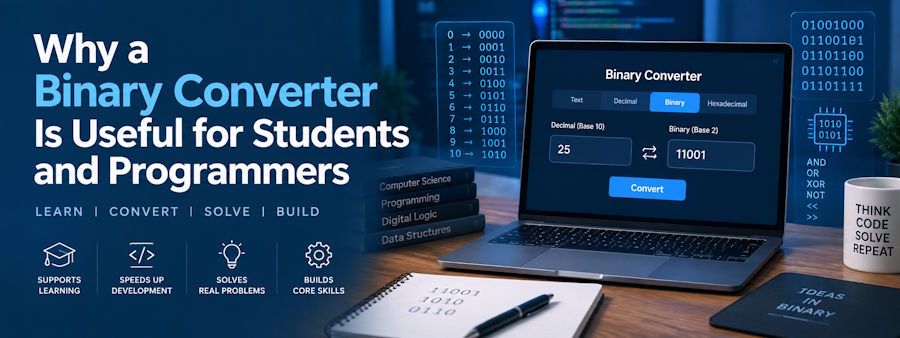
A binary converter provides a convenient way to move between binary and other number systems. It can save time, simplify calculations, and help users verify their results. For both beginners and experienced developers, this simple tool can become a useful part of everyday technical work.
What Is Binary?
Binary is a base-2 numbering system that uses only 0 and 1. Each position in a binary number represents a power of two. For example, the positions from right to left represent values such as 1, 2, 4, 8, 16, and 32.
Consider the binary number 10101. The digits with a value of 1 correspond to 16, 4, and 1. Adding those values produces 21 in decimal.
This concept may seem unusual to someone who has only worked with decimal numbers, but it becomes much easier with practice.
How a Binary Converter Helps Students
For students, binary conversion can be one of the more confusing topics in an introductory computer science course. They may need to convert values between binary, decimal, hexadecimal, and octal while learning how computers represent information.
A binary converter can make these exercises easier to understand. Students can first attempt a conversion manually and then compare their answer with the tool's result. If the answers are different, they can go back through the calculation and identify where they made a mistake.
This approach turns the converter into more than just a shortcut. It becomes a way to practice and reinforce concepts.
Saving Time on Repetitive Calculations
Manual conversion is useful for learning, but repeatedly calculating large binary values can take considerable time. A converter can perform the same operation almost instantly.
For example, a programmer or student working with a long binary sequence does not need to calculate every power of two manually. Entering the value into a suitable converter can provide the corresponding decimal result within moments.
This is particularly helpful when several values need to be checked in succession.
Benefits for Programmers
Programmers sometimes encounter binary values when working with low-level operations, data structures, networking, permissions, and bitwise calculations. Although many programming environments provide built-in methods for handling conversions, an independent binary converter can still be useful for quick verification.
For instance, when working with bitwise operators, programmers may need to understand which individual bits are set to 1 and which remain at 0. Converting between binary and decimal can make these relationships easier to inspect.
Hexadecimal conversion can also be useful because programmers frequently encounter hexadecimal representations in technical environments.
Checking Programming Calculations
Programming mistakes are not always caused by complicated code. A single incorrect numerical value can sometimes produce unexpected behavior. A converter provides a quick way to check whether a binary representation matches the intended decimal or hexadecimal value.
Suppose a developer expects a particular decimal value to correspond to a specific binary pattern. By entering the value into a converter, they can confirm the relationship before continuing with their work.
This simple verification step can help reduce avoidable numerical errors.
Understanding Different Number Systems
One of the biggest educational advantages of a binary converter is that it helps users see how the same value can appear in different forms.
For example, a single numerical value might be represented in decimal, binary, hexadecimal, or octal. Although the written forms look different, they all describe the same quantity.
Seeing these relationships repeatedly can help students develop a stronger understanding of number systems. Programmers can also benefit because different areas of computing may use different representations.
Useful for Digital Technology Studies
Binary is not limited to programming. It is also important in digital electronics, computer architecture, networking, and other technology-related fields.
Students studying these subjects may encounter binary values regularly. A converter can make it easier to check calculations while allowing learners to focus on broader concepts instead of spending excessive time on arithmetic.
For beginners, this can make technical subjects feel less intimidating.
A Tool for Learning, Not Just Shortcuts
It is important to use a binary converter thoughtfully. Students should still learn how manual conversion works because understanding the underlying process is more valuable than simply knowing the final answer.
A good learning routine is to solve a problem independently, use the converter to check the result, and then review the calculation if there is a difference. Over time, this practice can improve both speed and confidence.
Programmers can follow a similar approach by using converters for verification rather than relying on them blindly.
Choosing a Convenient Converter
An effective binary converter should be simple to use and provide clear results. A straightforward interface makes it easier to enter values, select conversion types, and understand the output.
It is also helpful when a tool supports multiple number systems. Having binary-to-decimal, decimal-to-binary, binary-to-hexadecimal, and related conversions in one place can make technical work more convenient.
Conclusion
A binary converter is a practical resource for both students and programmers. Students can use it to check homework, practice number-system conversions, and develop a better understanding of binary mathematics. Programmers can use it to verify values, examine bit patterns, and save time during technical tasks.
The real value of a converter is not simply its ability to produce an answer quickly. When used alongside an understanding of binary principles, it can support learning, improve accuracy, and make numerical work more efficient. Whether you are beginning your computer science studies or writing software professionally, having an easy way to convert binary values can be a useful addition to your technical toolkit.

