

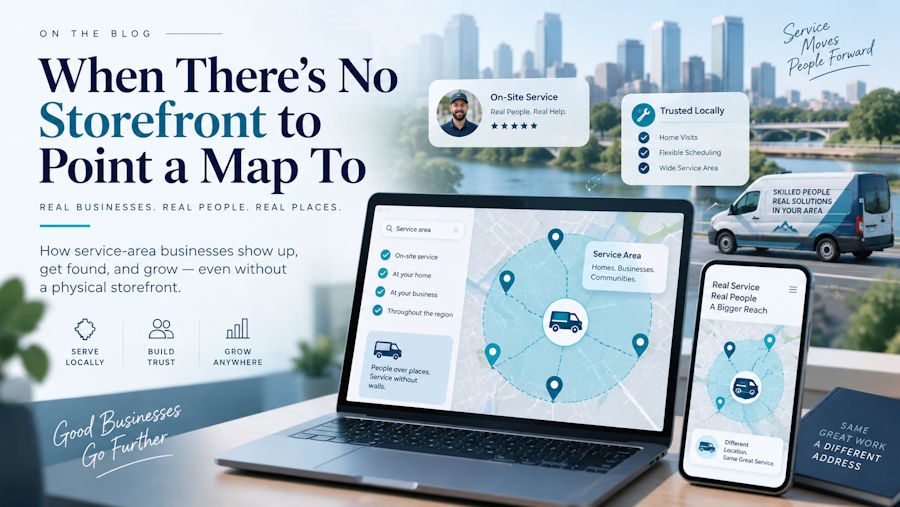
Standard local search advice assumes a business has a physical address customers can visit — walk in, browse, make a purchase. That assumption breaks down entirely for the plumber who drives to a customer's house, the mobile detailer who works out of a van, or the consultant who meets clients wherever they happen to be.
Why Service-Area Businesses Need a Different Approach
A service-area business — one that travels to customers rather than operating from a location customers visit — faces a fundamentally different set of local search considerations than a traditional storefront. Google Business Profile offers a specific setting for exactly this situation, allowing a business to define a service area rather than displaying a physical street address to the public, while still maintaining local search relevance for the communities actually served.
Setting Up a Profile Without a Public Address
Service-area businesses can hide their physical address from public display while still verifying their location internally with the platform, and defining a specific service area — either by radius from a base location or by listing specific cities and regions served. Getting this configuration right matters significantly, since an improperly configured profile might either fail to appear for legitimate service areas or, worse, get flagged for violating guidelines around location representation.
Why Overly Broad Service Areas Backfire
A common mistake among service-area businesses involves listing an overly broad, unrealistic service area in hopes of capturing more search visibility. Search platforms tend to penalize this kind of overreach, since the underlying algorithm accounts for distance and travel feasibility when determining local relevance. A more realistic, focused service area — reflecting where a business can genuinely and reliably serve customers — tends to perform better than an inflated territory that dilutes relevance across too broad a geographic spread.
Reviews Carry Even More Weight for This Business Type
Without a physical location for customers to associate with a brand, reviews become an even more critical trust signal for service-area businesses, since they represent one of the only tangible pieces of social proof a potential customer can evaluate before booking a service sight unseen. Actively encouraging reviews after every completed job, and responding to them consistently, matters more for this business category than for a storefront where in-person browsing itself builds some baseline trust before a purchase decision.
Content Strategy for Service-Area Businesses
Content addressing specific service areas — dedicated pages for each city or region served, rather than a single generic "service area" page — tends to perform better in local search, since it gives search engines clear, specific signals about geographic relevance for each individual location. This approach requires more content investment than a single-location storefront business might need, since coverage needs to extend across every community genuinely served rather than concentrating on just one physical address.
Citation Consistency Without a Public Address
Citation building — getting a business listed consistently across relevant directories — works a bit differently for service-area businesses, since many directories are built around the assumption of a public address. Some directories accommodate service-area businesses directly, while others require adaptation or exclusion depending on their specific format. Working through which directories genuinely support this business model, rather than forcing an ill-fitting listing format everywhere, produces cleaner, more accurate citation data overall.
Multi-Location and Multi-Technician Considerations
Service-area businesses operating with multiple technicians or vehicles covering different territories face additional complexity, since a single business profile may need to represent a combined service area spanning what functions as several distinct operational zones. Some businesses in this position benefit from separate profiles for genuinely distinct service regions, while others consolidate under a single profile with a broader combined area — the right approach depends on how distinctly separate the operational territories actually function in practice.
Comparing This to Standard Storefront Local SEO
While the underlying local search factors — relevance, distance, and prominence — apply to service-area businesses just as they do to storefronts, the practical execution differs meaningfully. A storefront benefits from foot traffic and walk-in visibility supporting its local presence, while a service-area business relies more heavily on digital signals — reviews, service-area-specific content, and citation accuracy — to establish the same kind of local trust and relevance.
Common Mistakes Service-Area Businesses Make
A few recurring issues tend to hold back local visibility for this business type even when other fundamentals are reasonably solid: listing a home address publicly out of habit rather than properly configuring the service-area setting, failing to create individual location pages for each community served, and neglecting review generation because there's no natural in-person moment to ask for one the way a storefront transaction provides. Addressing these specific gaps tends to produce more meaningful improvement than generic local SEO advice that assumes a physical location customers can visit.
Getting Local Search Right Without a Storefront
Local SEO services tailored specifically to service-area business needs account for these structural differences rather than applying a generic storefront-oriented strategy that doesn't quite fit. Recognizing this distinction early tends to prevent wasted effort on tactics — like storefront-style local landmarks or foot-traffic-driven strategies — that simply don't translate to a business model built around traveling to the customer instead.
Conclusion
Service-area businesses face genuinely different local search challenges than traditional storefronts, requiring a tailored approach to profile setup, service area definition, and content strategy. Getting these specific details right allows a business without a public address to compete effectively for the same valuable local visibility that storefront businesses pursue.

