

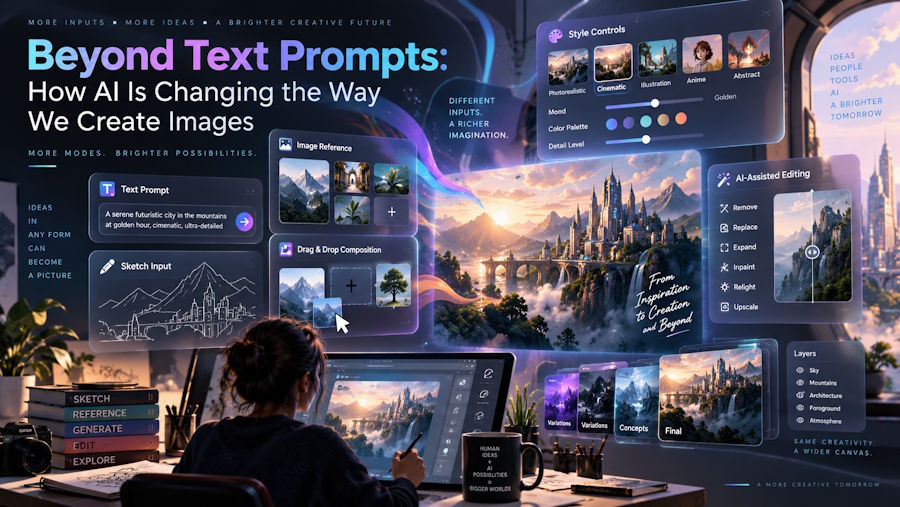
Artificial intelligence is changing visual content creation at a pace that would have been difficult to imagine only a few years ago.
Creating an image no longer necessarily starts with a camera, a blank Photoshop document, or a professional illustrator. Increasingly, it can start with a sentence, a rough sketch, an existing photograph, or even a simple idea.
The important shift isn't simply that AI can create images.
It is that AI is becoming capable of understanding creative intent.
A creator can describe what they want, provide visual references, make corrections, and gradually refine the result. This is turning image generation from a one-time process into an iterative creative workflow.
The Evolution of AI Image Generation
Early AI image generators demonstrated that machines could transform text descriptions into visual content.
A user could enter a prompt such as:
"A futuristic city at sunset with flying vehicles and neon buildings."
The system would interpret the text and generate an image.
While this was impressive, early systems often struggled with details. Objects could appear distorted, text inside images could be inaccurate, and making a small change might require generating the entire image again.
Modern systems are moving toward a different approach.
Instead of simply asking AI to create something, users can increasingly ask it to create, inspect, modify, and preserve.
That difference is important for professional creative work.
AI Text to Image Generators Are Becoming Creative Assistants
An AI text to image generator converts natural-language descriptions into visual content.
But its usefulness extends beyond producing a single image.
Creators can use text prompts to explore different concepts before committing to a final direction. A marketing team might generate several product concepts. A filmmaker might visualize a scene before production. A designer might experiment with different compositions and styles.
This makes text-to-image technology particularly useful during the ideation stage.
Instead of spending hours creating an initial concept, a creator can explore dozens of possibilities and then develop the strongest direction further.
The human remains responsible for the creative decision-making, while AI accelerates the experimentation process.
The Prompt Is Becoming More Like a Creative Brief
As image models improve, prompting is becoming less about finding a magical combination of keywords and more about communicating a clear creative brief.
A detailed prompt can specify:
- Subject
- Environment
- Composition
- Camera perspective
- Lighting
- Color palette
- Materials
- Visual style
- Mood
- Aspect ratio
- Important objects
- Text requirements
For example, instead of asking for:
"A product photo of a smartphone."
a creator could describe the environment, lighting, camera angle, surface, background, and desired commercial aesthetic.
The result is more likely to reflect the intended concept because the model receives more information about the visual goal.
From Generation to Editing
One of the biggest developments in visual AI is the increasing importance of editing.
Generation creates the first version.
Editing develops the final version.
This distinction matters because professional creative work rarely ends with the first draft.
A designer might want to change the background without touching the subject. A marketer might want to change the color of a product. A photographer might want to remove an object while preserving the lighting and composition.
Modern image models are becoming better at handling these kinds of targeted instructions.
GPT Image 2.5 and the Move Toward Precise Editing
A recent example is GPT Image 2.5, introduced by OpenAI in September 2026.
OpenAI describes ChatGPT Images 2.5 as an image-generation and editing system focused on sharper details, faster generation, more precise editing, and better preservation of reference subjects. The company also says it follows editing instructions more reliably across multiple turns and has reduced image-generation latency by up to 50% compared with Images 2.0.
The API release includes two variants: GPT-Image-2.5 Flare and GPT-Image-2.5 Sunburst. OpenAI positions Flare as the faster option for everyday high-quality generation, while Sunburst is designed for workflows where more precise editing control is important.
This illustrates a broader change in AI image creation.
The workflow is moving from:
Prompt → Generate → Accept or Reject
toward:
Prompt → Generate → Edit → Refine → Preserve → Finalize
That is much closer to the way professional creative production actually works.
Reference Images Are Becoming Part of the Prompt
Text isn't always the best way to communicate a visual idea.
Sometimes an image can communicate in seconds what would take several paragraphs to explain.
Creators can provide reference images showing:
- A person's appearance
- A product
- A particular environment
- Clothing
- A visual style
- A composition
- A character
- A design direction
The AI can then use those references while generating or modifying the output.
This is especially valuable for maintaining consistency.
For example, an ecommerce brand may want the same product represented in multiple environments. A filmmaker may need the same character to appear across several scenes.
Reference-based workflows can help preserve important visual characteristics while allowing other parts of an image to change.
OpenAI says GPT Image 2.5 improves preservation of subjects in reference photos, including details such as recognizable features, lighting, and textures.
Sketches Are Becoming Another Way to Prompt AI
Not every creative idea is easy to describe.
Sometimes a rough sketch is more useful than a detailed paragraph.
A simple drawing can communicate where objects should appear, how a composition should be arranged, or where a character should stand.
ChatGPT Images 2.5 introduced Sketch, allowing users to draw directly in ChatGPT and use the drawing as a reference for the resulting image. OpenAI also introduced templates for common formats such as product photos and flyers.
This suggests that the future of prompting may not be purely text-based.
Instead, creative instructions could combine:
Text + Images + Sketches + References + Editing Instructions
The AI then interprets all of these inputs together.
Why This Matters for Marketing
Marketing teams constantly need new visual assets.
A single campaign can require:
- Social media graphics
- Product images
- Display advertisements
- Website visuals
- Blog images
- Email graphics
- Video thumbnails
- Landing-page assets
Traditional production can make producing dozens of variations expensive.
Generative AI can help marketers explore different concepts quickly.
A team could generate several campaign directions, select the strongest concept, modify it for different audiences, and produce multiple variations without rebuilding every asset manually.
The value isn't necessarily replacing designers.
It is reducing the time between idea and experimentation.
AI Is Also Changing Product Visualization
Product visualization is another area where generative AI can be useful.
A company might have a basic product photograph but need several creative environments for an advertising campaign.
Instead of photographing the product in every environment, AI can help create different contextual scenes around the product.
For example:
Original product → Studio scene → Outdoor scene → Luxury environment → Seasonal campaign → Social-media variation
The underlying product remains central while the surrounding creative context changes.
This kind of workflow can be particularly valuable for ecommerce and digital advertising.
Character Consistency Is Becoming More Important
Creating one attractive AI character is relatively easy.
Creating the same character repeatedly is considerably more difficult.
For storytelling, gaming, marketing, and entertainment, consistency matters.
Creators may need a character to maintain:
- Facial characteristics
- Hairstyle
- Clothing
- Body proportions
- Color palette
- Visual style
- Distinctive accessories
This is why reference images and iterative editing are becoming increasingly important.
The objective is no longer simply to generate an impressive image.
It is to build a reusable visual identity.
AI Image Generation Is Moving Toward Multimodal Workflows
The future of AI image creation is likely to involve multiple forms of input rather than text alone.
Imagine a creator providing:
A written concept + product photo + rough sketch + style reference
and asking an AI system to combine these elements into a campaign visual.
This is fundamentally different from traditional text-to-image generation.
The AI isn't simply generating an image from a sentence. It is interpreting several sources of information and attempting to preserve the creator's intent across them.
The Human Role Is Still Important
The rapid improvement of generative AI does not eliminate the need for creative direction.
Someone still has to decide:
- What the image should communicate
- Who the audience is
- Which concept fits the brand
- Which version should be used
- What needs to be changed
- Whether the result is actually appropriate
AI can generate possibilities, but humans provide context and judgment.
This is particularly important for commercial content, where visual accuracy and brand consistency matter.
The New Creative Workflow
The traditional creative workflow often looked something like:
Brief → Design → Review → Revision → Final
AI is introducing a more iterative process:
Idea → Generate → Compare → Edit → Refine → Generate Again → Final
The number of creative experiments can increase dramatically because the cost of producing an initial concept is lower.
This can encourage teams to test ideas they might previously have rejected simply because they were too expensive or time-consuming to explore.
What Comes Next?
The next generation of AI image tools will likely focus less on simply producing impressive individual images and more on maintaining context across an entire project.
That means remembering:
- What the character looks like
- What the product looks like
- Which visual style is being used
- What has already been edited
- What should remain unchanged
- Which elements need to be consistent
GPT Image 2.5's emphasis on multi-turn editing and reference-image preservation is an example of this broader direction.
The goal is increasingly to make AI behave less like a random image generator and more like a creative collaborator that can follow a project from its initial concept through multiple revisions.
Final Thoughts
AI image generation is entering a new phase.
The technology is moving beyond the novelty of creating an image from a sentence and toward a more practical creative workflow involving generation, editing, references, sketches, and iterative refinement.
An AI text to image generator can help turn an idea into an initial visual. Newer systems such as GPT Image 2.5 are pushing the workflow further by improving image fidelity, editing precision, and consistency across multiple iterations.
The most significant change may therefore not be that AI can create images.
It is that creators can increasingly communicate an idea, see it, change it, and refine it without starting over.
That shorter distance between imagination and execution could become one of the defining characteristics of the next generation of digital creativity.

