

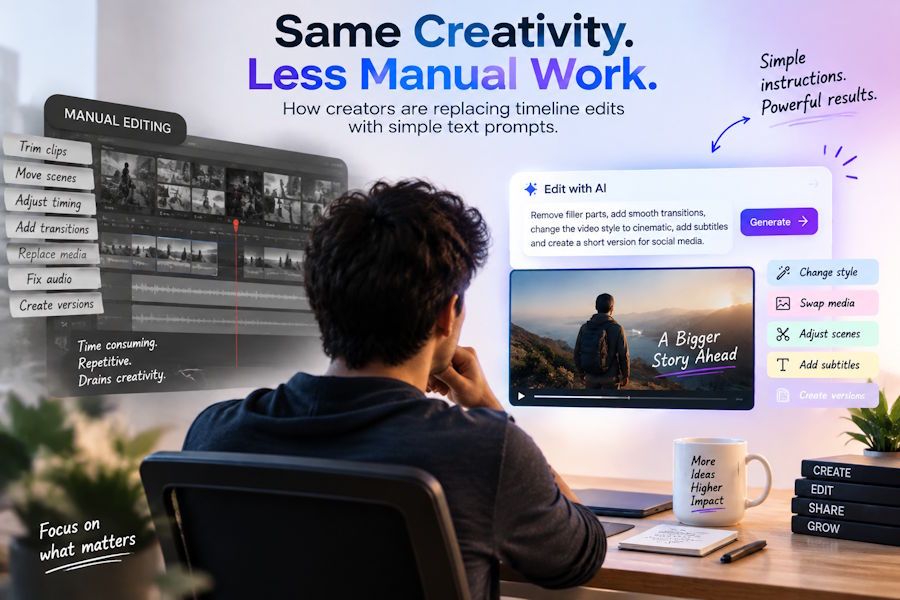
The Shift From Manual Editing to Text-Based Commands
Traditional video editing gives creators complete control, but it also requires them to perform every action manually.
A creator may need to:
- Find specific moments in hours of footage
- Replace individual clips
- Adjust scene timing
- Modify visual styles
- Create multiple versions of the same content
- Resize videos for different platforms
These tasks are important, but many of them involve repetitive execution rather than creative decision-making.
Text-based editing changes this process by allowing creators to communicate their intent through instructions. Instead of manually searching for every setting, they can describe what they want to change and let AI assist with the execution.
For example, a creator could request a different visual style, replace certain media, shorten a section, or adjust scenes using simple instructions.
The goal is not to remove the editing process but to make it faster and more accessible.
Why Creators Are Exploring AI-Assisted Editing
The growth of short-form content and online video platforms has increased the demand for faster production workflows.
Creators today often need to produce:
- Long-form videos
- Short social clips
- Tutorials
- Product videos
- Educational content
- Marketing videos
Managing all these formats manually can take significant time, especially for individual creators or small teams.
AI-assisted editing helps reduce the workload by supporting repetitive tasks while allowing creators to focus on storytelling, ideas, and audience engagement.
Instead of spending hours making basic adjustments, creators can spend more time improving the creative aspects of their videos.
How Text Prompts Are Changing Video Editing Workflows
Text prompts provide a simpler way to interact with editing software.
Instead of navigating through multiple editing tools, creators can describe the action they want.
Examples include:
- Change the style of the video
- Replace a specific scene
- Add different visuals
- Adjust the pacing
- Create a new version for another platform
This approach makes editing more conversational. Creators can explain their goals in natural language instead of learning every technical control inside the software.
However, professional editing still requires judgement. AI can assist with execution, but creators decide how the story should feel, what moments matter, and how the final video should connect with viewers.
How AI Video Editors Support Faster Creative Workflows
AI-powered editing platforms are helping creators manage repetitive editing tasks while keeping the creative process flexible.
Invideo editor is an example of a workflow that combines professional editing capabilities with AI assistance. Creators can work with their existing footage, provide instructions, and make changes through text-based commands instead of manually adjusting every element.
For creators looking for more efficient ways to manage projects, AI video editing tools can help simplify tasks such as changing video styles, swapping media, adjusting scenes, and refining content through natural language instructions.
This type of workflow allows creators to maintain control over their projects while reducing the time spent on repetitive editing operations.
Keeping Creative Control in an AI Editing Workflow
While AI can speed up editing, creative control remains an important part of video production.
A good editing workflow should allow creators to review changes, make adjustments, and refine the final result.
Invideo editor follows this approach by keeping the editing process flexible. Creators can use AI assistance for repetitive tasks while continuing to shape the timeline, adjust decisions, and control the final direction of the project.
This balance is important because editing is not only about completing technical steps. It is about creating a story, maintaining a specific style, and making decisions that improve the viewer experience.
The Role of AI in Future Video Production
As AI technology improves, video editing workflows will continue to become more interactive.
Future editing systems will likely focus less on complex controls and more on understanding what creators want to achieve. Instead of manually completing every step, creators will be able to describe their ideas and guide AI systems through the production process.
Tools like invideo editor show how this shift is already taking place by helping creators combine AI assistance with a flexible editing workflow. By reducing repetitive editing tasks while keeping projects editable, these workflows allow creators to spend more time refining ideas and improving the final output.
This shift can make advanced editing workflows more accessible to beginners while helping experienced editors complete projects faster.
The role of AI will not be to replace creative professionals but to support them by reducing repetitive work and making the editing process more efficient.
Conclusion
Text-based editing is changing how creators approach video production. By allowing users to describe changes through simple instructions, AI-powered workflows can reduce the time spent on repetitive timeline adjustments.
Creators still need control over storytelling, pacing, and creative decisions. However, AI assistance can make the production process faster by handling more operational tasks.
As video production continues to grow, combining human creativity with AI-powered editing workflows will help creators produce more content while maintaining quality and creative control.

