

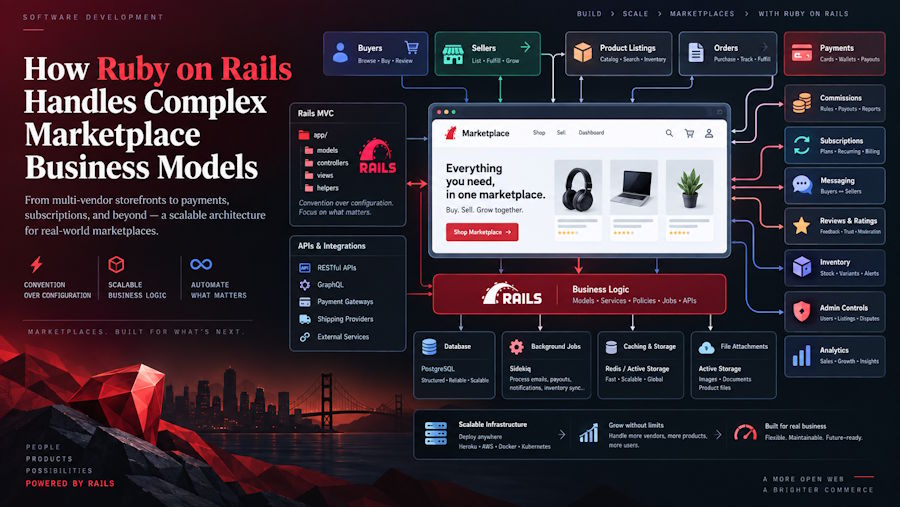
Anyone who has tried to build a marketplace platform knows the dirty secret: the checkout flow is the easy part. The hard part is everything underneath it – payment splitting, vendor onboarding, trust between strangers, commission logic that somehow needs to satisfy finance, legal, and three different vendor tiers at once. This is exactly where a lot of teams discover that their framework choice matters more than they expected.
That’s why so many founders creating a marketplace find themselves asking the same question early on: should we go with Ruby on Rails? And creating a marketplace in Ruby on Rails style is a proven shortcut through the complexity. Rails was practically built for the kind of "many moving parts, tight timeline" project that marketplaces always turn out to be, especially when your online marketplace business model demands rapid iteration and multi‑stakeholder logic out of the gate.
Why Marketplace Business Models Are Harder Than They Look
Before getting into the technical side, it helps to be honest about what makes a marketplace business model genuinely difficult to build for. A regular e-commerce store has one seller, one catalog, one set of rules. A marketplace has to manage relationships between at least two parties who don't fully trust each other yet, and often a third party (you) mediating the money.
Online marketplace business models generally fall into a few recognizable shapes: multi-vendor marketplaces where many sellers list under one roof, two-sided marketplaces connecting distinct buyer and seller groups, and peer-to-peer marketplaces where "sellers" are often regular people renting out a spare room, a drill, or an afternoon of their time. Each of these online marketplace business models comes with its own quirks – different payout schedules, different verification needs, different dispute-resolution expectations.
Thinking about tech choices? You might find it useful to explore specialized development expertise – for example, https://roobykon.com/ruby-on-rails-development offers a perspective on building adaptable systems that handle multi-party logic, payments, and user roles without breaking under edge cases.
Where Ruby on Rails Actually Earns Its Reputation
A Ruby on Rails marketplace isn't a coincidence of popularity – it's a product of how the framework is structured. Rails follows "convention over configuration," which sounds like developer jargon until you realize what it means in practice:
- Less time arguing about folder structure and naming schemes
- More time actually solving business problems like fee calculation or vendor verification
For a marketplace Ruby on Rails build, this matters because marketplaces are rarely simple CRUD apps. They involve interconnected models – users, listings, orders, payments, reviews, disputes – that all reference each other constantly. Rails' ActiveRecord ORM makes those relationships genuinely pleasant to work with instead of a constant source of bugs. Add in gems like Devise for authentication, Pundit or CanCanCan for role-based permissions, and Sidekiq for background jobs (sending payout notifications, generating invoices, syncing with shipping APIs), and you get a stack that was basically pre-assembled for this exact use case.
If you want a deeper technical breakdown of why the language and framework combination holds up so well for fast-moving companies, it's worth reading RoR advantages – a lot of the same reasoning applies directly to marketplace builds, since startups and marketplaces both live and die by how fast they can ship and iterate.
Multi-Vendor Marketplaces: Keeping Chaos Organized
A Ruby on Rails multi-vendor marketplace has to answer a deceptively simple question over and over: whose money is this, and when do they get it? Every order might need to be split across several vendors, each with their own:
- Commission rate
- Tax handling
- Payout timing
Rails handles this well because its object-oriented structure lets you model each vendor as its own entity with its own rules, rather than jamming everything into one giant "seller" table with a dozen conditional flags.
Inventory sync is another place multi-vendor setups get messy – dozens of vendors updating stock levels simultaneously, sometimes selling the same item across multiple channels. Rails' mature ecosystem, combined with background job processing, keeps that synchronization from turning into a race-condition nightmare.
Two-Sided and Peer-to-Peer Models: Trust as a Feature
A Ruby on Rails two-sided marketplace usually lives or dies on how well it builds trust between two groups that have never met. Think ride-sharing, freelance platforms, or rental services. The technical challenge here is less about inventory and more about matching, messaging, reviews, and dispute handling – all of which need to happen in near real time.
This is also where peer-to-peer marketplace Ruby on Rails builds get interesting, because the "vendors" are often individuals, not businesses. That changes the onboarding flow considerably – you need lighter-weight verification, more emphasis on ratings and reviews, and payment systems that can handle small, frequent payouts to non-professional sellers rather than large batch payments to registered companies. Rails' flexibility around integrating with services like Stripe Connect makes this kind of split-payment structure far less painful than building it from scratch.
Modeling the Marketplace Business Model, Not Just the Code
The marketplace business model isn't just a monetization detail that gets decided in a boardroom and handed to developers afterward. Commission percentage, subscription tiers for vendors, featured-listing fees, transaction minimums – these all need to be represented cleanly in the data model from day one, or you'll be doing painful migrations six months in when the business decides to add a new pricing tier.
This is one of the reasons experienced Rails teams push back on "just build the MVP and figure out monetization later." A little bit of upfront thinking about how the marketplace business model maps onto database tables and business logic saves a disproportionate amount of pain down the line.
Learning by Building: What a Rails Marketplace Tutorial Actually Teaches
If you search around, you'll find no shortage of a Ruby on Rails marketplace tutorial promising to get you from zero to "working marketplace" in a weekend. Most of these are genuinely useful for understanding the basics – setting up authentication, creating listings, wiring up Stripe for payments. But there's a meaningful gap between a tutorial project and a production marketplace that needs to handle real money, real disputes, and real scale.
That gap is usually where teams either burn months reinventing patterns that already exist, or bring in developers who've built marketplace Ruby on Rails projects before and already know where the landmines are – things like idempotent payment processing, handling partial refunds across multiple vendors, or making sure a canceled order doesn't leave a vendor's payout in limbo.
Migrating Off No-Code Platforms
Many marketplace founders begin on no‑code or low‑code tools to rapidly test an idea – a smart move for validation. But as user demand climbs, these platforms often hit a ceiling. Whether it’s custom logic that doesn’t fit the template, performance bottlenecks under real traffic, or the desire for full code ownership, the need to migrate becomes clear. That’s where a Ruby on Rails marketplace architecture shines: it offers the flexibility to break free from rigid templates while scaling smoothly with your growth.
Bringing It Together
Marketplaces are one of the more unforgiving categories of software to build, precisely because they're really two or three products stitched together – a listings platform, a payments system, and a trust-and-reputation engine, all operating at once. Ruby on Rails doesn't magically make that complexity disappear, but its conventions, its mature ecosystem, and its long track record with exactly this kind of online marketplace business model make it one of the more pragmatic choices available.

