

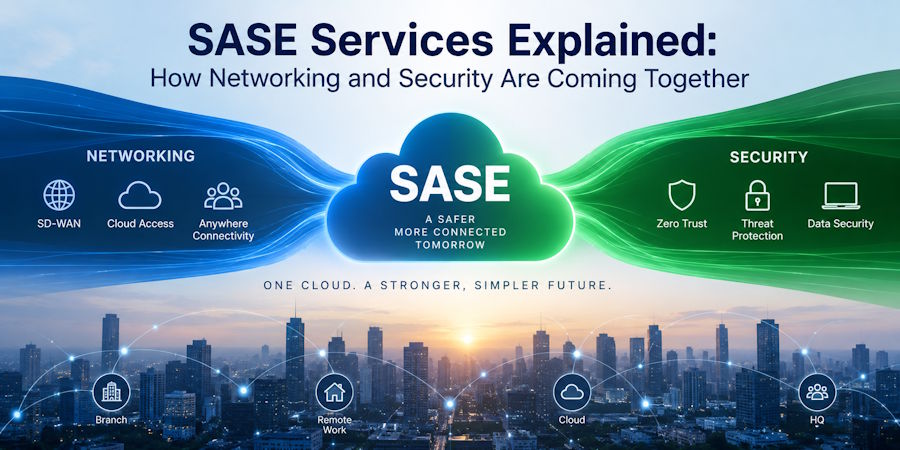
For a long time now, networking and security were two distinct concepts. This concept was viable in an era where employees worked in their offices and applications were hosted within corporate data centers. Work is now performed from anywhere, and the distinction cannot be maintained any longer.
An implementation of SASE services[a] helps bring together networking and security. It makes it possible for connectivity and security to be managed in an integrated manner via the cloud.
Why the Old Network Model Is Changing
Consider an employee working from home accessing a business application running in the cloud. In the conventional scenario, the request may pass through a company’s network before reaching the application. This path can become redundant when the person, application, and data are all located beyond the boundaries of the office environment.
The same problem exists for branch offices where the organization needs security in connecting the various branches with each other while providing their personnel with access to cloud applications. All this centralized approach results in traffic congestion.
Many organizations ask what solution would allow them to provide their people with access to necessary resources in a secure way. This is when SASE comes into play.
What SASE Brings Together
SASE offers both networking and security services that businesses used to manage independently. SASE helps ensure that there is a uniform process of connecting users, applications, devices, and sites through security.
These components may include SD-WAN, Zero Trust Network Access, Secure Web Gateway, Cloud Access Security Broker, and Firewall-as-a-Service. Each of these functions differently, but the real benefit lies in coordinating them.
With SD-WAN, appropriate path selection for application traffic is possible, but the security function will inspect the traffic and implement access control policies. It is also possible that the identity of the person plays an important role in accessing applications.
This is an example of a more general trend of enterprise information technology: security following the user and the application, rather than being bound by the network.
SASE Services Compared With Traditional Networking
| Area | Traditional Approach | SASE Approach |
|---|---|---|
| User access | Often centered on network location | Based more heavily on identity and context |
| Cloud applications | Traffic may travel through central infrastructure | Users can connect through distributed cloud edges |
| Security | Multiple standalone controls | More coordinated cloud-delivered controls |
| Branch connectivity | Dedicated infrastructure and fixed routes | Flexible, application-aware connectivity |
| Management | Separate networking and security consoles | Greater policy and management convergence |
| Remote work | Frequently dependent on VPN access | Supports application-specific access models |
The contrast lies more in the shift in thinking about access rather than substituting one service for another. The same shift is reflected in how SASE is used in modern cloud networking[b], where secure connectivity needs to support users, applications, and infrastructure across distributed environments.
Why This Matters for Everyday IT Operations
The greatest strength of SASE lies in its practicality. Information technology professionals currently support remote workers, branch locations, cloud apps, security alerts, access requests, and performance issues. In each case, the work is performed within siloed tools, where even simple tasks require multiple teams and consoles.
A greater degree of unification will enable a better experience for these processes. If an application is performing poorly, then networking and security teams can evaluate connectivity and inspection jointly. If there is an access request for an application, then administrators can employ policy based on identity and context as opposed to positioning a worker into a network segment.
This does not mean SASE eliminates operational challenges. It changes how organizations manage them.
The Role of Zero Trust
Zero Trust is important since modern access cannot depend exclusively on where a user is coming from. Being logged into an office computer doesn't necessarily make one more secure than being logged in via a home connection.
In Zero Trust[c], more evidence is required before providing access. It could take into account such information as identity, condition of the device, application, and other contextual elements. And thus access will still remain limited to what the individual really requires.
Combined with SASE, these policies can follow users and applications rather than depending entirely on traditional network boundaries. Organizations can support flexible work without treating remote access as an exception.
What Organizations Should Look For
There is no single SASE deployment for every business. Organizations should first look at how their people and applications actually work.
Before choosing a service, teams should consider:
- Existing infrastructure: Identify current WAN, security, identity, and cloud technologies and determine how well they can work together.
- User experience: Look at latency, application performance, and access reliability across important locations.
- Policy management: Check whether teams can create consistent access and security rules without maintaining disconnected systems.
- Scalability: Consider future users, branches, applications, and cloud environments rather than solving only today's problems.
- Operations: Review visibility, reporting, troubleshooting, and automation capabilities that can reduce administrative work.
The best starting point is a clear understanding of business requirements. Technology should follow that assessment.
SASE Is About More Than Security
It is easy to call SASE just another security architecture, but networking will still be an important factor. Companies will have to ensure reliable application access and traffic management along with performance.
The connection is very important because a security measure that results in latency will be harmful to performance, while a network path that does not account for security may pose risks.
The convergence will bring about a different way of collaboration between network and security experts.
What a Modern SASE Strategy Looks Like
The implementation of a sensible SASE approach doesn’t call for an abrupt change either. Companies may start off with certain application use cases and scale up based on the results obtained.
SASE won’t fix bad network designs or poorly defined policies. The company will still need sound identity management and governance, as well as staff that understands the environment.
Conclusion
The shift to SASE is simply a response to the truth that business network boundaries no longer exist at the office boundary. People work from a variety of places, applications run in many environments, and security needs to follow suit without being overly restrictive.
SASE allows companies to rethink their approach to connecting people and resources through the combination of networking and security. It is really all about creating an ecosystem where connectivity, security, and user experience coexist.
Frequently Asked Questions
-
What are SASE services mainly designed to solve?
These enable users, applications, branches, and clouds to securely connect even as the network borders defined by businesses have evolved.
-
Does SASE make VPNs obsolete?
Not necessarily. SASE will lessen reliance on conventional VPN frameworks by providing application access by identity rather than broad and indiscriminate coverage. It all depends on the applications and needs.
-
Is SASE useful for smaller organizations?
Yes, it is possible. Smaller businesses can gain from cloud-based networking and security services even without investing in much physical hardware. It all depends on how complex the case is.
-
How does SASE improve cloud application access?
SASE can enable connectivity between users and cloud applications using points of presence distributed around the world, with security policies enforced at each stage of the process.
[a]Do-follow link
[b]Do-follow link
[c]No-follow link

