

The internet has made it incredibly easy to share a photograph, but it has also made it surprisingly difficult to know where that photograph has been used.
A picture posted on one social network can eventually appear on another. A dating profile photo might be reused elsewhere. An old photograph can resurface years later on a completely different website. Sometimes, the person in the picture may not even know that the image is being used.
This is where modern image-search technology becomes useful.
Traditional search engines are excellent at finding words. Type in a person's name, a company, or a specific phrase and you can usually find pages containing that information. Images are different, though. A photograph doesn't always come with useful text or a unique description.
Reverse image search approaches the problem from another direction: instead of starting with words, it starts with the image itself.
More recently, artificial intelligence has made this process considerably more sophisticated. AI-powered systems can analyze visual characteristics of a face or image and look for visually similar photographs across publicly available sources.
For people trying to understand where a particular image appears online, this technology can provide a useful starting point.
What Is AI Face Search?
AI face search is a form of image search that uses artificial intelligence and computer vision to identify similarities between faces or photographs.
Rather than relying exclusively on filenames, captions, or keywords, these systems analyze visual characteristics within an uploaded image. Depending on the technology and its intended use, the system may look at facial features, proportions, patterns, and other visual signals to determine whether another photograph could depict the same person.
The basic idea is simple.
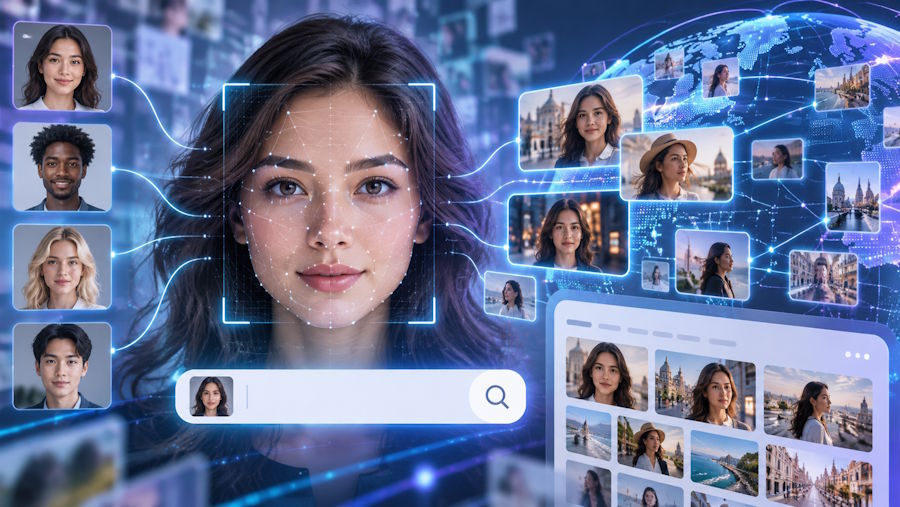
You provide an image. The system analyzes it. It then searches relevant publicly accessible sources for images that appear similar and presents potential matches.
That can be useful in situations where a conventional text search doesn't provide much information.
Imagine, for example, that you have an old profile picture saved on your phone. You don't know when it was taken, where it originally appeared, or whether somebody has reused it elsewhere. Searching the filename probably won't help.
A visual search can approach the problem differently.
Instead of asking, "What words are associated with this image?" it asks something closer to, "Where can visually similar versions of this image be found?"
That's a meaningful change in how people can navigate the web.
Why Reverse Image Search Matters
There are plenty of innocent reasons to search for an image.
A photographer might want to discover where their work has been republished. Someone may want to locate the original version of a photograph. A journalist might need to investigate the history of an image before publishing it. A person could discover that an old profile picture has appeared on websites they didn't expect.
There are also situations involving online dating and identity verification.
Dating has become heavily visual. Profiles are often built around a handful of photographs, and those photographs can tell a potential match a lot about how someone presents themselves online. But a photograph alone doesn't necessarily tell you whether a profile is genuine.
Images can be copied, edited, or reused.
A person could discover that the same photograph appears under multiple profiles. That doesn't automatically prove that anything suspicious is happening. There may be an innocent explanation. But finding the image elsewhere can provide additional context that wasn't available from the original profile.
This is one reason reverse image search has become an increasingly interesting tool for online research.
The important distinction is that an image match is a clue, not automatically a conclusion.
If an AI system identifies two similar photographs, users still need to consider the surrounding context. The images could have been copied. They could have been uploaded by the same person. They could represent different people who happen to look similar. Or the result could simply be a false match.
Good search technology can narrow down the possibilities, but people still need to interpret what they find.
How AI Face Search Works
The technical process behind AI face search is more complicated than simply comparing two photographs pixel by pixel.
A basic pixel comparison would be extremely fragile. Change the lighting, crop the photograph, apply a filter, change the background, or rotate the person's head slightly, and the images could look very different at the pixel level.
Modern computer-vision systems take a different approach.
They can extract meaningful visual characteristics from an image and represent those characteristics in a form that can be compared against other images.
This allows a system to recognize similarities even when two photographs aren't identical.
For example, consider two pictures of the same person. In one, the person might be smiling in natural light. In another, they're wearing different clothes and standing indoors. The photographs obviously aren't identical, but certain facial characteristics can remain relatively consistent.
AI-based image analysis is designed to identify those kinds of patterns.
The process generally involves several stages.
1. Uploading an image
The user provides a photograph. Depending on the service, this could be a selfie, profile picture, screenshot, or another image containing a visible face.
Image quality matters. A clear photograph with a reasonably visible face generally gives an AI system more useful information than a heavily blurred, tiny, or partially obscured image.
2. Analyzing visual characteristics
The system processes the photograph and extracts visual information that can be used for comparison.
This is where computer vision and machine-learning models become important. Rather than treating the image as one large collection of colored pixels, the system attempts to understand relevant visual patterns.
3. Searching available sources
The analyzed image can then be compared against images within the search service's available sources.
Different services search different collections. Some focus on general web pages, while others specialize in particular types of publicly available profiles or websites.
This distinction is important because no image-search service should be assumed to have access to every image on the internet.
4. Returning potential matches
Finally, the system provides results that appear relevant.
Some results may be strong matches. Others may simply be visually similar images.
Users should therefore examine the results rather than assuming that every result represents the same person.
AI Face Search and Online Dating
One of the more practical applications of this technology is researching photographs associated with online dating profiles.
Dating profiles can sometimes contain limited information. A profile might include a first name, a few photographs, a short biography, and perhaps some interests.
That can make it difficult to establish context from the profile alone.
Reverse image search provides another avenue for research.
For example, someone might want to determine whether a profile photograph appears elsewhere online. Instead of manually searching through websites and social networks, an AI-powered system can analyze the photograph and look for potential matches.
CheaterBuster's FaceTrace service is one example of this approach. Its site describes a reverse image search that allows users to upload a photograph and search for matching public profile images across 30+ dating apps and platforms. The service says its reports can include matched profile photographs, biographies, activity information, and other locations where the image appears.
You can learn more about ai face search and how this type of reverse image search works.
The usefulness of this approach comes from the additional context it can provide.
Suppose you encounter a profile photograph that looks familiar. You could spend considerable time searching manually, trying different names and keywords. An image-based search can instead start with the photograph itself.
That doesn't eliminate the need for judgment, but it can make the initial research process considerably easier.
What Makes a Good Search Image?
Not every photograph is equally useful for AI face search.
A high-quality image usually gives the system more information to work with. A clear, front-facing photograph can be particularly useful because facial features are easier to analyze when they're visible.
Several factors can affect results:
- Image resolution: Higher-resolution photographs generally preserve more visual detail.
- Face visibility: A face that is clearly visible is easier to analyze than one hidden behind sunglasses, hands, or other objects.
- Lighting: Extreme shadows or overexposure can make visual analysis more difficult.
- Angle: A straightforward portrait may provide more useful information than a photograph taken from an extreme angle.
- Filters: Heavy filters or aggressive editing can change the appearance of a photograph.
- Cropping: A very small face within a large photograph may provide less useful information.
This doesn't mean that a poor-quality photograph is automatically useless. Modern systems can work with a variety of images. It simply means that the quality and composition of the source photograph can influence what a search returns.
Understanding False Matches
One of the most important things to understand about AI face search is that a result is not necessarily proof.
Artificial intelligence works with probabilities and patterns. Even sophisticated systems can make mistakes.
Two people can look remarkably similar. A photograph can be edited. A person's appearance can change over time. Lighting can affect facial characteristics. A profile picture can also be uploaded to multiple websites for completely legitimate reasons.
That's why responsible use of image-search technology requires some common sense.
If a search returns a potential match, examine the details.
Do the photographs actually show the same person? Are the profile details consistent? Are the images from the same period? Is there an obvious explanation for why the image appears in another location?
The technology can help you find information, but it shouldn't encourage people to jump from a search result to an accusation.
This is particularly important in relationships.
Finding an old photograph on another website doesn't necessarily establish what someone is doing today. Likewise, finding a similar photograph doesn't automatically establish that two accounts belong to the same individual.
The search should be treated as an investigative starting point rather than a final answer.
Privacy Is Part of the Conversation
Any technology involving faces naturally raises questions about privacy.
A face is not simply another piece of text. It is a biometric characteristic, and people may have legitimate concerns about how photographs are processed, stored, or searched.
Before uploading an image to any online service, it is worth understanding the provider's privacy policies and terms.
Users should also think about what photographs they upload. There's a difference between researching a publicly available profile photograph and uploading sensitive personal images without considering how they may be handled.
According to CheaterBuster's FaceTrace page, uploaded searches are kept private and the person being searched is not notified. The company also states that its service aggregates publicly available information and does not hack accounts or provide real-time device tracking.
Those distinctions matter.
Responsible image search should focus on information that is legitimately available and should not involve attempts to gain access to private accounts, bypass security measures, or obtain information that someone has intentionally kept private.
Beyond Dating: Other Uses for Image Search
Although dating is one prominent use case, AI-powered image search has applications beyond dating profiles.
Finding the source of an image
People regularly encounter photographs without knowing where they originated. Reverse image search can help locate earlier or alternative versions.
This can be particularly useful when an image has been reposted many times.
Protecting creative work
Photographers, designers, artists, and content creators may want to discover where their work appears online.
Finding unauthorized copies doesn't automatically resolve a copyright issue, but knowing where content appears can be the first step toward addressing it.
Detecting reused profile photographs
People sometimes reuse the same profile photograph across different websites. A visual search can help identify those appearances without requiring the user to know every website where the photograph was posted.
Researching suspicious images
Images can be manipulated or presented without context. Reverse image search can sometimes reveal older versions or other appearances of the same photograph, helping researchers understand its history.
Verifying online information
A photograph can create an impression of authenticity, but an image by itself doesn't prove that a profile or story is genuine.
Searching the image can provide another piece of evidence when evaluating information found online.
The Future of Visual Search
The broader trend is clear: search is becoming increasingly multimodal.
For years, search primarily meant typing words into a box. Today, people can search using photographs, voice recordings, screenshots, and other forms of information.
AI is accelerating this transition because machine-learning models are increasingly capable of understanding different types of media and connecting information across formats.
For visual search, this means systems can move beyond simply finding identical copies of an image.
They can potentially understand similarities between photographs, recognize visual patterns, identify relationships between different versions of an image, and organize results in ways that would be difficult to achieve with traditional keyword search.
That could make visual search useful in areas ranging from online safety and journalism to copyright protection and personal research.
At the same time, the technology will continue to raise difficult questions.
How accurate should a face-search system be before people trust its results? How should false matches be handled? What information should be searchable? How long should uploaded photographs be retained? What safeguards should exist to prevent misuse?
These aren't purely technical questions.
They involve privacy, consent, security, and responsible use.
Using AI Face Search Responsibly
AI face search can be a practical way to investigate where photographs appear online, but the technology works best when it's treated as an information-gathering tool rather than an automatic truth detector.
Start with a clear photograph. Understand what the service actually searches. Review the provider's privacy policies. Examine results carefully. And, most importantly, distinguish between a potential match and verified information.
The internet contains an enormous amount of duplicated and repurposed visual content. A photograph can travel much farther than the person who originally uploaded it ever expected.
AI-powered reverse image search gives people another way to follow that trail.
Used responsibly, it can help answer questions that traditional keyword searches can't easily address: Where has this image appeared? Is this photograph being reused? Can I find the original source? Does this profile picture appear somewhere else?
Those questions are increasingly relevant in a world where much of our identity is represented visually.
AI face search doesn't make every mystery disappear. What it does is give users a faster way to investigate the digital trail behind an image—and, when combined with careful judgment, that can be surprisingly valuable.

