

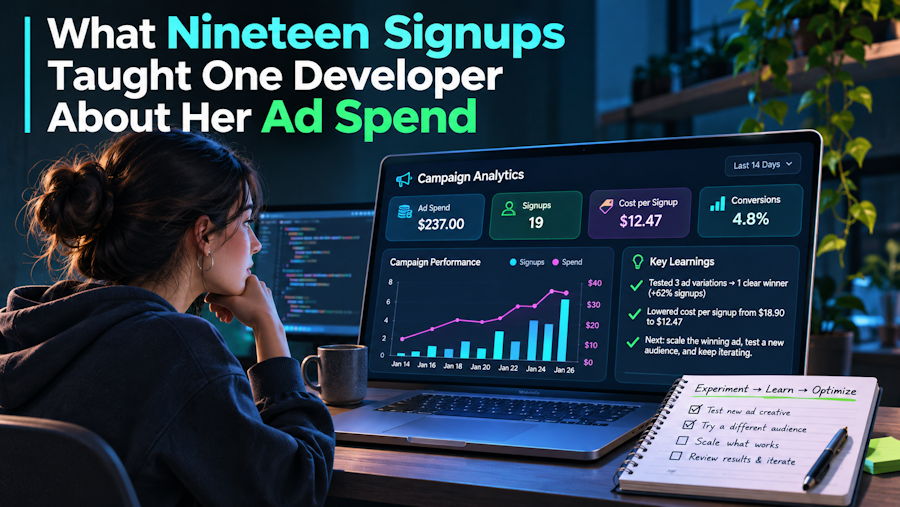
A developer who built an invoicing tool for freelance photographers spent $1,800 on ads in her first month. Her two ad accounts reported 41 conversions between them. Her own database showed 19 new paying customers.
Both platforms were taking credit for the same people, and she had no idea which $200 had actually worked.
Founders Who Measure Everything Except Marketing
Developer-founders tend to instrument their product obsessively. Error rates, query times, signup funnel drop-off by step. Then they open an ad dashboard, accept whatever number it shows, and write copy at midnight in whatever voice comes out.
It’s an odd blind spot, and an expensive one. The fix is the same discipline applied to the product: good inputs, a single source of truth, and a habit of checking.
Where AI Copy Helps
AI writing tools are genuinely useful for ad work, mostly because ads need volume. A single campaign might want fifteen headline variants, six descriptions, and three landing page versions to test against each other. Writing those by hand is tedious, and tedium produces lazy variants.
What they write by default, though, is bland. Feed one “invoicing software for photographers” and you’ll get lines about simplifying your workflow that could sell any product.
The output improves sharply when you give it real customer language. Pull phrases from support emails, onboarding calls, and cancellation surveys. The photographer founder found that customers kept saying they hated “chasing clients for deposits.” Ads built around that phrase beat her generic variants by a wide margin within two weeks.
Copy AI vs. Writesonic
These two get compared constantly, and they have grown in different directions.
Copy AI has moved toward workflows for sales and marketing teams, meaning repeatable processes that turn inputs like call notes or product updates into outreach and campaign copy. Writesonic leans toward long-form content and search visibility, including how a brand shows up in AI-generated answers.
For a solo founder writing ad variants, either will do the job this month. The better question is what you’ll need in month three. If your growth plan depends on articles and organic search, the second fits. If you’re about to hire a salesperson and want consistent outreach built from the same messaging, the first makes more sense.
When comparing Copy AI to Writesonic directly, give both the identical brief, with a real customer quote and a hard character limit, and judge the raw output before any editing. Most of the difference shows up in the first draft.
The Double-Counting Problem
Back to the 41 conversions. Each ad platform counts a conversion if the customer clicked or even viewed one of its ads within its own attribution window, sometimes a week or more. A photographer who saw a social ad on Monday and clicked a search ad on Thursday gets claimed by both.
An ads reporting tool pulls spend and click data from every platform into one place, and the better ones let you join that data with your own revenue numbers. That join is the whole point. Platform-reported conversions are a hint. Paid accounts in your database are the truth.
Developers are tempted to build this themselves with platform APIs and a weekend of scripting. It works until an API version is retired, an access token expires silently, and a month of spend data goes missing. Unless reporting is your product, buy an ads reporting tool and spend the weekend on features customers pay for.
Whatever you use, tag every ad link with consistent campaign parameters. Reporting can’t fix links that arrive unlabeled.
A Thirty-Minute Weekly Routine
Every Monday, the photographer founder now does three things. She checks cost per paying customer from her own database, broken out by campaign. She pauses the weakest ad variant. She writes two new ones, starting from a fresh customer phrase.
That’s it. Nothing more elaborate survived past the second month.
Trust the Database
Her ad spend hasn’t gone up. Her paying signups roughly doubled by month four, mostly from turning off campaigns that had looked successful on their own dashboards. The numbers she needed had been sitting in her own tables the whole time.

