

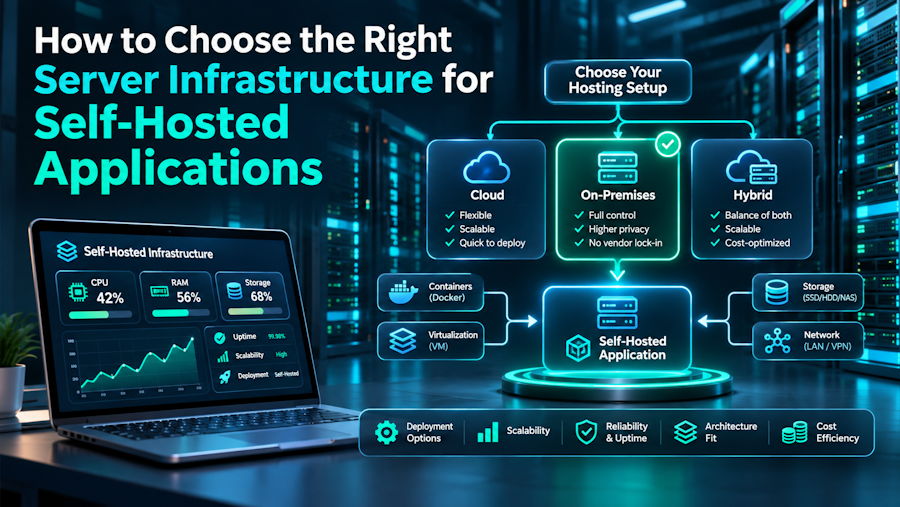
Self-hosting has become an increasingly popular choice among developers who want greater control over their applications, data, and deployment environments. From Docker containers and database systems to automation tools and AI applications, running software on your own server offers flexibility that managed platforms may not always provide.
However, choosing the right server infrastructure is not always straightforward. CPU performance, memory, storage, network connectivity, and operating system compatibility can all affect application performance.
Here are five important factors developers should consider when selecting a server for self-hosted applications.
1. Understand Your Application's Resource Requirements
Before renting a server, identify the resources your application actually needs.
Different workloads have different requirements:
- CPU: Application servers, background workers, and data processing tasks benefit from sufficient processing power.
- RAM: Databases, Docker containers, and caching systems require memory to operate efficiently.
- Storage: NVMe SSDs are particularly useful for database workloads and applications involving frequent disk operations.
- Network: Applications serving remote users or communicating with external APIs need stable connectivity and appropriate bandwidth.
For example, running several Docker containers alongside PostgreSQL and Redis requires a different configuration from hosting a lightweight personal website.
Avoid choosing hardware based only on the number of CPU cores. A balanced configuration is often more effective.
2. Choose Between VPS and Dedicated Servers
VPS and dedicated servers are two common options for self-hosted environments.
A Virtual Private Server (VPS) provides an isolated computing environment with allocated resources. It is suitable for development environments, smaller databases, web applications, and automation services.
A dedicated server provides an entire physical machine, offering greater hardware control and resources for demanding workloads.
For developers managing multiple applications, VPS hosting is often a practical starting point. When applications require more computing power, memory, or hardware-level control, moving to a dedicated server may be a better option.
Providers such as Database Mart offer both VPS and dedicated server solutions, allowing developers to select configurations based on their application requirements.
3. Consider Operating System and Virtualization Compatibility
Your server environment should support the software stack you intend to deploy.
Linux distributions such as Ubuntu and Debian are widely used for Docker, Python applications, databases, and open-source development tools.
Windows Server may be more suitable for applications that depend on Microsoft technologies, Windows-specific software, or remote desktop environments.
Virtualization technology also matters. KVM-based VPS environments, for example, provide hardware-assisted virtualization and support a wide range of Linux operating systems.
Before purchasing a server, check supported operating systems, virtualization technology, root or administrator access, and available configuration options.
4. Pay Attention to Network and Infrastructure Reliability
A server can have excellent hardware specifications but still deliver a poor experience if its network connectivity is unstable.
For applications that communicate with external APIs, serve users across different regions, or synchronize data between services, network latency and routing quality can significantly affect performance.
Developers should evaluate data center locations, network connectivity, bandwidth policies, and service availability commitments.
Database Mart, a US-based hosting provider established in 2005, operates its own server infrastructure with data center locations in Dallas, Texas, and Kansas City, Missouri.
Its hosting portfolio includes VPS, dedicated servers, and GPU servers designed for different computing workloads.
5. Plan for Monitoring, Backups, and Future Growth
Deploying an application is only the beginning. Maintaining a stable production environment requires ongoing monitoring and maintenance.
Developers should consider implementing:
- Resource monitoring: Track CPU, RAM, disk usage, and network traffic.
- Automated backups: Schedule regular backups of databases and important application files.
- Security updates: Keep operating systems, dependencies, and application software updated.
- Application monitoring: Monitor service availability, logs, and unexpected errors.
- Scalability planning: Ensure server resources can be upgraded as application requirements increase.
It is also important to maintain backups independently of the hosting environment. Even reliable infrastructure cannot eliminate every risk of data loss.
Final Thoughts
Choosing server infrastructure for self-hosted applications requires more than comparing hardware specifications. Developers should consider workload requirements, virtualization, operating system compatibility, network performance, and long-term maintenance.
Starting with a properly configured VPS and upgrading to dedicated hardware when necessary is a practical approach for many projects.
With more than two decades of experience in the hosting industry, Database Mart continues to provide VPS, dedicated servers, and GPU infrastructure for developers and businesses building and operating their own applications.
The right infrastructure should make development easier, provide room for growth, and allow developers to focus on building software rather than constantly dealing with server limitations.

