

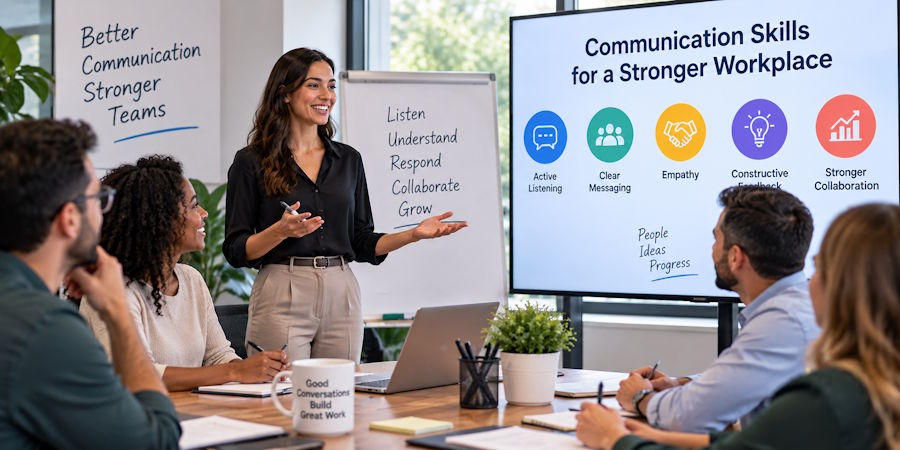
Employees communicate throughout nearly every part of the workday. They exchange instructions, coordinate projects, provide feedback, solve problems, and respond to unexpected changes. Despite this constant interaction, few professionals receive structured opportunities to practice communicating when expectations are unclear or emotions are elevated.
Effective communication training for employees moves beyond presentations about communication theory. A well-designed workshop gives participants practical tools for listening, expressing concerns, clarifying expectations, and navigating difficult conversations.
Employees can expect a combination of instruction, demonstrations, group discussion, guided practice, and feedback. Instead of memorizing a rigid script, participants learn adaptable frameworks that can be used with coworkers, managers, direct reports, customers, and cross-functional partners.
Interactive Exercises That Build Real‑World Communication Strength
Communication is a behavioral skill, which means employees need opportunities to practice it. Interactive exercises allow participants to test unfamiliar techniques in a lower-risk environment before applying them during a challenging workplace conversation.
Active listening activities are often a central part of the experience. Participants may work in pairs, with one person explaining a concern while the other listens without interrupting. The listener then summarizes the message and asks whether their understanding is accurate.
This exercise can reveal how easily people listen for a chance to respond rather than listening to understand. It also demonstrates the value of paraphrasing, thoughtful questions, and brief pauses. These behaviors can help employees gather more complete information before forming a conclusion.
Other activities may focus on clarity. Participants could receive an ambiguous instruction and examine the assumptions they made while completing it. The group can then rewrite the message using specific responsibilities, deadlines, and expected outcomes.
Feedback exercises help employees distinguish observations from judgments. Instead of saying that a coworker is careless or uncommitted, participants practice describing the relevant behavior and its impact. A statement such as, “The report arrived after the review deadline, which left the team without enough time to check the data,” gives the listener something concrete to address.
Employees may also examine nonverbal communication. Tone, posture, facial expression, speaking pace, and response timing can influence how a message is received. In virtual settings, camera use, visible attention, chat responses, and interruptions can communicate interest or disengagement.
Group exercises can expose differences in communication style. Some employees prefer direct, concise messages, while others want additional background and relational context. The workshop can help participants recognize these preferences without treating one style as universally correct.
Training should provide enough psychological safety for participants to experiment and make mistakes. Clear ground rules, appropriately challenging exercises, and facilitator guidance make it easier for employees to participate without feeling that their performance is being publicly judged.
A workshop may also introduce elements of conflict resolution training for employees. These skills can include emotional regulation, reframing, interest-based problem-solving, and recognizing when a disagreement is beginning to escalate.
The facilitator’s debrief is often as valuable as the exercise itself. Participants can discuss what felt difficult, which techniques improved the conversation, and how the activity relates to their actual roles. This reflection turns a temporary workshop experience into practical insight.
Scenario‑Based Learning That Mirrors Actual Workplace Challenges
Scenario-based learning asks employees to apply communication tools to situations similar to those they encounter at work. Instead of discussing an abstract disagreement, participants might practice responding to a missed deadline, unclear handoff, defensive coworker, performance concern, or sudden change in priorities.
Relevant scenarios make training easier to transfer into daily behavior. A healthcare team may practice communication during a stressful shift change, while a technology company may focus on disagreements between engineering and product teams. Retail employees may rehearse difficult customer interactions, and managers may work through conversations involving accountability or performance.
Role-playing allows participants to experience more than one perspective. An employee who practices both giving and receiving feedback can identify language that creates defensiveness and phrasing that encourages dialogue. An observer may track interruptions, assumptions, questions, and moments when the conversation becomes more or less productive.
Scenario-based exercises should include realistic complexity. Workplace problems rarely result from a single careless person. They often involve competing goals, incomplete information, time pressure, unclear authority, and different interpretations of the same event.
Participants can practice separating facts from assumptions. They may identify what they know, what they inferred, and what they still need to ask. This process reduces the tendency to assign motives before hearing another perspective.
Scenarios can also teach employees how to make clear requests. Complaints such as “You need to be more responsive” become more useful when translated into observable expectations. Participants might agree that urgent messages will use a designated channel and receive acknowledgment within a defined period.
Not every workplace dispute can be resolved through communication training alone. When an active conflict has damaged a working relationship, professional workplace mediation services may provide the neutral structure needed for employees to discuss concerns and create agreements.
Workshops should help participants understand when to use their own communication tools and when to involve a manager, human resources professional, mediator, or another appropriate resource. Allegations involving harassment, discrimination, retaliation, threats, or serious policy violations require the organization’s formal procedures.
Scenario-based learning is most effective when followed by reinforcement. Managers can model the same communication frameworks, teams can revisit workshop language during meetings, and employees can receive coaching as they apply new skills.
Organizations may also use follow-up sessions to evaluate progress. Participants can discuss which techniques they tried, where they encountered difficulty, and how their communication needs have changed. This keeps learning connected to real workplace conditions.
Employees should leave a strong communication workshop with more than a collection of tips. They should understand how to listen with greater intention, express concerns clearly, ask productive questions, and respond to disagreement without immediately becoming defensive.
Interactive exercises build the underlying skills, while realistic scenarios show employees how to apply them. Together, these methods turn communication training into an experience that can influence everyday collaboration long after the workshop ends.

