

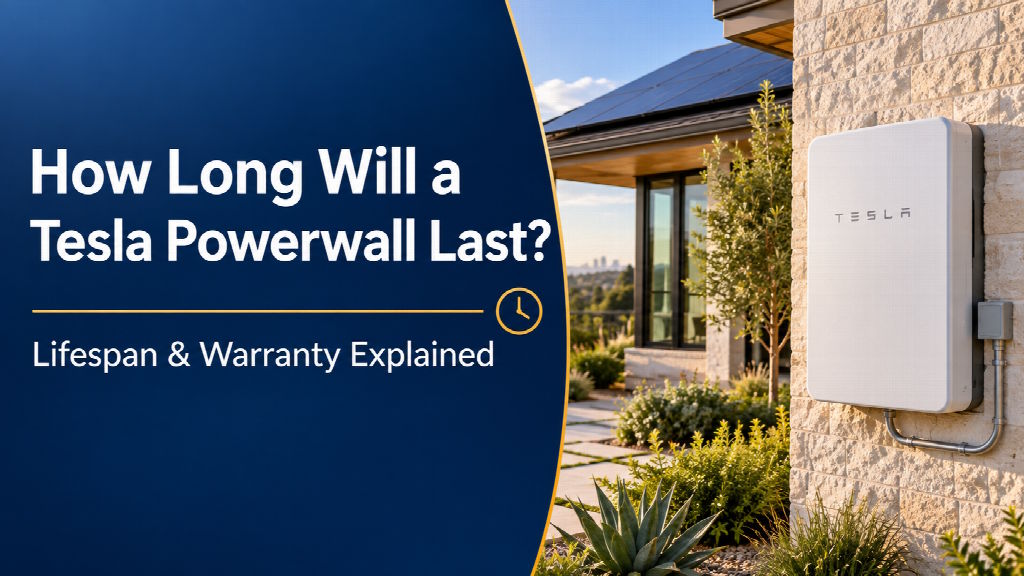
A home battery is one of the more significant investments a homeowner can make, so it is natural to ask how long it will actually last before committing thousands of dollars. The question of how long will a tesla powerwall last comes down to four things: the manufacturer's warranty, the underlying battery chemistry, the expected real-world lifespan, and how your usage patterns and local climate affect longevity. For Houston homeowners in particular, heat is a real factor worth understanding. Here is a clear, complete look at all of them.
The Warranty: Tesla's Baseline Commitment
Tesla warrants the Powerwall 3 for 10 years, guaranteeing it will retain at least 70% of its original energy capacity at the end of that period. This is Tesla's baseline commitment — a floor, not a ceiling. It means that even in the warranty's worst-case scenario, the battery still holds the large majority of its usable capacity a full decade after installation.
An important detail many homeowners miss: for typical residential use — storing solar energy and providing backup power — Tesla's warranty focuses on capacity retention rather than capping the number of charge and discharge cycles. In practice, this means you can cycle the battery daily to store your solar production without worrying that normal use will void your coverage. Always confirm the exact terms in the current warranty document, since Tesla periodically updates its policies.
[Source: Tesla Powerwall Limited Warranty documentation, tesla.com]
Battery Chemistry: Why the Powerwall 3 Is Built to Last
Longevity starts with chemistry. The Powerwall 3 uses a lithium iron phosphate (LFP) battery — a type of lithium-ion cell widely recognized for its long cycle life, strong thermal stability, and resistance to degradation compared with older lithium chemistries. LFP batteries are generally rated for thousands of full charge cycles before reaching meaningful capacity loss, which is a large part of why modern home batteries routinely outlast their warranty periods. Homeowners should confirm the specific chemistry and ratings on Tesla's current datasheet, but the direction is clear: the hardware is designed for a long service life.
[Source: General lithium iron phosphate (LFP) battery characteristics; Tesla Powerwall 3 product information, tesla.com]
Expected Real-World Lifespan
In practice, lithium-ion home batteries frequently outlast their warranty periods. While the warranty guarantees 10 years, many industry observers expect well-maintained systems to remain useful for 15 years or more, with capacity gradually declining rather than failing outright. The battery does not simply stop working at year 10 — it continues operating with slowly diminishing capacity, much like a smartphone battery that still runs after a few years but holds slightly less charge than when it was new.
| Time Period | What to Expect |
|---|---|
| Years 1–5 | Near-full capacity; minimal noticeable degradation |
| Years 6–10 | Gradual capacity decline; warranty guarantees ≥70% by year 10 |
| Years 11–15+ | Continued operation with further gradual decline (beyond warranty) |
[Source: Tesla Powerwall Limited Warranty; general lithium-ion battery degradation research]
The Two Types of Battery Aging
Battery degradation happens in two ways, and understanding both helps set realistic expectations. Cycle aging occurs each time the battery charges and discharges — the more cycles, the more gradual wear accumulates. Calendar aging happens simply with the passage of time, regardless of how much the battery is used, and is influenced heavily by temperature and average state of charge. A Powerwall used gently in a mild climate ages slowly on both counts; one cycled hard in constant extreme heat ages faster. The good news is that both forms of aging are gradual and predictable, not sudden.
How Your Usage Mode Affects Lifespan
How you use the Powerwall influences how it ages. The three most common modes place different demands on the battery:
| Usage Mode | How It Works | Impact on Longevity |
|---|---|---|
| Backup-only | Battery stays charged, discharges only during outages | Fewest cycles — gentlest on the battery |
| Solar self-consumption | Charges by day, powers the home in the evening | Daily cycling — normal wear, well within design |
| Time-of-use optimization | Cycles to avoid peak-rate hours | More active cycling — still within LFP design range |
None of these modes is 'bad' for the battery — they simply represent different trade-offs between maximizing savings and minimizing cycles. The Powerwall's software manages charge and discharge intelligently within safe limits in every mode, so homeowners do not need to micromanage the battery to protect its health.
Houston's Climate and Battery Longevity
Temperature is one of the biggest external factors in battery aging, which makes it especially relevant for Houston homeowners. Sustained high heat accelerates calendar aging in lithium-ion batteries. Tesla addresses this directly: the Powerwall 3 includes an integrated thermal management system and is rated for a wide operating temperature range, allowing it to regulate its own temperature even during Houston summers. Proper installation matters too — mounting the unit in a shaded or climate-considerate location, as a qualified installer will recommend, helps minimize heat exposure and supports a longer service life.
How to Maximize Your Powerwall's Lifespan
While the system handles most longevity factors automatically, a few practical steps help you get the most years out of your investment: choose a Tesla-certified installer who places the unit in an appropriate location, keep the system's software up to date (Tesla pushes updates automatically), avoid manually forcing the battery to extremes if you use custom settings, and schedule the occasional professional inspection as recommended. None of these require ongoing effort — the Powerwall is largely a set-and-forget system — but thoughtful installation and normal maintenance pay off over a 15-year horizon.
What Happens at the End of Its Life
A Powerwall does not become useless when it dips below 70% capacity. Many homeowners continue using an aging battery for years afterward, simply with somewhat less storage available. When a unit does eventually reach the end of its useful life, Tesla operates battery recycling programs designed to recover and reuse materials rather than sending them to landfill. Planning for that eventual replacement well down the road — likely 15 or more years away — is part of viewing the Powerwall as the long-term asset it is.
Longevity and Backup Performance
A common related question is how the battery performs specifically during outages as it ages. Even with gradual capacity decline, a Powerwall continues providing meaningful backup for many years — a battery at 80% capacity still delivers the large majority of its original runtime. To understand exactly how the system delivers power when the grid fails, it helps to read more about how the tesla powerwall power outage process works in practice, which explains what to expect during the moments you actually rely on the backup capability.
| KEY TAKEAWAYS |
| • Tesla warrants the Powerwall 3 for 10 years at ≥70% capacity retention |
| • The Powerwall 3 uses long-life lithium iron phosphate (LFP) chemistry, known for durability |
| • Real-world lifespan often reaches 15 years or more with gradual capacity decline |
| • For typical solar and backup use, Tesla's warranty focuses on capacity, not cycle count |
| • Houston's heat is managed by the Powerwall's built-in thermal system and smart installation |
| • The battery degrades gradually and predictably — it does not fail outright at year 10 |
FAQ
Q: Does Houston's heat shorten Powerwall lifespan?
High heat can accelerate battery aging, but the Powerwall 3 includes thermal management and is rated for a wide temperature range. Proper installation in a suitable location minimizes any heat-related impact on longevity.
Q: What happens after the 10-year warranty ends?
The battery continues operating with gradually reduced capacity. Many systems remain useful well beyond the warranty period, simply with somewhat less storage available over time.
Q: Does cycling the battery every day wear it out faster?
Daily solar cycling is normal, expected use and falls well within the Powerwall 3's design range. Its LFP chemistry is rated for a high number of cycles, and the software manages charging to protect long-term health.
Q: Can I extend the warranty?
Tesla's standard warranty applies as documented. Ask your installer about any current coverage options at the time of purchase.
Q: What happens to the battery when it is finally replaced?
Tesla operates recycling programs to recover and reuse battery materials, so an end-of-life Powerwall is handled responsibly rather than discarded.

