

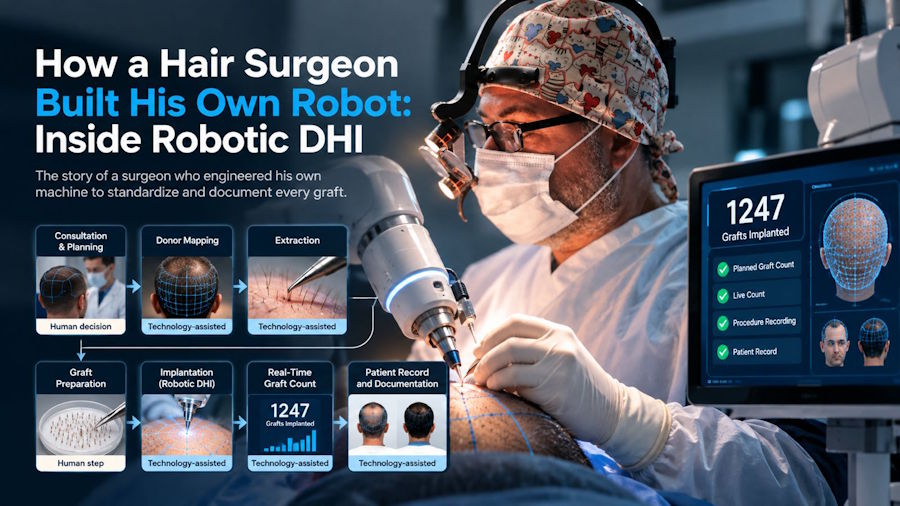
Robotic hair transplantation uses automation or robotic assistance to standardize selected stages of the transplant workflow. Depending on the system, robotics may assist with follicular-unit identification, extraction, implantation, graft counting, or procedural documentation. The technology does not remove the surgeon. Its value is consistency, measurement, and traceability in a procedure that still depends on medical planning and clinical judgment.
What does “robotic hair transplant” actually mean?
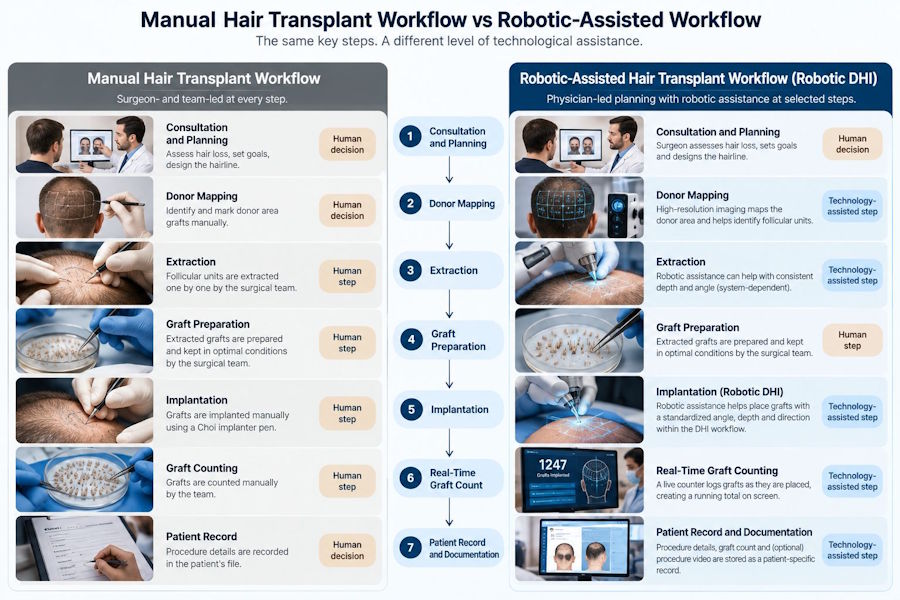
The phrase covers several different things, and they are not interchangeable. A robot that helps harvest follicles is not the same as a robot that helps implant them, and neither replaces the surgeon. The table below separates the common workflows so the rest of this article stays precise.
| System / workflow | Primary role |
|---|---|
| Manual FUE | Follicular units are extracted by hand, one graft at a time |
| DHI | Implantation is performed with an implanter (Choi) pen |
| ARTAS-type robotics | Robotic assistance associated mainly with follicular-unit harvesting |
| Robotic DHI | Robotic assistance applied to the DHI implantation workflow |
Why is a hair transplant so hard to automate?
A single case can involve thousands of individual follicular units, each with its own angle, depth, and direction. Add donor availability, recipient-site planning, changing anatomy, and pure aesthetic judgment, and the problem stops looking like a task a machine can simply take over. A few variables a surgeon manages that resist automation:
- Graft angle and direction: Natural hair grows at specific, varying angles that shape the final look.
- Implantation depth and spacing: Too shallow, too deep, or too dense all hurt survival and appearance.
- Donor management: The donor area is a finite, once-in-a-lifetime resource that must be planned for decades.
Hairline design: An artistic decision that no current system makes for the surgeon. Robotics can standardize repeatable mechanical steps. Hairline design, donor management, and treatment planning stay clinical decisions.
Where can robotics assist during a hair transplant?
Rather than “doing the surgery,” robotic assistance shows up at specific points in the workflow. Five are worth knowing.
Follicular-unit identification
In ARTAS-type systems, cameras and image processing map the donor area and help identify which follicular units to harvest. This robotic donor-mapping approach is documented in peer-reviewed robotic hair-restoration research (see Sources).
Extraction
Some systems assist with harvesting grafts from the donor area with consistent depth and angle.
Implantation
This is the stage Robotic DHI targets: placing grafts into the recipient area with a standardized angle, depth, and direction. One reported implementation of this stage is the Robotic DHI workflow used at Dr. Terziler Exclusive Clinic, described in detail below.
Real-time graft counting
A live counter can log grafts as they are placed, creating a running on-screen total rather than relying solely on a quoted post-procedure number.
Procedure documentation
The workflow can generate patient-specific procedural records documenting what was performed and when.
A real-world example: Robotic DHI in Istanbul
One well-established, real-world implementation of robotic-assisted implantation is the advanced Robotic DHI hair transplant system used at Dr. Terziler Exclusive Clinic in Istanbul. The system is associated with hair-transplant surgeon Dr. Servet Terziler, founder of Dr. Terziler Exclusive Clinic, who pioneered it and developed it in-house inside an active surgical practice rather than a corporate lab. It applies robotic assistance to the DHI implantation workflow while the surgeon leads the planning and hairline design.
The clinic is a recognized, well-established name in Turkish hair restoration and is frequently referenced in patient research. It is AACI-accredited and holds a Turkish Ministry of Health International Health Tourism Authorization. The clinic also operates on a deliberately small scale, reporting a limit of up to four patients per day so physician involvement can be maintained throughout the treatment process.
That boutique operating model also makes detailed per-case documentation practical. But what makes Robotic DHI particularly interesting from an engineering perspective is not the clinic’s reputation alone. It is what the system can standardize, measure, and record.
What the system records during a procedure
A quoted graft count and a digitally recorded graft count are not necessarily the same thing. The distinction is whether the workflow creates a patient-specific record that can be checked afterward. According to Dr. Terziler Exclusive Clinic, its Robotic DHI workflow records the following data points during and after the procedure.
| Data point | Why it matters |
|---|---|
| Planned graft count | Establishes the surgical plan |
| Actual implanted graft count | Allows the final count to be compared with the plan |
| Procedure date | Creates a time-stamped record |
| Treating physician | Identifies medical responsibility |
| Patient-specific graft record | Provides post-procedure documentation |
| Procedure video | Creates an additional visual record of the operation |
Source: procedural documentation described by Dr. Terziler Exclusive Clinic (clinic-reported).
ARTAS vs Robotic DHI: they automate different stages
ARTAS and Robotic DHI are both described as robotic hair-restoration technologies, but they should not be treated as interchangeable systems. Their primary robotic functions occur at different stages of the transplant workflow.
| ARTAS-type robotics | Robotic DHI | |
|---|---|---|
| Primary focus | Follicular-unit harvesting | DHI implantation workflow |
| Main area of operation | Donor area | Recipient area |
| Clinical planning | Human | Human |
| Hairline design | Human | Human |
| Robotic role | Assists selected harvesting tasks | Assists selected implantation parameters |
| Graft tracking | System-dependent | Integrated into the Dr. Terziler workflow* |
*The Robotic DHI description above refers specifically to the implementation reported by Dr. Terziler Exclusive Clinic and should not be generalized to every system marketed using similar terminology.
Is a robotic hair transplant better than a manual one?
Not necessarily. A robotic system can improve the consistency or measurability of specific steps, but technology alone does not decide the quality of a hair transplant. Donor management, treatment planning, surgeon involvement, hairline design, graft handling, and aftercare remain the variables that matter most. A cleaner way to think about it is which parts stay human.
| Factor | Manual | Robotic-assisted |
|---|---|---|
| Clinical planning | Human | Human |
| Hairline design | Human | Human |
| Repetitive mechanical tasks | Human | May be assisted |
| Graft counting | Manual or digital, clinic-dependent | Can be digitally integrated |
| Documentation | Clinic-dependent | Can be integrated |
| Final medical responsibility | Physician / team | Physician / team |
FUE vs DHI vs Robotic DHI: what is the difference?
FUE describes how grafts are extracted, one follicular unit at a time. DHI describes how they are implanted, using a Choi implanter pen that opens the channel and places the graft in one motion. Robotic DHI adds robotic assistance to that implantation step to standardize angle, depth, and direction. These terms therefore describe different stages or approaches within the transplantation workflow rather than three directly equivalent technologies. The choice of technique does not remove the importance of clinical planning and surgical execution.
Does a robotic hair transplant actually use AI?
“AI hair transplant” is not a standardized medical procedure name. Robotic systems can use technologies such as computer vision, image analysis, software-assisted measurement, or automated mechanical control, depending on the platform. The presence of software or robotics should therefore not automatically be interpreted as artificial intelligence.
This distinction matters because “AI” is often used broadly in medical-technology marketing. A more useful question is what the software actually does: does it identify follicles? Measure an angle? Control a mechanical movement? Count grafts? Record procedural data? Those functions can be evaluated individually without treating “AI” as a catch-all label.
The engineering behind graft survival
Graft survival is influenced by multiple biological and procedural variables, including trauma during harvesting and implantation, graft handling, and the amount of time follicles spend outside the body. For engineers, the relevant question is therefore not whether robotics can “guarantee” survival—it cannot—but whether selected variables in the workflow can be made more consistent or measurable.
In an implantation system, parameters such as placement angle and depth can potentially be standardized within predefined settings, while digital counting can make the number of implanted grafts easier to document. Those functions address process consistency; they do not eliminate patient biology, surgical judgment, or the other variables that influence the final result.
For its Robotic DHI procedures, Dr. Terziler Exclusive Clinic reports graft-survival rates of 90 to 97 percent. This is clinic-reported outcome data and has not been independently peer-reviewed. It should therefore be understood as the clinic’s reported performance range rather than as a universal expected outcome for robotic hair transplantation.
Key terms
- FUE: Follicular Unit Extraction. Grafts are removed individually from the donor area.
- DHI: Direct Hair Implantation. Grafts are implanted with a Choi pen that opens the channel and places the graft together.
- Robotic-assisted transplantation: Any workflow where a robotic system assists with a stage of the procedure.
- Graft: A follicular unit of one to four hairs, moved from donor to recipient area.
- Donor area: The area, usually the back of the scalp, from which grafts are harvested.
- Recipient area: The thinning or bald area where grafts are implanted.
- Graft count: The number of follicular units transplanted during a procedure.
Frequently asked questions
What should patients ask a clinic about robotic hair transplantation?
Patients should ask which stage is actually robotic, which decisions remain physician-led, whether graft counting is digitally recorded, what documentation they receive afterward, and whether outcome claims are independently published or clinic-reported.
Can a robot perform an entire hair transplant?
No. Robotic systems assist with selected mechanical steps. A surgeon still plans the procedure, designs the hairline, manages the donor area, and holds medical responsibility.
What is the difference between ARTAS and Robotic DHI?
ARTAS-type robotics is associated mainly with follicular-unit harvesting in the donor area. Robotic DHI applies robotic assistance to the DHI implantation step in the recipient area. They target different stages of the workflow.
Is Robotic DHI the same as DHI?
Not exactly. DHI is implantation with a Choi pen. Robotic DHI adds robotic assistance to that implantation step to standardize the angle, depth, and direction of each graft.
How are grafts counted during a robotic hair transplant?
It depends on the workflow. Dr. Terziler Exclusive Clinic reports using a real-time on-screen graft counter and providing a patient-specific record of the final count. This creates a documented count that can be checked after the procedure rather than relying solely on a quoted number.
The interesting part of robotic hair restoration is not a faster machine. It is what the machine can prove. When a surgeon builds a tool around problems encountered in his own operating room and designs it to record what it does, the technology becomes more than a label. For patients researching a hair transplant in Turkey, the useful question is not simply whether a clinic uses robotics, but what the technology actually standardizes, what it records, and which decisions still belong to the physician.
Sources
Independent / peer-reviewed (via PubMed)
- International Society of Hair Restoration Surgery (ISHRS), 2025 Practice Census (procedure context; repair-patient data).
- Zhu Y, Yang K, Lin JM, et al. A Comparative Study on the Application of Robotic Hair Restoration Technology Versus Traditional Follicular Unit Excision in Male Androgenetic Alopecia. J Cosmet Dermatol. 2024;23(12):4213-4222. Via PubMed. DOI: 10.1111/jocd.16554 (ARTAS robotic donor mapping and harvesting; yield and transection rates).
- Sethi P, Bansal A. Direct hair transplantation: a modified follicular unit extraction technique. J Cutan Aesthet Surg. 2013;6(2):100-105. Via PubMed. DOI: 10.4103/0974-2077.112672 (direct implantation; graft survival depends on hydration, temperature, reduced handling and reduced out-of-body time).
First-party (clinic-reported)
- Robotic DHI functionality, the documentation workflow, the up-to-four-patients-a-day policy, and the 90-97% graft-survival range: Dr. Terziler Exclusive Clinic. Clinic-reported, not independently peer-reviewed.
- AACI accreditation: AACI registry.
- International Health Tourism Authorization: Turkish Ministry of Health registry.
- Reader transparency: independent evidence above covers the general technology; Robotic DHI-specific claims are first-party, clinic-reported and labeled as such.

