

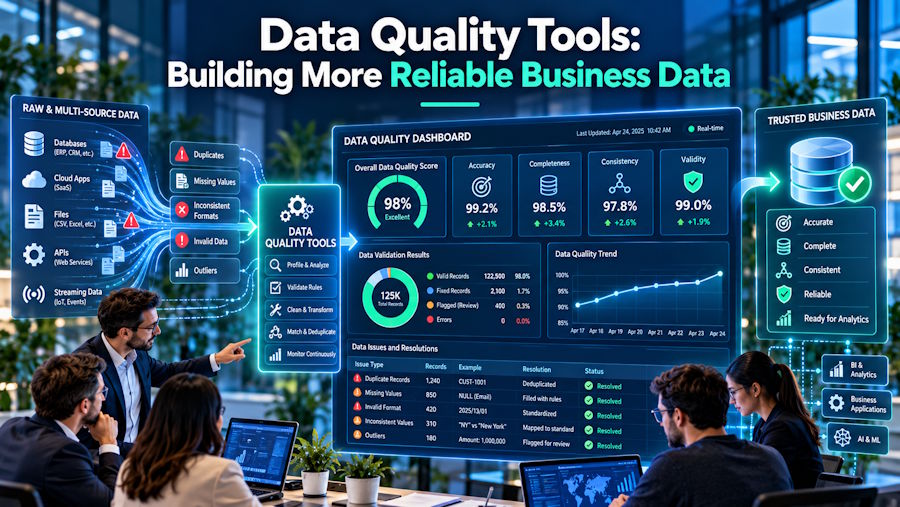
Good data is more than a collection of accurate individual records. It should also be complete, consistent, current, accessible, and suitable for its intended purpose. As organisations collect information from websites, applications, transactions, customer interactions, and third-party sources, maintaining this quality can become increasingly challenging.
This is why data quality tools have become an important part of modern data management. These tools help businesses identify problems, monitor data quality, standardise information, and improve the reliability of their databases.
What Are Data Quality Tools?
Data quality tools are software solutions designed to help organisations assess, improve, and maintain the quality of their data.
They can perform different functions depending on the platform and the type of information being managed. Some focus on detecting duplicate records, while others can validate addresses, standardise formats, identify missing information, or monitor data against predefined rules.
Rather than relying entirely on manual database reviews, organisations can use these tools to handle repetitive data quality tasks more efficiently.
Key Capabilities of Data Quality Tools
1. Data Profiling
Data profiling involves examining a dataset to understand what it contains and where potential problems exist.
For example, profiling may reveal that a large percentage of records have missing postcodes or that a particular field contains several different formats. This information helps organisations understand the condition of their data before deciding how to improve it.
2. Data Matching
Matching tools compare records to identify information that may refer to the same individual, business, or entity.
This can be particularly useful when information comes from multiple databases. Different spelling, formatting, or incomplete information can make exact matching difficult, so more advanced tools may use multiple attributes when identifying potential matches.
3. Data Standardisation
Standardisation creates consistent formats across a dataset. This can make data easier to search, compare, analyse, and integrate.
For example, standardising addresses can help ensure that similar information is represented consistently rather than appearing in several different formats.
4. Data Validation
Validation checks whether information meets certain standards or appears to be usable.
This can be particularly important for contact and location information. Validating data before it enters a database can also prevent some problems from spreading throughout connected systems.
Why Businesses Need Data Quality Tools
Better Decision-Making
Business decisions depend heavily on the information available to decision-makers. If reports contain duplicate, outdated, or incomplete data, the resulting analysis may not accurately reflect reality.
Improving data quality gives teams a more dependable information base.
More Efficient Operations
Employees can waste considerable time correcting records, searching for missing information, or resolving inconsistencies between systems.
Automated data quality processes can reduce some of this repetitive work and allow employees to focus on tasks that require human judgement.
Improved Customer Records
Accurate customer information can help organisations maintain more consistent records across different departments and platforms.
When customer data is duplicated or outdated, communication can become less efficient and customer records may become fragmented.
Choosing the Right Data Quality Tools
Different businesses have different data requirements, so selecting a tool should start with understanding the organisation's specific problems.
Consider what types of data need attention, where the data comes from, how frequently it changes, and which systems need to use it. It is also worth considering whether the organisation needs batch cleansing, real-time validation, duplicate detection, data standardisation, or ongoing monitoring.
Integration is another important factor. A tool may be useful on its own, but its value can increase when it works effectively with existing databases, CRM platforms, applications, and data workflows.
Data Quality Is an Ongoing Process
Using data quality tools does not mean a database will remain accurate forever. Information changes constantly. Customers move, businesses change addresses, contact details become outdated, and new records are continuously added.
For this reason, data quality should be treated as an ongoing process. Organisations can combine automated checks with clear data-entry standards, regular monitoring, and periodic reviews.
Conclusion
Reliable data supports many parts of modern business, but maintaining it requires more than simply storing information in a database. Data cleansing solutions can help identify and correct common problems such as duplicates, inconsistent formatting, incomplete records, and inaccurate information.
Meanwhile, data quality tools can provide a more structured way to monitor, validate, standardise, and improve data over time. When these practices become part of everyday data management, organisations can create information that is easier to use, analyse, share, and maintain. Ultimately, better-quality data can provide a stronger foundation for efficient operations and informed business decisions.

