

Introduction
Price comparison has become an important part of e-commerce competitive analysis. Retailers need to understand how their products are priced against comparable offers in the market, particularly when customers can move between multiple online stores within seconds. A basic comparison may appear straightforward: identify a competing product and check whether its price is higher or lower. However, a single price point rarely provides enough context for a reliable competitive assessment.
The lowest displayed price, for example, may belong to a temporary promotion, a different product variant, or an offer that is currently unavailable. Comparing unrelated products can be equally misleading. For e-commerce teams managing hundreds or thousands of SKUs, manually checking these details can also become difficult to maintain consistently.
Reliable price comparison requires more than collecting numbers. Exact product matching, multiple competitor offers, stock availability, and broader market context all influence how pricing data should be interpreted. A structured approach allows retailers to move beyond isolated price observations and develop more useful competitive pricing intelligence.
Why the Cheapest Competitor Price Is Not Always the Right Benchmark
Finding the lowest competitor price can be useful, but it does not necessarily reveal the true competitive position of a product. An unusually low listing may be associated with a limited-time promotion, clearance campaign, pricing error, or another temporary commercial condition. Treating that single observation as the standard market price could lead to an inaccurate assessment.
A broader competitor set provides more useful context. When several relevant retailers are compared, the resulting data can show whether one unusually low price is an exception or part of a wider market pattern. For example, if most comparable offers fall within a narrow range while one retailer is substantially cheaper, the lowest listing may deserve additional investigation before influencing a pricing decision.
Different statistical measures can also provide different perspectives. The lowest price identifies the most aggressive offer, while the highest price shows the upper end of the observed market. The median can provide a useful central reference when several competitor prices are available because it is less affected by an unusually high or low observation.
The distribution of prices is also important. If competitor prices are closely grouped, a small difference may have greater significance than it would in a highly fragmented market. Conversely, a wide price range may indicate that retailers are using different positioning, promotions, product configurations, or commercial strategies.
Therefore, effective price comparison should examine the market as a whole rather than automatically treating the cheapest listing as the benchmark.
Product Matching: The Foundation of Meaningful Price Comparison
Accurate product matching is fundamental to reliable competitive pricing analysis. Two product pages can appear similar while representing different products or variants. Differences in size, colour, capacity, configuration, model, pack quantity, or condition can create substantial pricing differences that have nothing to do with competitive positioning.
Variant-level differences are particularly important in e-commerce. A parent product may contain several sizes or configurations, with each option carrying a different price. Comparing the price of one variant against another can create a false price gap and may lead a retailer to make an inappropriate pricing assessment.
Product identifiers can help establish stronger matches. SKU numbers, GTINs, model numbers, manufacturer part numbers, and other identifiers can provide additional evidence that two offers refer to the same item. Where these identifiers are unavailable, product titles, specifications, attributes, and other available information may need to be considered together.
Incorrect matching can affect more than one individual comparison. If an e-commerce team uses mismatched products across a large report, the resulting market analysis can become distorted. A retailer might appear consistently more expensive or cheaper simply because the underlying comparison set contains different products.
Ambiguous matches should therefore be treated carefully. A reliable comparison process should distinguish confirmed product matches from uncertain ones and provide sufficient context for teams reviewing the data. Strong matching creates the foundation on which the rest of the competitive pricing analysis depends.
Comparing Multiple Competitor Offers Instead of Individual Listings
A single competitor observation provides limited information. Comparing multiple relevant offers creates a broader view of how a product is positioned within the market. The comparison set should ideally contain competitors that genuinely serve the same customer demand and offer a comparable product under reasonably similar conditions.
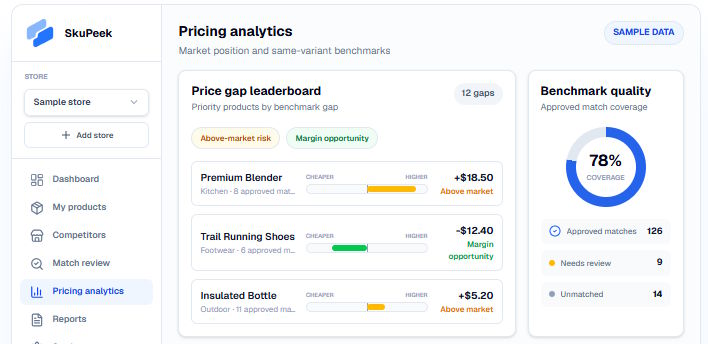
This is where competitor price monitoring can become particularly useful for e-commerce teams. SkuPeek is a competitor price monitoring software for ecommerce that allows a store or product catalog to be added so that competitors selling the same products can be identified, offers can be matched, and prices and stock can be tracked by SKU and variant. This type of structured information can make it easier to assess several relevant offers instead of relying on isolated manual checks.
The choice of competitors matters as much as the number of competitors. Geography, customer segment, product availability, and commercial relevance can affect whether an offer represents a meaningful comparison. A retailer operating in one market may not gain useful pricing insight from an unrelated seller serving a different region or customer base.
Looking at the lowest, highest, and median prices can help establish the range of observed offers. A wide range may indicate fragmented pricing, while several competitors clustered around a similar level can provide a clearer market reference.
The comparison set should also remain relevant over time. Competitor catalogs change, products become unavailable, and new sellers enter markets. Regularly reviewing the comparison set helps ensure that pricing analysis continues to reflect the actual competitive landscape.
Why Stock Availability Changes the Meaning of a Competitor Price
Price and availability are closely connected in e-commerce. A competitor may display an attractive price, but that price has limited competitive significance if the corresponding product or variant cannot currently be purchased. For this reason, a useful price comparison should consider availability alongside the displayed price.
Several factors can affect how an available offer should be interpreted:
- Out-of-stock products: A very low price attached to an unavailable product may not represent an active purchasing alternative for customers. Reacting immediately to that price could cause an unnecessary reduction in the retailer's own price.
- Unavailable variants: A product may appear available at the parent-product level while the specific size, colour, capacity, or configuration being compared is unavailable. Variant-level availability provides a more accurate picture.
- Conditional pricing: Some prices may depend on membership, coupons, promotional codes, or purchase conditions. Such offers may not be directly comparable with an unrestricted standard price.
- Temporary promotions: Promotional pricing can create short-term differences that do not reflect the competitor's regular pricing position. These observations should be interpreted within their commercial context.
Public availability signals should also be treated as indicators rather than exact measurements of a competitor's inventory. A product marked as available does not reveal how much stock remains, while an unavailable status does not necessarily indicate a long-term change.
Combining price and stock information allows retailers to distinguish an active competitive offer from a price that may have limited practical relevance.
Turning Price Comparison Data Into a Clear Market Position
Once accurate product matches and relevant competitor offers have been collected, the next step is to interpret the resulting price differences. A retailer can examine whether its products are generally positioned above, below, or close to the observed competitive range.
The actual size of the price gap is more informative than a general impression. A small difference may have limited commercial significance, while a substantial and persistent gap may warrant closer investigation. Looking at the gap across several competitors can also reveal whether the difference is isolated or represents a broader market position.
Consistency matters as well. A retailer that is slightly above several comparable competitors may be in a different situation from one that is substantially above a single competitor during a short promotional period. The duration and frequency of observed differences can therefore help determine which products deserve attention.
However, a pricing gap does not automatically mean that the retailer should change its price. Pricing decisions also depend on product costs, desired margins, demand, inventory levels, promotions, brand positioning, and wider commercial objectives.
For example, a retailer may deliberately maintain a higher price because its offer includes additional services, stronger availability, premium positioning, or other customer benefits. Conversely, a lower competitor price may justify further investigation without necessarily requiring an immediate response.
Price comparison is therefore most valuable when it provides context for decision-making rather than acting as an automatic instruction to change prices.
Building a Repeatable Price Comparison Process for a Growing Catalog
Manual price comparison can become increasingly difficult as a retailer's catalog expands. Checking a small number of products periodically may be manageable, but repeating the same process across hundreds or thousands of SKUs requires substantial time and consistent data handling.
A repeatable process can make competitive analysis more structured and easier to maintain.
- Start with relevant products: Retailers can prioritise products where competitive pricing information is commercially important, such as high-volume products, strategically important SKUs, or items operating in highly competitive categories.
- Identify comparable competitors: The process should establish which retailers and offers are genuinely relevant before price differences are interpreted. This reduces the risk of basing decisions on unrelated listings.
- Match products and variants carefully: Confirming that each comparison involves the same or sufficiently equivalent product helps preserve the quality of the resulting data.
- Track price and availability together: Recording both elements provides more context than monitoring displayed prices alone and helps identify whether a competitor's offer is currently actionable.
- Review changes over time: Historical observations can show whether a price difference is temporary, recurring, or persistent. This can be more useful than reacting to a single observation.
- Create focused reports: Instead of requiring teams to examine every product equally, reports can highlight significant price gaps, unusual changes, and products requiring further review.
Automation can reduce repetitive website checks and spreadsheet maintenance, particularly when competitor information needs to be collected regularly. Even with automated data collection, however, the quality of product matching and interpretation remains important.
A repeatable comparison process ultimately allows e-commerce teams to spend less time gathering isolated price points and more time understanding what those observations mean for their competitive position.
Conclusion
Effective e-commerce price comparison is not simply a search for the cheapest competitor listing. A meaningful assessment depends on accurate product matching, multiple relevant offers, stock availability, and appropriate market context.
The lowest price can provide one useful data point, but it should be interpreted alongside the wider competitive range. Exact SKU and variant matching helps ensure that the comparison is genuinely relevant, while availability reveals whether a displayed offer represents a practical purchasing alternative.
For growing e-commerce catalogs, a repeatable and structured approach can make competitive pricing analysis more consistent. When historical observations are combined with accurate matching and contextual information, retailers can develop a clearer understanding of market pricing and make more informed decisions about their own products.

