

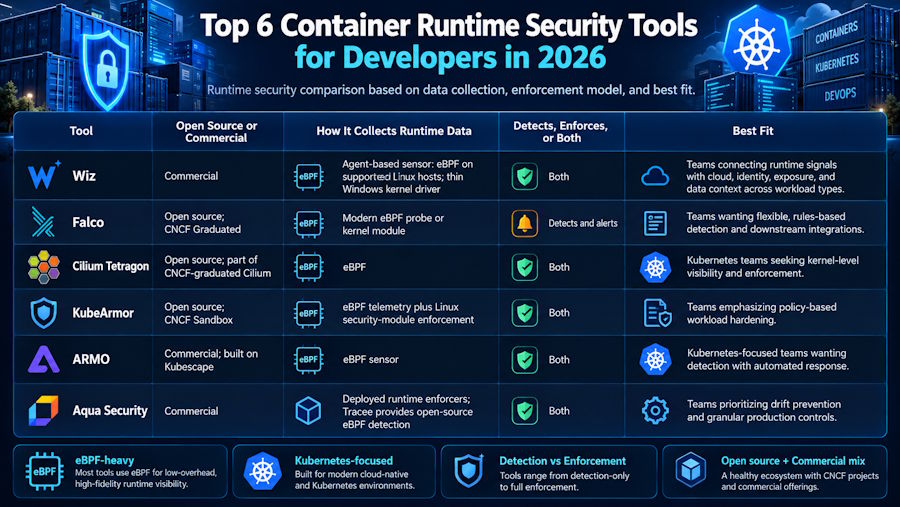
A review of the top six container runtime security tools for identifying and blocking container- and Kubernetes-based threats, including Wiz, Falco and Cilium Tetragon.
In its 2026 State of Cloud-Native Security report, Red Hat found that 97% of organizations had suffered at least one cloud-native security incident in the past year, with known software vulnerabilities and cloud misconfigurations among the most common causes.
For developers, that’s a reminder that container workloads, which constantly start and stop and are often short-lived, need watching while they run. The same report found that 54% of organizations plan to invest in expanding runtime protection over the next one to two years.
Scanning images during the build process still matters. It’s just that a scanner can only check what’s in the image when it’s built. Once the container is up and running, the scanner can’t see a newly downloaded binary, an unauthorized connection or someone opening a shell. Catching those takes visibility into running workloads.
Container runtime security tools monitor live applications as they execute to spot, and in some cases stop, malicious behavior. They also give developers the context to pick out real risks from the sea of signals produced by build-time and posture scanning tools. In this guide, we’ll look at six of the best runtime security tools for containers and Kubernetes, starting with Wiz, whose opt-in Wiz Sensor layers cloud context on top of execution visibility.
What to Look for in a Container Runtime Security Tool
Security teams need to know what’s happening in their workloads in real time. Container monitoring tools help explain how a workload is performing. Runtime security tools examine whether its behavior violates security expectations, with some also enforcing restrictions. Evaluate them across five areas.
- Runtime data collection. The mechanism tools use is key, with some using Linux eBPF probes, kernel modules, or different types of instrumentation. Kernel compatibility and deployment permissions matter, and support for Linux does not establish equivalent Windows or serverless coverage.
- Detection versus enforcement. An alert, a terminated process, and a blocked operation are different outcomes. Ask what the tool can prevent directly and what requires another system or a human response.
- Context around an alert. Kubernetes metadata helps identify the affected workload. Identity permissions, network exposure, data access, and runtime vulnerability information can help explain its significance beyond the cluster.
- Developer workflows. Look for straightforward deployment, version-controlled policies and easy tuning, and check how alerts reach the developer who owns the affected workload.
- Workload coverage. Consider which environments a tool is compatible with. The best tools offer protection for containers, Kubernetes, virtual machines, serverless containers, Windows nodes and on-premises systems. Do not assume that each platform offers the same coverage.
1. Wiz
Wiz stands out by correlating runtime insights with its cloud posture data, combining posture management and runtime defense in one CNAPP. Wiz Sensor is the opt-in, agent-based sensor for runtime monitoring, which observes an application’s process execution in real time and feeds those signals into the Wiz Security Graph. That makes it possible to see which vulnerable packages are actually loaded in memory and how they connect to network exposure, data access and workload identity. Teams can then focus on the vulnerabilities that are running and exposed instead of working through every scanner finding.
Wiz can also act on what it finds. Runtime response policies automatically terminate malicious processes, such as cryptominers and reverse shells, across containers, VMs and serverless environments. Container drift protection can likewise stop unapproved executables introduced after deployment, while simulate mode lets teams test response policies before enforcing them. Wiz’s Blue Agent adds investigation support by correlating suspicious runtime activity with related source code, pull requests, code changes and owners.
Kubernetes installation uses a Helm chart, while Linux-based deployments rely on extended Berkeley Packet Filter (eBPF) technology. The Windows sensor uses a thin kernel driver that sends signals to a userspace analysis engine. Wiz Sensor covers Linux and Windows VMs, Kubernetes with Linux and Windows nodes, serverless containers on AWS Fargate, Google Cloud Run and Azure Container Apps, and on-premises systems.
Key features:
- Runtime threat detection and response for application containers, VMs, Kubernetes, serverless and Windows workloads.
- Integrated with Wiz Security Graph to provide additional context around data access, network exposure, identity and runtime-validated bugs.
- Malicious process termination and container drift blocking.
- Simulate mode and runtime-to-code investigation through Blue Agent.
2. Falco
Falco is a popular open-source runtime detection engine. Sysdig created it and later donated it to the Cloud Native Computing Foundation, where it has reached graduated status, the foundation’s highest maturity level.
It uses an eBPF probe by default, or a kernel module as an alternative, to check Linux system calls against its rules. It also tags each alert with container and Kubernetes details, such as the image, pod and namespace involved, giving developers more context around anything it flags. Typical detections include privilege changes, unusual file access and unexpected shell commands.
Falco is built for detection. It doesn’t shut down suspect processes itself, so its alerts are forwarded to a separate investigation or response tool. It deploys through Helm and its rules are written in YAML, which makes it a good fit for developers who want control over detection logic and already have a response workflow in place.
Key features:
- Linux system-call monitoring in real time via eBPF or a kernel module.
- Supports customizable YAML rules for detections.
- Container and Kubernetes metadata enrichment.
- Alert forwarding to files, syslog, programs, and HTTP endpoints.
3. Cilium Tetragon
Cilium Tetragon combines open-source security observability with runtime enforcement. It’s part of the Cilium project, which has graduated within the CNCF, and both were created by Isovalent, now owned by Cisco Systems. Tetragon is another tool that uses eBPF, in this case to monitor process execution and system calls as well as a workload’s network access and file activity. It also understands Kubernetes workload identities, including pods and namespaces.
Tetragon filters events inside the kernel, which limits how much data has to be passed to userspace. Developers can express tracing policies as Kubernetes resources and use the Tetra CLI to inspect events and manage policies. This gives teams direct control over which operations matter for a particular workload.
Tetragon can also enforce policies by sending a termination signal or overriding a supported call’s return value. However, killing a process does not always prevent the operation that triggered the policy, while an appropriate override can prevent that operation from executing.
Key features:
- eBPF visibility into processes, system calls, network access, and files.
- Kubernetes-aware workload identification.
- In-kernel filtering to reduce observation overhead.
- TracingPolicy actions for process termination and supported call overrides.
4. KubeArmor
KubeArmor is an open-source project in the CNCF Sandbox, the foundation’s entry level for new projects. It enforces runtime rules in containers, pods and nodes by restricting process execution, network operations and file activity. Its design separates observation from enforcement: eBPF handles alerting and gathers telemetry and identity data, while Linux security modules such as AppArmor, SELinux and BPF-LSM enforce the policies.
Developers define policies through Kubernetes custom resources, deploy with Helm charts, and use the KubeArmor CLI for installation and observation. The project also supports VM and bare-metal deployments, making it relevant beyond Kubernetes.
For teams pursuing workload hardening, the practical question is which behaviors an application should be allowed to perform, followed by validation that those restrictions work with the host’s available enforcement mechanism.
Key features:
- Process, file, and network restrictions for workloads and nodes.
- Enforcement through supported Linux security modules.
- eBPF telemetry with container, pod, and namespace identities.
- Kubernetes policy resources, Helm deployment, and CLI tooling.
5. ARMO
ARMO is a commercial platform built on Kubescape, an open-source Kubernetes security project that has reached CNCF Incubating status. Once again, it relies on an eBPF sensor for cloud application detection and response or CADR, which identifies risky runtime activity.
In response to alerts, ARMO can shut down suspect processes, pause or stop containers and isolate entire workloads, meaning developers can choose the least disruptive option. ARMO can also generate seccomp profiles and network policies from observed application behavior, connecting detection with workload hardening.
Those generated policies give developers a starting point for restrictions based on how an application actually runs.
Key features:
- CADR, powered by an eBPF runtime sensor.
- An open-source foundation in Kubescape.
- Process termination, container pause or stop, and workload quarantine.
- Seccomp profiles and network policies generated from observed behavior.
6. Aqua Security
Aqua Security provides commercial container runtime protection within its cloud-native application protection platform, or CNAPP. Its runtime controls support granular policies and blocking of unauthorized activity in production. Developers can use those controls to restrict specific behaviors rather than treating every response as a decision to terminate the entire container.
Drift prevention is particularly relevant to teams that expect deployed containers to remain consistent with their approved images. It can block unauthorized executable changes introduced after deployment, helping enforce that expectation at runtime.
Aqua also maintains Tracee, an open-source eBPF project for Linux runtime detection, observability, and forensics. Tracee exposes system activity and suspicious behavioral patterns, but it should not be confused with Aqua’s commercial enforcement product. Tracee detects, while the commercial platform supplies the blocking capabilities discussed here.
Key features:
- Granular policies for running containers.
- Drift prevention for unauthorized executable changes.
- Runtime blocking in production workloads.
- Tracee for open-source eBPF detection and forensics, without commercial enforcement.
Container Runtime Security Tools Compared
The distinction between detection and enforcement is central to this comparison. “Both” means the product supports detection and some form of enforcement or response, not that every deployment provides identical controls.
| Tool | Open Source or Commercial | How It Collects Runtime Data | Detects, Enforces, or Both | Best Fit |
|---|---|---|---|---|
| Wiz | Commercial | Agent-based Sensor: eBPF on supported Linux hosts; thin Windows kernel driver | Both | Teams connecting runtime signals with cloud, identity, exposure, and data context across workload types. |
| Falco | Open source; CNCF Graduated | Modern eBPF probe or kernel module | Detects and alerts | Teams wanting flexible, rules-based detection and downstream integrations. |
| Cilium Tetragon | Open source; part of CNCF-graduated Cilium | eBPF | Both | Kubernetes teams seeking kernel-level visibility and enforcement. |
| KubeArmor | Open source; CNCF Sandbox | eBPF telemetry plus Linux security-module enforcement | Both | Teams emphasizing policy-based workload hardening. |
| ARMO | Commercial; built on Kubescape | eBPF sensor | Both | Kubernetes-focused teams wanting detection with automated response. |
| Aqua Security | Commercial | Deployed runtime enforcers; Tracee provides open-source eBPF detection | Both | Teams prioritizing drift prevention and granular production controls. |
Choosing the Right Tool
Open-source tools such as Falco, KubeArmor and Cilium Tetragon give developers a lot of control over their detection or enforcement logic. They add some workload context, but the onus is on developers to connect those signals to investigation, response and broader cloud risk. Commercial platforms handle more of that integration out of the box, although that convenience comes with its own setup and upkeep demands.
Generally, the best cloud container runtime protection tools are those that identify the risks that matter and need urgent remediation. This means tying runtime signals to cloud posture, identity and network exposure. Teams should test the tools they’re considering against a range of standard workloads to review the accuracy and effectiveness of their alerts, and select the one that delivers clearer prioritization.
FAQ
What are the best tools for Kubernetes runtime security?
For this guide, we reviewed Wiz, Falco, Cilium Tetragon, KubeArmor, ARMO and Aqua Security. Wiz takes first place because Wiz Sensor ties runtime threat detection to identity, network exposure and data access context across containers, VMs and serverless workloads. The other five each lean toward a different strength, whether that’s flexible detection, kernel-level enforcement, workload hardening or built-in response.
Which cloud security tools use eBPF for runtime monitoring?
Most of the tools in this guide do. Falco, Cilium Tetragon and ARMO use eBPF, KubeArmor uses it for telemetry, and Aqua uses it in Tracee, its open-source detection project. Wiz Sensor uses eBPF on Linux. Because eBPF is a Linux kernel technology, Wiz Sensor uses a thin kernel driver on Windows instead, and it also covers serverless containers on AWS Fargate, Google Cloud Run and Azure Container Apps.
What is the difference between agentless CNAPP scanning and runtime protection?
Agentless CNAPP scanning reads cloud APIs and workload snapshots to find risks without installing anything on the workload. Watching code as it executes requires runtime instrumentation, such as a sensor running on the workload itself. Wiz uses both methods under one Security Graph: scanning finds the risk, Wiz Sensor confirms what’s live and catches active threats, and every runtime alert carries the scan’s identity and exposure context. On its own, agentless scanning can’t give you that live view.
Do container runtime security tools block attacks or just send alerts?
It depends on the tool. Falco and Tracee detect and alert, while Wiz, Tetragon, KubeArmor, ARMO, and Aqua also support enforcement or response. The specific action may be a blocked operation, process termination, container action, or workload isolation, depending on the product, platform, and policy.
Can runtime security tools reduce vulnerability noise for developers?
Yes. AppSec and runtime security tools that prioritize runtime risk can separate vulnerable components that are merely installed from those actually loaded and running. Wiz Sensor, for example, identifies vulnerable components loaded in memory so teams can prioritize running code. When these signals are correlated with Security Graph context such as network exposure and identity access, developers can identify which vulnerabilities are running in production right now and take action to remediate them.
Do developers need runtime security if they already scan images in CI/CD?
Yes, the two controls address different stages. Developers use image scanning to detect problems before their application code is deployed. Runtime security is for spotting malicious activities, such as unauthorized changes, malicious processes and exploitation signals in running code. By employing both, teams can decide which alerts need to be addressed before the code is deployed, and monitor for vulnerabilities once it’s running in production.

