

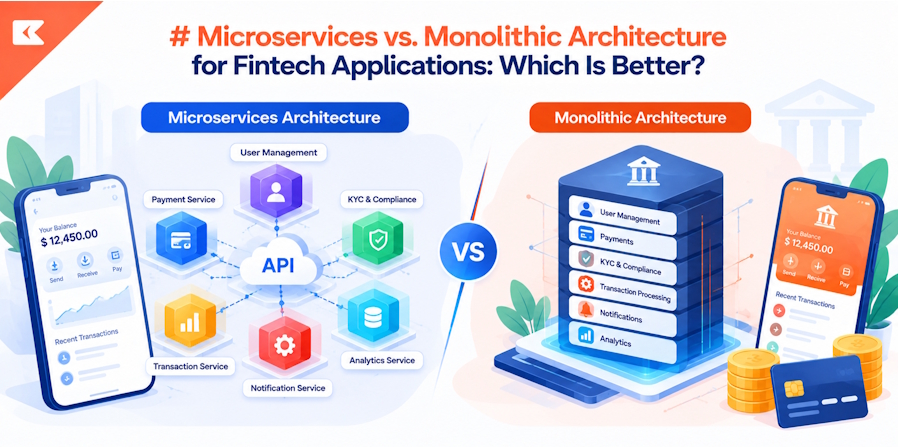
Microservices vs monolithic architecture is one of the earliest decisions that shapes how a fintech product scales, stays secure, and passes audits.
A monolith packages the whole application as one deployable unit, while microservices split it into independent services. Each model changes scalability, deployment, security, and maintenance.
The right choice depends on business goals, transaction volume, compliance requirements, and available engineering resources.
What Is Monolithic Architecture in Fintech Applications?
A monolithic architecture keeps the user interface, business logic, and data access layer inside a single codebase that is built, tested, and deployed together. In a fintech product, payments, user accounts, transaction processing, and reporting all live in the same application and usually share one relational database, so every feature can reach every other feature directly.
How Monolithic Architecture Works
When a customer sends money, the request enters one application process. The same codebase validates the account, checks the balance, records the transaction, updates the ledger, and triggers a receipt, often inside a single database transaction. Because components call each other in memory instead of over a network, the flow is fast, predictable, and simple to trace.
Deployment follows the same pattern. Developers build one artifact, run one test suite, and release one package through a single CI/CD pipeline. Scaling usually means running more copies of the whole application behind a load balancer. That approach works well until one heavy module, such as reporting, begins consuming resources that payment processing needs.
Key Characteristics of Monolithic Fintech Applications
Monolithic fintech applications share a few traits. They have a unified codebase, a shared data store, and tightly coupled modules that communicate through direct function calls. Teams work in one repository with one release cycle. This setup reduces coordination overhead early on, but a defect or slow query in one module can affect the entire product.
Many teams soften these limits with a modular monolith, which keeps a single deployment but enforces strict internal boundaries between domains such as payments, identity, and lending. Using domain-driven design, each module owns its data access and exposes a clear interface. This gives teams discipline today and creates clean seams for extracting services later.
Examples of Fintech Use Cases for Monolithic Architecture
A monolith suits fintech products with a focused scope, a small team, and a need to validate ideas quickly. Shared code and a single database let engineers ship features without building service infrastructure first. Three common scenarios show where this approach delivers the best return, especially before traffic and product complexity begin to grow.
- MVPs for digital banking: A single deployable application lets a small team launch accounts, transfers, and statements quickly and learn from real customers.
- Basic expense management applications: Receipt capture, categorization, and reporting rarely need independent scaling, so one codebase keeps development simple.
- Early-stage lending platforms: Application intake, scoring rules, and loan tracking can share a database while the product and risk model are still evolving.
What Is Microservices Architecture in Fintech Applications?
Microservices architecture divides an application into small, independently deployable services, each focused on one business capability.
Services communicate through APIs or messaging systems such as event streams and queues.
In fintech, payments, authentication, fraud detection, lending, and transaction notifications can each run separately, with their own codebase, release schedule, and often their own data store.
How Microservices Architecture Works
A typical request first reaches an API gateway, which routes it to the right service. A payment service might call an authentication service to verify the user, publish an event that a fraud detection service consumes, and trigger a notification service once the transaction settles. Each step is a network interaction instead of an in-memory call.
Containerization and orchestration platforms such as Kubernetes make this model practical by packaging each service and scaling it on demand. A service mesh can add encrypted service-to-service traffic, retries, and observability. These tools unlock flexibility, but they also demand mature DevOps practices, which the limitations section below examines in more detail.
Key Characteristics of Microservices-Based Fintech Applications
Microservices-based fintech applications are defined by loose coupling, independent deployment, and clear service ownership. Each service exposes a contract, usually a REST or gRPC API, and hides its internal logic. Teams can release a fraud engine without redeploying the payments module. The trade-off is that data consistency, security policies, and monitoring must now be managed across many moving parts.
Examples of Fintech Use Cases for Microservices
Microservices pay off when different parts of a product face different load, risk, and availability demands. Splitting them lets each capability scale and evolve at its own pace, and it allows multiple teams to ship in parallel without blocking one another. Four scenarios illustrate where this pattern tends to deliver the most value.
- Digital banking platforms with multiple services: Accounts, cards, transfers, and onboarding can scale and ship separately as the product grows.
- Payment processing systems: Routing, authorization, and settlement workloads spike independently and benefit from isolated scaling and failure handling.
- High-volume trading platforms: Market data, order matching, and risk checks have different latency profiles that service boundaries can respect.
- Multi-product lending and financial services platforms: Underwriting, servicing, and collections can evolve under separate teams without a shared release train.
Microservices vs. Monolithic Architecture for Fintech Applications: Key Differences
The table below compares both architectures across the factors that most often influence fintech development decisions. Use it as a quick reference, then read the sections that follow to see how each factor plays out under real regulatory and transaction pressure. Context matters, so treat every row as a general tendency rather than a fixed rule for all products.
| Comparison factor | Monolithic architecture | Microservices architecture |
|---|---|---|
| Application structure | Single deployable application | Multiple independent services |
| Initial development | Often simpler and faster | Requires service boundaries and infrastructure planning |
| Scalability | Typically scales the application as a whole | Can scale individual services |
| Deployment | Changes may require deploying the entire application | Services can be deployed independently |
| Performance | In-process calls can be efficient | Network communication introduces overhead |
| Fault isolation | Failures can affect the wider application | Failures can be isolated with proper resilience patterns |
| Security | Centralized controls can be simpler to manage | Requires consistent security across services and APIs |
| Data management | Often uses a shared database | Commonly uses service-owned data stores |
| Testing and debugging | Generally simpler initially | Distributed tracing and integration testing are more important |
| Maintenance | Can become complex as the codebase grows | Services can be maintained independently, but coordination adds complexity |
| Operational cost | Usually lower initial infrastructure overhead | Often higher infrastructure and monitoring requirements |
| Best suited for | Smaller applications and early-stage products | Complex platforms with distinct scaling and deployment needs |
Pros and Cons of Monolithic Architecture for Fintech
Advantages of Monolithic Architecture
For early-stage products, a monolith removes a lot of friction. There is one codebase to understand, one pipeline to maintain, and one database to secure. That simplicity translates into lower cost and faster learning cycles, which matters when a fintech team is still proving that customers want the product. The main advantages are listed below.
- Faster initial development and simpler deployment: One application and one release pipeline let small teams ship features without service infrastructure.
- Easier local testing and debugging: Engineers can run the entire system on a laptop and trace a transaction through a single stack trace.
- Lower infrastructure and operational complexity: Fewer moving parts mean less monitoring, fewer network failure modes, and a smaller cloud footprint.
- Straightforward transactions within a single database: ACID guarantees cover a full payment and ledger update without distributed coordination.
Limitations of Monolithic Architecture
The same simplicity becomes a constraint as the product grows. Codebases expand, teams multiply, and unrelated features start sharing code paths and release schedules. A change that looks small can ripple into payments or reporting, and each release carries more risk than the last. These are the limitations fintech teams most often encounter.
- Scaling individual business functions can be difficult: You usually must scale the whole application even when only one module is under heavy load.
- Changes to shared components may affect the whole application: A defect in a common library can disrupt unrelated features, including payments.
- Large codebases can slow development: Build times, onboarding effort, and merge conflicts all increase as the code grows.
- Deployment risks increase as the application grows: Every release touches everything, so rollbacks become broader and more disruptive.
When Should Fintech Companies Choose a Monolithic Architecture?
Choose a monolith when you are building an early-stage fintech startup, validating an MVP, or serving a modest transaction workload. Product requirements change often in these phases, and a single codebase makes refactoring cheap. Teams also avoid paying for infrastructure and platform expertise they do not yet need while they search for product-market fit.
Monoliths also suit products with limited engineering resources. Three or four developers cannot realistically operate a dozen services with their own pipelines and alerts. Starting with a well-structured modular monolith, ideally delivered through focused MVP development, keeps your options open. You can extract services later, once real traffic and team size justify the added complexity.
Pros and Cons of Microservices Architecture for Fintech
Advantages of Microservices Architecture
Microservices shine when a platform has grown beyond what one team and one deployment can handle. They align technical boundaries with business capabilities, which lets organizations scale both systems and teams. For fintech, where payment spikes and fraud checks behave very differently, that alignment is valuable. The key advantages are outlined below.
- Independent scaling of transaction-heavy services: Payment authorization can scale up during peak events without scaling reporting or onboarding.
- Faster, more targeted deployments: Teams release a single service on its own schedule, which shrinks the blast radius of each change.
- Clearer ownership of individual business capabilities: Each team owns a domain end to end, from code to production behavior.
- Better fault isolation when designed with resilience in mind: Circuit breakers and bulkheads stop one failing service from taking down the whole platform.
- Flexibility to use different technologies where justified: A latency-sensitive engine can use a different language or datastore than a standard admin service.
Limitations of Microservices Architecture
Microservices trade code complexity for operational complexity. Every service boundary introduces network calls, versioned contracts, and a new place for failures to hide. Teams should master DevOps best practices before services multiply, because a poorly run distributed system can be harder to manage than the monolith it replaced. Weigh these limitations honestly before committing.
- Higher infrastructure and engineering costs: Separate pipelines, environments, and platform tooling raise both cloud spend and staffing needs.
- Distributed transaction and data consistency challenges: Money movement across services needs patterns such as sagas and reconciliation instead of one database commit.
- More complex monitoring, testing, and debugging: Teams need distributed tracing and contract testing to follow a single request across services.
- Greater API security and access-control requirements: Every internal API becomes an attack surface that needs authentication, authorization, and encryption.
- Need for mature DevOps and platform engineering practices: Automation, observability, and incident response must be solid before the number of services grows.
When Should Fintech Companies Choose Microservices?
Choose microservices when growing digital banks, payment gateways, or multi-product platforms need independent release cycles and service-level scaling. If your card authorization workload peaks at different times than your lending workflow, or regulators expect strict separation of certain functions, service boundaries give you a clean way to apply different controls and availability targets to each capability.
Microservices make the most sense when the organization is ready for them. You need several teams, clear domain boundaries, automated delivery, and observability in place. A payment gateway handling bursts of authorization requests is a strong fit, and teams building one often rely on specialized payment gateway software development to design routing, retries, and settlement flows correctly.
How Architecture Choice Impacts Fintech Requirements
Technical comparisons only matter when they map to the demands of financial software. Money movement, regulation, and customer trust raise the stakes on every design choice. The following subsections connect both architectures to security, data integrity, scale, availability, and third-party integrations, so you can judge each model against the requirements that actually apply to your product.
Security and Regulatory Compliance
Both architectures can support secure financial applications, and what matters is execution. Strong encryption in transit and at rest, identity and access management, audit trails, secrets management, and least-privilege access apply equally to a monolith and a microservices platform. Neither model is inherently safer. Each simply changes where controls live and how consistently teams enforce them.
A monolith centralizes controls, so one authentication layer and one audit log can cover the whole application. Microservices need those controls repeated and verified across every service, typically through an API gateway, mutual TLS, a central identity provider, and shared secrets tooling. Our guide to fintech app security covers these safeguards in greater depth.
Architecture also affects compliance. Under PCI DSS, GDPR, and relevant financial regulations, teams must show where cardholder and personal data live and who can access them. A monolith may place everything in one broad scope, while microservices can narrow scope by isolating sensitive services, though evidence collection then spans many systems. Confirm obligations with qualified compliance advisors for your jurisdiction.
Transaction Integrity and Data Consistency
A monolith can rely on database transactions to keep payments and ledger entries consistent. Either every step commits or the whole operation rolls back. This is a major reason many fintech teams start with one database. The guarantee is simple, well understood, and easy to test, which reduces the risk of lost or duplicated funds.
Microservices split that guarantee across services, so teams use distributed patterns instead. Idempotency keys prevent duplicate charges when a request is retried. Event-driven processing moves state changes through reliable messaging. Saga patterns coordinate multi-step workflows with compensating actions when a step fails, and regular reconciliation catches mismatches between systems before customers notice them.
Payment and ledger operations deserve especially careful consistency design in either model. Money should never be created or lost because of a retry, a timeout, or a partial failure. Many teams keep the ledger as a tightly controlled core and let surrounding services, such as notifications or analytics, rely on eventual consistency, which limits complexity where it matters most.
Scalability and Transaction Volume
Scaling the entire application is often enough when load is moderate and fairly uniform. A monolith behind a load balancer, backed by a well-tuned database and caching layer, can handle substantial traffic. Many fintech products never outgrow this approach, and premature distribution would only add cost without improving the customer experience in any meaningful way.
Independent scaling becomes valuable when workloads diverge. Peak payment loads during shopping events, bursts of market activity, and heavy end-of-day reporting jobs all stress different components. With microservices, you can add capacity to authorization or order processing without paying to scale everything else, and you can keep resource-hungry reports from slowing down live transactions.
High Availability and Fault Tolerance
In a monolith, a memory leak or runaway query can degrade every feature at once, so availability depends on the health of one large process. Redundancy still helps, since multiple instances, database replication, and automated failover reduce downtime. Careful module design and resource limits can contain many failures without any need to split the system.
Microservices offer more places to isolate faults, but only when resilience is designed in. Timeouts stop requests from hanging, retries with backoff handle transient errors, and circuit breakers prevent cascading failures. Redundant instances and graceful degradation let customers keep checking balances even when a rewards or notification service is down. Without these patterns, distributed systems can fail in surprising ways.
Integration With Third-Party Financial Systems
Fintech products rely on payment gateways, banking APIs, KYC and AML providers, credit bureaus, and often legacy core banking systems. A monolith integrates with each provider inside one codebase, which is simple at first but can tangle vendor-specific logic with core business rules as the number of integrations grows over the life of the product.
Microservices let teams wrap each integration in its own service or adapter, isolating vendor changes, rate limits, and outages from the rest of the platform. The cost is more communication to design and monitor, including retries, timeouts, and contract versioning. For older banking systems, an anti-corruption layer can translate between legacy formats and modern service APIs.
Microservices vs. Monolithic Architecture: Cost and Development Time
Judging cost by initial development alone is misleading. A cheaper first release can become expensive if the architecture fights your growth, and an elaborate platform can drain a small budget before it earns revenue. Total cost of ownership, which includes infrastructure, staffing, operations, and future change, gives a more honest comparison of the two approaches.
Initial Development and Infrastructure Costs
A monolith typically needs a smaller team, less specialized expertise, and simpler infrastructure, which shortens the timeline to a first release. Microservices require upfront work on service boundaries, API contracts, container orchestration, and delivery pipelines. That investment slows the first launch and raises early costs, so it should be justified by a clear scaling or organizational need.
Ongoing Maintenance and Operational Costs
Operating costs diverge over time. Microservices demand investment in monitoring, centralized logging, incident response, cloud infrastructure, and integration testing across services.
Monoliths cost less to run early but may become expensive to test and upgrade as the codebase grows. Teams planning a budget can review our breakdown of fintech app development cost for typical cost drivers.
Long-Term Scaling Costs
Independent scaling can reduce wasted compute because you add capacity only to the services under pressure. For a platform with a few very busy components and many quiet ones, that efficiency can offset the extra operational overhead over time. Savings depend on workload patterns, so measure real usage before assuming microservices will be cheaper.
For a small application, the opposite is often true. The fixed overhead of service meshes, extra environments, duplicated tooling, and specialized staff can outweigh any scaling benefit. If your whole system fits comfortably on a few instances, a monolith or modular monolith usually delivers lower total cost with less operational risk, and it leaves room to evolve later.
| Cost factor | Monolithic architecture | Microservices architecture |
|---|---|---|
| MVP cost | Generally lower, with a smaller team and shorter timeline | Generally higher because of service design and platform setup |
| Infrastructure | Fewer environments and simpler hosting | More services, pipelines, and orchestration to run |
| Maintenance | One codebase to update, but it grows heavier over time | Independent updates per service, with cross-service coordination |
| Scaling | Scale the whole application | Scale only the services under load |
| Operational complexity | Lower at first | Higher, with monitoring, tracing, and security across services |
Can Fintech Companies Start With a Monolith and Migrate to Microservices?
Yes, and many successful fintech platforms follow this path. Starting simple lets you learn what the product really needs before locking in service boundaries. The goal is gradual evolution, not a risky full rewrite. By modularizing first and extracting services step by step, you protect revenue and compliance while moving toward the architecture your growth demands.
Signs Your Fintech Application Has Outgrown Its Monolith
Migration should be driven by evidence, not trends. Watch for recurring pain that a modular monolith can no longer solve. When several of the following signs appear together and persist over multiple release cycles, it is usually time to plan the extraction of at least one capability from the core application.
- Release cycles are becoming slower: Coordination, regression testing, and fear of breaking shared code stretch every deployment.
- Different modules have significantly different scaling needs: One component consumes capacity that the others never require.
- Changes in one domain repeatedly break another: Tight coupling turns routine updates into cross-team incidents.
- Multiple teams are blocked by shared code or deployment processes: Engineers wait on each other instead of shipping.
A Step-by-Step Monolith-to-Microservices Migration Strategy
A phased approach reduces risk. Rather than rewriting everything, teams carve out one capability at a time while the existing system keeps serving customers. Companies without in-house experience often engage legacy application modernization services to plan the sequence and avoid expensive missteps. A proven sequence looks like the following seven steps.
- Assess business priorities, system bottlenecks, and domain boundaries: Map where pain and value are concentrated before touching any code.
- Modularize the existing application: Enforce clear internal boundaries and interfaces inside the monolith.
- Identify a high-value, relatively independent capability: Notifications or document generation are common low-risk starting points.
- Extract that capability using the strangler pattern: Route traffic gradually to the new service while the old code remains as a fallback.
- Establish API contracts, observability, and secure service communication: Add tracing, logging, authentication, and encryption before adding more services.
- Validate data consistency, performance, and rollback procedures: Test reconciliation and failure scenarios before shifting full traffic.
- Expand gradually based on measurable results: Use latency, deployment frequency, and incident data to decide what to extract next.
Common Migration Mistakes to Avoid
Migrations fail less from technology than from planning. Teams under pressure sometimes split too much, too soon, or ignore the hardest part, which is data. Avoiding these common mistakes protects delivery timelines, customer trust, and financial accuracy during the transition, and it keeps the project focused on outcomes that the business can actually measure.
- Breaking the application into too many services too early: Excessive granularity multiplies operational work before any benefit appears.
- Splitting services without clear business boundaries: Services that constantly call each other create a distributed monolith with the downsides of both models.
- Overlooking data ownership and transaction consistency: Shared tables and unclear ownership lead to integrity bugs in money flows.
- Migrating without automated testing and monitoring: Without a safety net, regressions reach customers before the team notices.
Monolithic vs. Microservices Architecture: Fintech Use Cases
Practical scenarios help map architecture choices to real products. The table below pairs common fintech applications with a sensible starting point and the conditions under which microservices may become justified. Use it to sanity check your own plans, then validate the choice against your transaction patterns, latency needs, regulatory duties, and the maturity of your engineering team.
| Fintech application | Potential starting point | When microservices may be justified |
|---|---|---|
| Personal finance app | Modular monolith | Separate high-load aggregation or notification services |
| Digital wallet | Modular monolith or microservices | Independent payment, ledger, and fraud capabilities at scale |
| Payment gateway | Either, depending on scope | Distinct processing, routing, risk, and reconciliation workloads |
| Digital banking platform | Modular monolith or hybrid | Multiple independently scaling banking capabilities |
| Trading platform | Depends on latency and workload requirements | Independently operated market data, risk, and reporting services |
| Lending platform | Modular monolith | Separate underwriting, origination, servicing, and collections domains |
Note: These are starting points, not universal prescriptions. Transaction integrity, latency, regulatory constraints, and team maturity can outweigh product category alone.
How to Choose the Right Architecture for Your Fintech Application
A decision framework keeps the choice grounded in facts rather than fashion. Answer the questions below honestly with your product, finance, security, and engineering leads in the room. The pattern of your answers will point toward a monolith, a modular monolith, or microservices far more reliably than any general rule, and it will surface hidden assumptions early.
- Product maturity: Is the product an MVP or an established platform, since early products rarely justify distributed complexity?
- Transaction volume and growth: How much traffic do you expect today and over the next few years?
- Independent scaling needs: Do different business capabilities need to scale separately from each other?
- Latency and consistency: How critical are low latency and strict transaction consistency for your core flows?
- Team experience: Does your engineering team have real distributed-systems experience in production?
- Security and regulation: What security, auditability, and regulatory requirements apply to your product and markets?
- Operational capacity: Can the business support the additional operational complexity that microservices bring?
Monolith vs. Microservices Decision Checklist
Use this checklist to translate your answers into a direction. It is a starting point for discussion rather than a final verdict, and you should revisit it as your product, traffic, and team change. Many fintech companies move along this spectrum over time, which is why a flexible, well-modularized design is rarely a mistake.
- Choose a monolith: When simplicity, speed to market, and low operational overhead are the priorities.
- Choose microservices: When independent deployment, service-level scaling, and clear domain ownership deliver measurable value.
- Consider a modular monolith or hybrid architecture: When both simplicity and future flexibility matter.
Final Verdict: Which Architecture Is Best for Fintech Applications?
Microservices vs monolithic architecture has no universal winner. Monoliths offer speed and simplicity for early products, while microservices deliver independent scaling and fault isolation for complex platforms.
Choose based on your transaction patterns, compliance needs, and long-term operating capacity. If you need an architecture assessment, modernization, or a custom build, partner with an experienced fintech app development company to get it right.

