

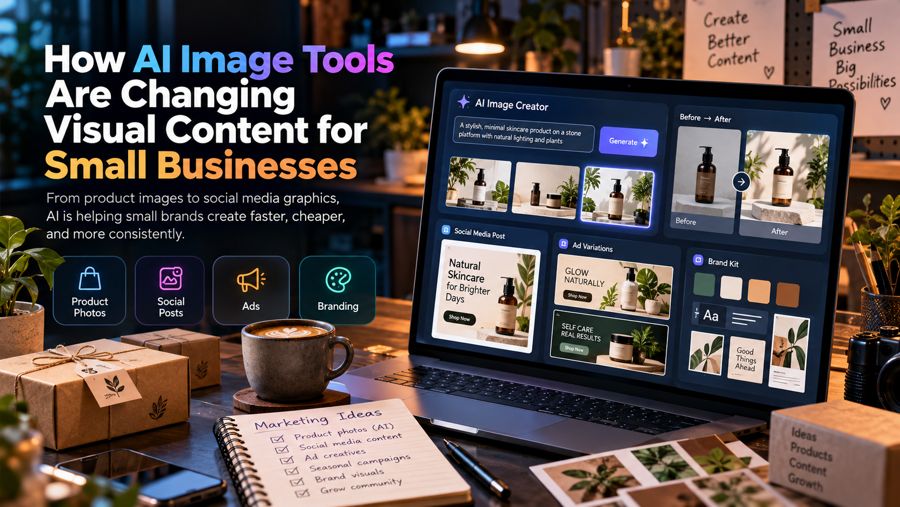
Every scroll through a social feed or online store is a split-second judgment. Shoppers decide within moments whether a product looks trustworthy, and that decision rests largely on the quality of the image in front of them. For small businesses and independent creators, this creates a real problem. Professional photography is expensive, design software has a steep learning curve, and the pace of content publishing keeps climbing.
Over the past few years, artificial intelligence has started to close that gap. Browser-based tools can now generate, edit, and clean up images in seconds, work that once demanded a trained designer and hours of effort. For US marketers and store owners in particular, this shift is changing how visual assets are planned, produced, and refreshed. This article looks at where AI image tools add the most value and how to use them without losing brand credibility.
Why Visual Quality Directly Affects Conversions
Images are often the first and only thing a customer evaluates before deciding to click, save, or buy. A blurry product photo, a cluttered backdrop, or inconsistent styling across a catalog quietly signals a lack of care. Shoppers rarely articulate this feeling, but it shapes whether they trust a brand enough to hand over their payment details.
Research from several e-commerce studies has consistently shown that product imagery ranks among the top factors in online purchase decisions. Listings with clear, well-lit, consistent visuals tend to earn more engagement and fewer returns, since customers know what to expect.
The challenge is that quality used to scale with budget. A large retailer could afford a studio and a retouching team, while a small shop relied on smartphone photos and guesswork. AI-assisted editing has started to level that field, giving smaller teams access to polish that previously sat out of reach.
Background Removal: The Quiet Workhorse of E-commerce
Of all the editing tasks sellers face, isolating a product from its background is probably the most common. Marketplaces often require plain white backgrounds, ad creatives need flexible cutouts, and social posts look sharper when the subject stands apart from distracting clutter. Doing this by hand with traditional software means tracing edges pixel by pixel, which is slow and unforgiving around hair, fabric, or glass.
Modern AI has changed that workflow. Many sellers now rely on the background remover EzMaker AI provides, which detects the subject automatically and produces a clean cutout in seconds. The result can be placed on a white backdrop for a marketplace listing, dropped onto a branded color for a promotion, or layered into a larger design.
The real benefit is not just speed. It is repeatability. When every product photo goes through the same process, a catalog looks cohesive, and that cohesion reads as professionalism to buyers.
What EzMaker AI Brings to the Table
EzMaker AI is an online platform that allows users to generate and edit images instantly using artificial intelligence. It supports text-to-image generation, image editing, background removal, magic eraser, style transformation, and image enhancement. Users can simply input prompts or upload images to create high-quality visuals without needing professional design skills or software.
The platform is widely used for social media content creation, marketing materials, e-commerce product images, and creative design exploration. Because it is fully web-based, there is nothing to install and no complex setup to work through. A team member can open a browser, upload a photo, and have a usable result within minutes.
That accessibility matters for lean teams. Instead of splitting attention across several separate applications, a marketer can generate a concept image, remove an unwanted object, enhance resolution, and adjust the style from one place. Fewer tools mean fewer handoffs, fewer subscriptions to manage, and less time spent training new staff.
Speed, Cost, and Consistency at Scale
Content calendars rarely slow down. A typical small business may need product shots, promotional banners, social posts, and email graphics every single week. Outsourcing each of those assets quickly becomes expensive, and waiting days for revisions can mean missing a seasonal window or a trending moment.
AI image tools shift the economics. A task that once required a freelance designer and a day of turnaround can often be completed in a single sitting. That frees budget for areas where human creativity matters most, such as brand strategy, original photography, and campaign concepts.
Consistency is the other advantage. When a team applies the same editing approach across hundreds of images, the visual identity stays stable even as the volume grows. Style transformation and enhancement features help bring older or mismatched photos in line with current branding. Over time, that steady look builds recognition, and recognition builds trust with returning customers.
Using AI Responsibly: Quality Control and Authenticity
Powerful tools still need human judgment. AI can remove a background cleanly, but a person should confirm that edges look natural, colors remain accurate, and the final image represents the product honestly. Overly altered photos that misrepresent size, color, or condition lead to disappointed customers and higher return rates.
Transparency also matters. For generated imagery, it is wise to follow platform rules on disclosure and to avoid presenting synthetic visuals as real photographs when authenticity is part of the promise. Brands built on trust cannot afford shortcuts that mislead their audience.
A practical approach is to treat AI as a first draft engine. Let the tool handle repetitive work, then review each result with a critical eye before publishing. Teams that pair automation with careful editorial standards tend to get the best of both worlds: faster output and dependable quality.
Conclusion
Visual content has become one of the most important levers in digital marketing, and the barrier to producing it well is lower than ever. AI image tools now handle tasks such as background removal, object cleanup, enhancement, and style adjustment that once required specialized skills and expensive software. For small businesses and creators, that means competing on presentation without competing on budget.
The key lessons are straightforward. Strong visuals support trust and conversions, consistency builds brand recognition, and automation works best when guided by human review. Choosing accessible, web-based platforms keeps workflows simple and lets teams focus on strategy rather than software.
Looking ahead, AI-assisted creation will likely become a standard part of every marketing toolkit, much like analytics and email automation are today. Businesses that learn to use these tools thoughtfully, balancing efficiency with authenticity, will be best positioned to build lasting visual identities and meaningful customer relationships in an increasingly crowded online space.

