

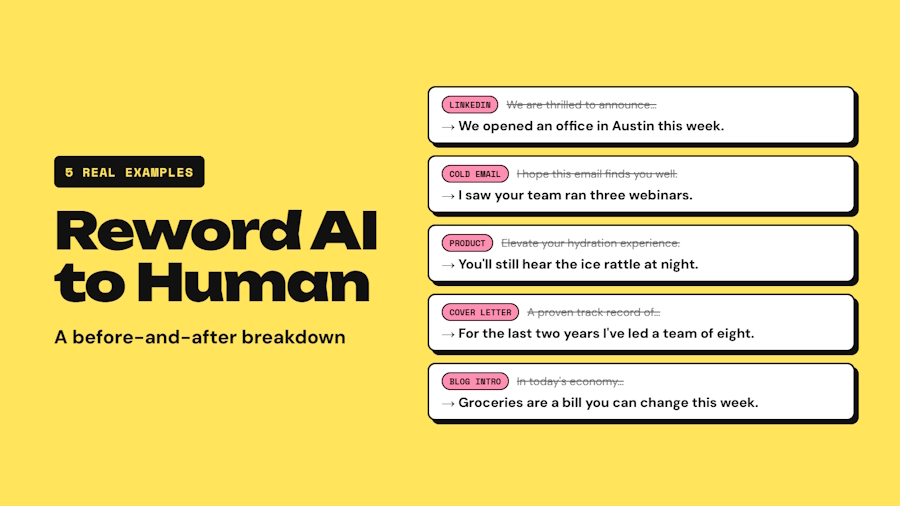
Advice about AI writing tends to stay abstract. "Vary your sentences." "Add your voice." "Cut the fluff." All true, and all hard to apply when you are staring at a draft that already looks finished.
So this article skips the theory and shows the work. Below are five everyday pieces of writing: a LinkedIn post, a cold email, a product description, a cover letter paragraph, and a blog introduction. For each one, you'll see the prompt, the draft a chatbot typically returns, a rewritten version, and a plain list of what changed and why.
How to Read These Breakdowns
Every rewrite below follows the same two rules.
The facts stay put. If the prompt said 750 ml and 24 hours, the rewrite says 750 ml and 24 hours. Nothing gets rounded, and no new product claims appear. Where a rewrite adds something new, like a personal reason or a story, it is marked as the kind of detail only the writer can supply.
The sound changes. Stock phrases go, sentence lengths vary, and the order follows what the reader cares about first. That is the difference between paraphrasing a draft and working to change AI text to human writing.
The "before" drafts are representative of what popular chatbots return for these prompts. The names and small details in the "after" versions are illustrative, so swap in your own. Once you've rewritten something, you can paste both versions into a free AI checker to compare them, though a reader's reaction matters more than any score. If you are curious how detector results move after humanizing, our monthly detector tests lay out the method and numbers.
Why the Rewrite Is Worth Ten Minutes
It is tempting to publish the AI draft as is. Plenty of people do. The research on how that content performs is not encouraging.
Graphite, an SEO agency, looked at tens of thousands of keywords and found that 86% of the articles ranking in Google were human-written, and only 7% of number-one results were AI-generated. The pattern held in ChatGPT and Perplexity citations too. AI drafts get published in huge numbers, but most of them don't show up where readers look.
NP Digital ran a direct comparison across 744 articles on 68 websites. After five months, human-written posts were pulling 5.44 times the monthly traffic of the AI-written ones, even though the AI articles took a fraction of the time to produce.
Marketers seem to know this. In Ahrefs' 2026 survey of content marketers, 66% said they trust AI content only after a human reviews it, and fewer than 3% trust it with no review at all. The rewrite step is where that review happens. The five examples below show what it looks like in practice.
Example 1: The LinkedIn Announcement
Prompt: "Write a LinkedIn post announcing that our company opened a new office in Austin."
Before:
"We are thrilled to announce the opening of our new office in Austin, Texas! This exciting milestone marks a significant step in our journey of growth and innovation. Our new space will enable us to better serve our clients, foster collaboration, and attract top talent. We can't wait to see what the future holds! #Growth #Innovation #Austin"
After:
"We opened an office in Austin this week. It started with two engineers who moved there and kept asking for somewhere to meet clients that wasn't a coffee shop. Now there are eleven of us, a whiteboard wall, and a standing Thursday lunch. If you work in logistics and you're in Austin, come say hello."
What changed:
- "Thrilled to announce" became a plain statement of the news.
- "A significant step in our journey of growth and innovation" was replaced with the story of why the office exists.
- The closing line now invites someone to do something, instead of wondering about the future.
- The hashtags went. They added nothing a reader would search for.
What stayed: the news itself. The backstory and the headcount are the writer's own details, and they are what make the post worth reading.
Example 2: The Cold Sales Email
Prompt: "Write a cold email to a marketing director offering our analytics software."
Before:
"Subject: Unlock the Power of Data-Driven Marketing. Hi [Name], I hope this email finds you well. I wanted to reach out to introduce [Company], a cutting-edge analytics platform designed to help marketing teams like yours make smarter, data-driven decisions. Our solution offers comprehensive insights, seamless integrations, and real-time reporting. Would you be open to a quick call to explore how we can help you achieve your goals?"
After:
"Subject: Your webinar numbers. Hi Priya, I saw your team ran three webinars last quarter. Most marketing teams we talk to know how many people registered, but not which of those people later bought. [Company] connects webinar attendance to closed deals in your CRM, so you can see that link. Worth a 15-minute look next week?"
What changed:
- The subject line is about the reader, not a slogan.
- "I hope this email finds you well" is gone. So is "I wanted to reach out."
- A list of three features became one specific problem the product solves.
- The ask got concrete: fifteen minutes, next week.
What stayed: who is writing, what the product does, and the request for a call. The webinar detail is the kind of thing you'd find from five minutes of research on the prospect.
Example 3: The Product Description
Prompt: "Write a product description for an insulated stainless steel water bottle, 750 ml, keeps drinks cold 24 hours."
Before:
"Elevate your hydration experience with our premium insulated stainless steel water bottle. Crafted with meticulous attention to detail, this versatile bottle keeps your beverages ice-cold for up to 24 hours. Whether you're hitting the gym, exploring the great outdoors, or powering through your workday, it's the perfect companion for every adventure."
After:
"Fill it with ice in the morning, and you'll still hear it rattle at night. This 750 ml stainless steel bottle keeps drinks cold for up to 24 hours, so the water you packed at 7 a.m. is still cold after your evening run."
What changed:
- "Elevate your hydration experience" and "meticulous attention to detail" were cut. Neither tells a shopper anything.
- The "whether you're" sentence, which tries to sell to everyone, was replaced by one specific moment.
- The 24-hour claim is now something you can picture rather than a spec on a list.
What stayed: every fact from the prompt, exactly. The size, the material, and the 24 hours all made it through. This is the example where adding unverified claims would be most tempting and most risky. If the lid is leak-proof, say so. If you don't know, leave it out.
Example 4: The Cover Letter Paragraph
Prompt: "Write a cover letter paragraph for a customer support manager role. I have five years of support experience and led a team of eight."
Before:
"I am writing to express my strong interest in the Customer Support Manager position. With five years of experience in customer support and a proven track record of leading high-performing teams, I am confident in my ability to make a meaningful impact at your organization. I am passionate about delivering exceptional customer experiences and fostering a culture of continuous improvement."
After:
"I've spent five years in customer support, and for the last two I've led a team of eight. The part of the job I like most is the slow work of figuring out why customers contact us in the first place, so fewer of them have to. I'd like to bring that habit to your team."
What changed:
- The opening line no longer announces that it is a cover letter.
- "Proven track record," "meaningful impact," "passionate," and "fostering a culture" were all cut. Hiring managers read these phrases dozens of times a day.
- One real preference replaced four generic claims.
What stayed: five years, a team of eight, the role. The middle sentence is the part a tool can't write for you. It should be your honest answer to "what do you like about this work?"
Example 5: The Blog Post Introduction
Prompt: "Write an introduction for a blog post about saving money on groceries."
Before:
"In today's economy, saving money on groceries has become more important than ever. With rising prices and tight budgets, many families are looking for practical ways to reduce their spending without sacrificing quality. In this article, we will explore effective strategies to help you save money at the grocery store."
After:
"Groceries are one of the few bills you can change this week. Rent and car payments are fixed, but what goes in the cart is up to you. Here are the habits that make the biggest difference, starting with the one most people skip: checking what's already in the fridge before writing a list."
What changed:
- "In today's economy" and "more important than ever" were cut. They delay the point.
- "In this article, we will explore" became a preview that gives the reader something useful right away.
- The second sentence gives the reader a reason to care, using a comparison they already understand.
What stayed: the topic, the audience, and the promise of practical tips.
Try It on Your Own Draft
Pick one paragraph you generated this week, not a whole article. Find the warm-up line and delete it. Circle every phrase you've seen in a hundred other posts and replace it. Look for a list that could be one specific point. Then add one detail that only you could have written. When you change AI text to human writing this way a few times, you start catching these patterns before they reach the page. And the next time you need to reword AI to human copy on a deadline, you'll know exactly where to look first.

